
Contact Sales Now
Thank you! Your submission has been received!
Oops! Something went wrong while submitting the form.

Contact Sales Now
Thank you! Your submission has been received!
Oops! Something went wrong while submitting the form.

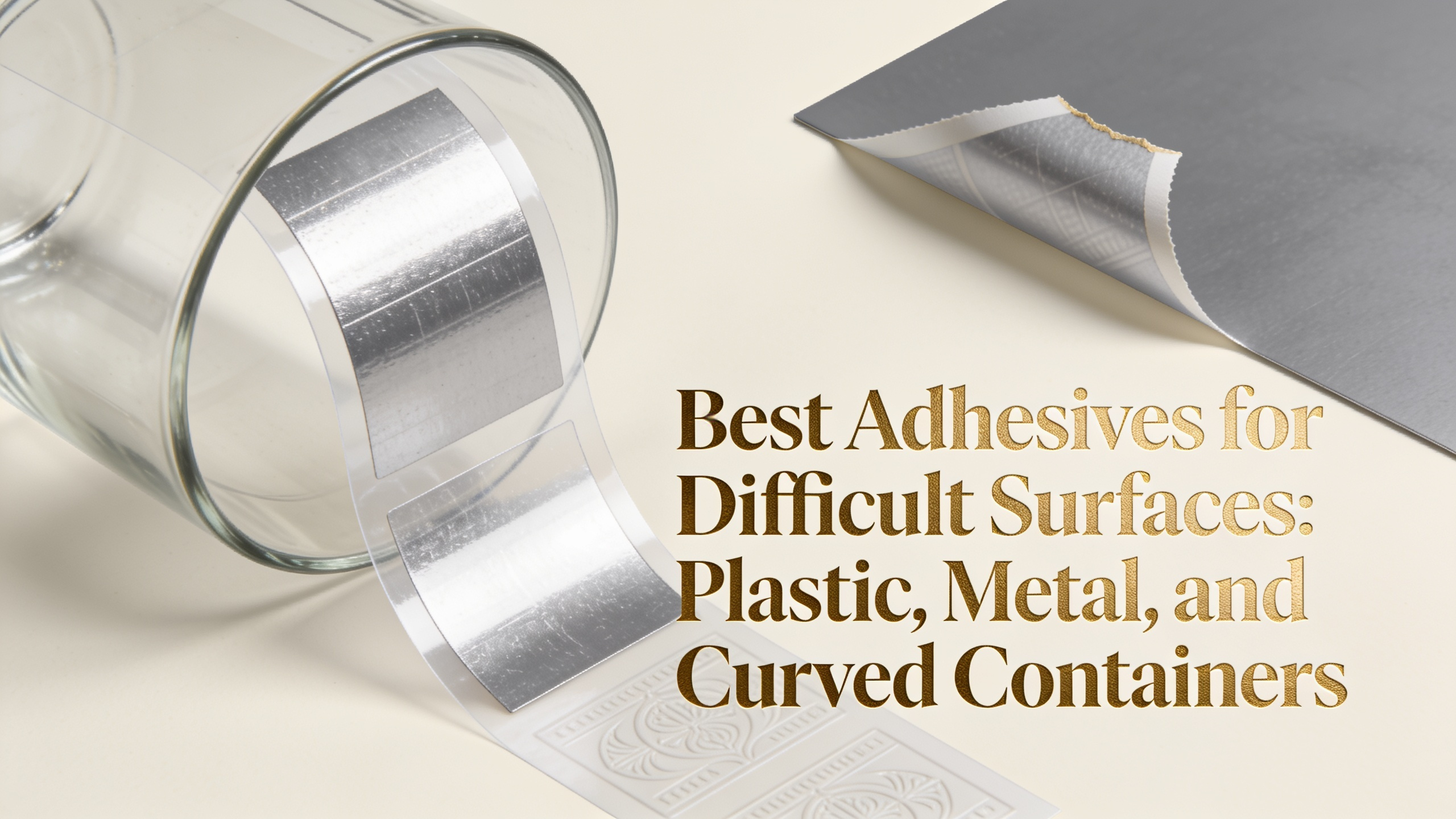
Labeling smooth glass or coated paperboard is straightforward. The real engineering challenge starts when your packaging involves polyolefins, powder-coated metals, or squeezable bottles. Adhesive selection here determines whether your label survives distribution or peels within days.
This guide covers the technical criteria for selecting pressure-sensitive adhesives (PSAs) that perform on the toughest substrates in commercial packaging today.
Surface energy, measured in dynes/cm, dictates how well a liquid adhesive wets out on a substrate. High surface energy (HSE) materials like glass (~500 dynes/cm) and stainless steel (~700 dynes/cm) allow adhesives to spread and form strong molecular bonds.
Polyolefins tell a different story. HDPE sits around 30 dynes/cm, and polypropylene hovers near 29 dynes/cm. Both fall below the 36 dynes/cm threshold that separates easy substrates from problematic ones.
When adhesive surface tension exceeds substrate surface energy, the adhesive beads up instead of flowing. The result is minimal contact area, weak anchoring, and edge lift within hours or days.
Common low surface energy (LSE) substrates in packaging include:
Corona or flame treatment can temporarily raise surface energy to 38–44 dynes/cm, but the effect degrades over weeks. Never rely on treatment alone for long shelf-life products.
Standard acrylic PSAs fail on polyolefins because they cannot wet the surface adequately. Purpose-built low surface energy adhesives use modified rubber-based or specialty acrylic chemistries designed to flow across low-dyne surfaces and build bond strength over 24 to 72 hours.
When selecting the best adhesive for plastic labels on HDPE or PP, look for these performance markers:
Rubber-based hot melt adhesives dominate this category. They offer aggressive quick-stick performance and forgive imperfect application pressure. The tradeoff is limited UV and temperature resistance compared to acrylics.
Modified acrylics bridge the gap. Newer formulations achieve LSE performance while retaining the clarity, aging stability, and chemical resistance that traditional acrylics provide. Expect a 15–25% cost premium over standard permanent acrylics.
Bare metal is straightforward. So what adhesive sticks to metal reliably? For clean aluminum, stainless steel, or tin plate, general-purpose permanent acrylic PSAs deliver 50+ oz/in peel strength and hold indefinitely under normal conditions.
Powder-coated metal changes the equation. The cured epoxy or polyester coating creates a surface with variable energy, often between 32 and 40 dynes/cm depending on formulation and cure quality. Textured powder coats add another layer of complexity through reduced contact area.
For powder-coated surfaces, consider these adhesive categories:
Painted metal behaves similarly to powder coat but with more variation. Automotive-grade paints, industrial enamels, and consumer appliance finishes each present different surface chemistries. Always test on the actual finish, not a similar substitute.
Oily or oxidized metal surfaces require aggressive tackifier packages. For lubricated parts or field-applied labels on outdoor equipment, specify adhesives rated for oily metal application with specific dwell time expectations.
Flat panels forgive stiff face stocks and firm adhesives. Curved containers do not. The tighter the radius, the greater the mechanical force trying to lift the label edges after application.
For adhesive for curved surfaces, three factors matter more than raw peel strength:
Small-diameter containers under 30mm require particular attention. Vials, lip balm tubes, and travel-size bottles bend labels aggressively. Specify BOPP or thin PE face stocks paired with high-flow LSE adhesives at 20+ gsm coat weight.
Squeezable containers add dynamic stress. Every squeeze cycle flexes the label and pumps air toward the edges. Use highly conformable film face stocks combined with rubber-based or specialty acrylic adhesives designed for flex fatigue.
Ovals, tapers, and compound curves need pre-application testing. What performs on a 50mm cylinder may fail on a 25mm shoulder curve on the same bottle. Sample the actual production geometry before finalizing specifications.
Textured plastics reduce effective contact area dramatically. A label may appear fully adhered while actually bonding only to the raised peaks of the texture, leaving 30–60% of the adhesive interface unsupported.
Compensate with these adjustments:
Post-consumer recycled (PCR) plastics create unpredictable surface conditions. Recycled HDPE and PP often contain residual additives, colorants, and mold release agents from previous life cycles that migrate to the surface over time.
Test labels on aged PCR containers, not fresh production samples. A label that holds at day one may release at week six as contaminants migrate. Specify adhesives with contamination tolerance and request accelerated aging data from suppliers.
Recycled paperboard and molded fiber packaging demand different thinking. High absorbency can starve adhesive at the interface. Consider adhesives with higher solids content or barrier-coated face stocks that manage moisture transfer.
Adhesive chemistry only delivers if application conditions cooperate. Standardize these variables to maximize performance on any challenging substrate:
Cold application onto refrigerated containers requires cold-temperature adhesives specifically formulated for wet-out below 40°F. Standard adhesives will fail even if they show initial tack.
Can I use one adhesive for both HDPE bottles and glass jars?
Yes. Modern LSE acrylic adhesives perform well on both low and high surface energy substrates. Expect slightly lower peel values on glass compared to a dedicated HSE adhesive, but performance remains within commercial acceptance ranges.
Does corona treatment eliminate the need for LSE adhesives?
No. Corona treatment raises surface energy temporarily, but effects diminish within days to weeks. For shelf-stable products with long distribution timelines, always specify an LSE-rated adhesive regardless of substrate treatment.
What adhesive sticks to metal that will be exposed to outdoor weather?
Permanent acrylic PSAs with UV stabilizers and marine-grade formulations. Look for products rated for 5+ years outdoor exposure with peel retention above 70% after accelerated weathering per ASTM G154.
Is the best adhesive for plastic labels always the most aggressive?
No. Aggressive adhesives can damage certain plastics through plasticizer migration or stress cracking. Match adhesive aggression to substrate tolerance, and verify with a 30-day compatibility test before high-volume production.
How do I choose an adhesive for curved surfaces with tight radii?
Prioritize adhesive flow and face stock conformability over peel strength. A moderately tacky adhesive on a flexible film outperforms an aggressive adhesive on stiff face stock when curvature is severe.
Do low surface energy adhesives cost significantly more?
Yes, typically 15–30% more than standard permanent acrylics. The cost difference is negligible compared to the expense of label failure, product returns, and brand damage from peeled labels in the field.
Can I test adhesive performance without lab equipment?
Yes, for basic screening. Apply labels to actual production containers, wait 72 hours, then attempt manual peel from multiple edges. Look for face stock tearing rather than clean adhesive release. For final qualification, request formal peel and shear testing from your label supplier.
Selecting adhesives for difficult surfaces requires matching chemistry to substrate reality, not catalog assumptions. Partner with a label converter who tests on your actual containers and provides documented performance data for your specific application conditions.