
On this page
- Freezer-Grade Adhesives Explained
- Freezer Labels and Label Material: Cryogenic Labels and Freezer-Grade Label Adhesive Solutions for Cold Temperatures
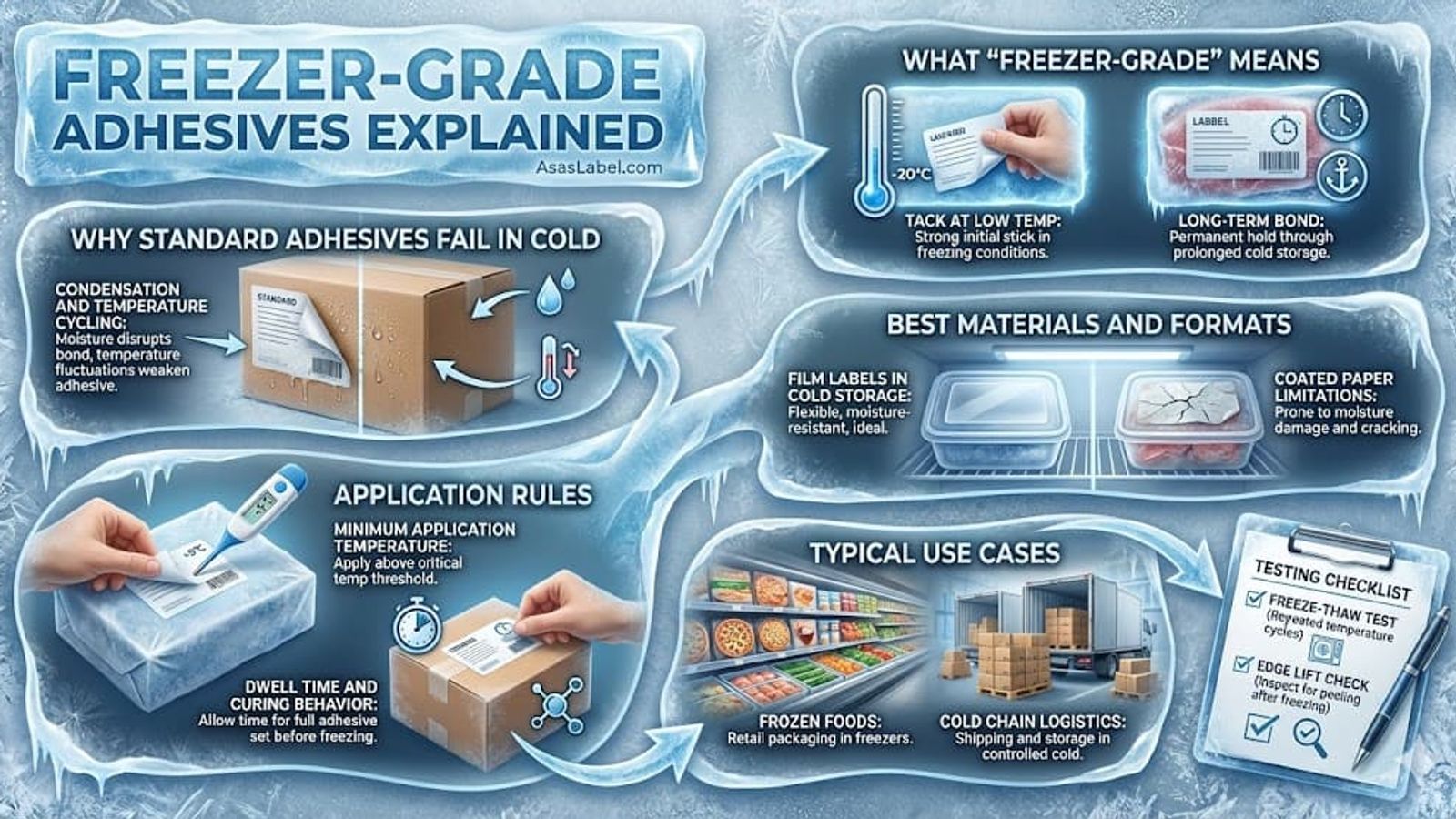
- Why Standard Adhesive Choices Cause Labels Fail and Lose Adhesion in Cold Storage
- Combating Condensation and Moisture: How Adhesion and Tack Perform in a Storage Environment
- What Defines a True Freezer-Grade Adhesive: Choosing the Right Label Material Designed for Cold
- Tack Response and Initial Tack at Low Temperatures: How Adhesives Perform in Extreme Cold
- Essential Application Temperature Protocols: Label Adhesive Performance for Cold Storage
- Adhering to Minimum Application Temperature and Service Temperature for Freezer Labels
- Managing Dwell Time and Label Failure When You Apply Labels in Extreme Cold
- Selecting Optimal Label Material and Substrate to Prevent Adhesion Failure
- Leveraging Polypropylene and Synthetic Films for Durable Labels in Cold Storage Labeling
- Understanding Coated Paper Limitations and Why Paper Freezer Labels Fail
- Where Freezer-Grade Adhesives and Cryogenic Labels Become Mandatory for Sample Storage
- Cold Storage Labeling for Frozen Foods: How Adhesives Perform for Labeling Solutions
- A Checklist for Label Performance: Choosing the Right Label and Testing Adhesion
- Conducting Freeze-Thaw and Edge Lift Tests to Ensure Adhesives Perform in Extreme Temperatures
Freezer-Grade Adhesives Explained
Freezer Labels and Label Material: Cryogenic Labels and Freezer-Grade Label Adhesive Solutions for Cold Temperatures
Adhesion failure in a cold environment creates costly operational disruptions across the supply chain. Standard labeling solutions frequently detach, crack, or flag when temperatures drop and they are subjected to sub-zero temperatures. Identifying the correct freezer adhesive formulation is not merely about sticking a label to a box; it is about ensuring data integrity and barcode labels remain legible through harsh thermal cycles.
Operations managers and packaging engineers must distinguish between service temperature ranges and application performance capabilities. A misunderstanding of these rheological properties leads to wasted inventory and label failure. Securing your cold storage labeling requires a technical understanding of how pressure-sensitive adhesives behave when thermal energy drops in a blast freezer.
Why Standard Adhesive Choices Cause Labels Fail and Lose Adhesion in Cold Storage
General-purpose pressure-sensitive adhesives rely on flow and wet-out to create a bond. At room temperature, the polymer chains within the label adhesive are mobile and fluid. They flow into the microscopic peaks and valleys of the substrate, creating the necessary bond strength and mechanical interlock for adhesion.
As cold temperatures take hold, standard acrylics and rubber-based adhesives can stiffen and reach their glass transition temperature (Tg). This is the precise thermal point where a viscoelastic material transitions from a rubbery state to a brittle, glassy state. Once an adhesive crosses this threshold, the polymer chains lock in place and adhesives perform poorly.
A "glassy" standard adhesive loses its ability to flow or establish initial tack. It creates a hard, brittle layer that sits on top of the substrate rather than bonding with it. Under these extreme cold conditions, even minor physical shock or vibration will cause the label might pop off the surface entirely.
Standard adhesive types often claim versatility but fail in extreme temperature or deep freeze scenarios. They may function adequately at 0°C but crystallize at -20°C. This crystallization reduces the internal cohesive strength and eliminates the tack required to maintain contact with the container or package surface.
Combating Condensation and Moisture: How Adhesion and Tack Perform in a Storage Environment
Moisture and frost are the primary antagonists in cold storage labeling. When a product moves from a filling station to a freezer, or from cold storage to a loading dock, condensation forms immediately. This layer of surface moisture acts as a barrier, preventing the adhesive from touching the substrate surface.
If you apply labels over a thin layer of frost or condensation, the bond strength is doomed. The adhesive effectively bonds to the ice, not the package. Once that ice sublimates or melts, the label failure is inevitable as it loses its anchor and slides off the container.
Temperature changes and cycling create expansion and contraction issues. Most materials used in packaging, such as corrugated cardboard or HDPE plastic, shrink when frozen. The label material also shrinks, but often at a different rate than the package. This differential creates shear stress at the bond interface in the storage environment.
Standard adhesives lack the shear resistance to handle this push-and-pull dynamic. Over multiple freeze-thaw cycles, the stress accumulates until the adhesive layer fractures or delaminates. Durable labels designed for freezer grade must possess enough elasticity to absorb this kinetic variance without losing their grip.
What Defines a True Freezer-Grade Adhesive: Choosing the Right Label Material Designed for Cold
Freezer-grade adhesives are adhesives engineered for low-temperature applications with a significantly lower glass transition temperature. Formulators manipulate the polymer structure, often adding specific tackifiers, to ensure the label material remains viscoelastic even at extremely low temperatures approaching -40°C or lower.
These labeling solutions generally fall into two categories: hot melt rubber-based adhesives and specialized acrylic emulsions. Rubber-based hot melts offer superior initial tack in cold conditions because they remain softer. They are aggressive and bite into the substrate quickly, even if the label frozen surface is slightly textured.
Acrylic adhesives are designed to offer better long-term UV stability and clarity but require precise formulation for cold temperatures. A true freezer-grade acrylic has been modified to suppress its freezing point. This prevents the hardening phenomenon that renders standard adhesive options useless in a blast freezer.
The distinction lies in the aggressive nature of the bond in cold air. While a standard adhesive becomes dormant, adhesives are designed with freezer-grade variant to maintain "live" chemistry. It resists the stiffening effects of the cold, retaining the fluidity required to maintain surface contact with the container.
Tack Response and Initial Tack at Low Temperatures: How Adhesives Perform in Extreme Cold
Tack refers to the immediate holding power of the label adhesive upon contact. In sub-zero freezer temperatures, achieving initial tack is chemically difficult because low thermal energy slows down molecular movement. Freezer-grade adhesives are designed to behave aggressively despite this energy deficit.
A high-tack freezer adhesive overcomes the surface tension of cold packaging materials. Whether you apply labels to a polybag or a waxed cardboard carton, the adhesive must wet out instantly. If the tack is insufficient, the label edges will lift before the permanent adhesive bond can set.
Long-term storage relies on the adhesive's ability to resist "cold flow" or creep. While the adhesive must remain soft enough to bond, it cannot be so soft that it oozes out from under the label during the entire supply chain journey. This balance between low temperatures flow and structural integrity is the hallmark of quality freezer grade labels.
The bond strength should ideally increase over time. While the initial tack secures the label during the application process, the ultimate adhesion strength develops as the adhesives can stiffen and microscopically conform to surface irregularities. In freezer-grade variants, this curing process happens even in the absence of heat.
Essential Application Temperature Protocols: Label Adhesive Performance for Cold Storage
Successful labeling is as dependent on the application performance as it is on the material science. The physical environment during the labeling event dictates the success rate. Ignoring thermodynamic realities and temperature changes during application guarantees failure regardless of the adhesive performance.
Frozen surfaces must be clean and dry. While freezer-grade adhesives are more resistant to moisture than standard glues, they cannot displace a heavy layer of moisture and frost. Using air knives or wipe-down procedures prior to when you apply a label ensures the adhesive contacts the substrate directly.
Pressure is critical for label performance. Freezer labels are pressure-sensitive. In cold environment settings, the adhesive is naturally stiffer, so increased application pressure is required to force the adhesive into the substrate's pores. A light touch that works when applied at room temperature will fail in a blast freezer.
Adhering to Minimum Application Temperature and Service Temperature for Freezer Labels
Every technical data sheet for freezer labels specifies a Minimum Application Temperature (MAT). This is the lowest temperature at which the adhesive is fluid enough to create an initial bond. Attempting to label frozen products below the MAT results in zero adhesion.
If a label has a MAT of -20°C, it can be applied in a freezer. However, if the MAT is +5°C, the label must be applied before the product enters the cold storage. Once the bond is formed above the MAT, the product can be cooled down to the Service Temperature range of the storage environment.
Confusing MAT with service temperature is a common error. Service temperature is the temperature range the bond can endure *after* it has set. A label might survive at -50°C (service temperature) but require application at +10°C (MAT). Violating the MAT creates a "dry bond" where the label adhesive fails and the label falls off immediately.
Cryogenic storage environments often demand adhesives with the lowest possible MAT to allow for labeling inside cold storage facilities. However, adhesives with extremely low MATs can be difficult to convert and dispense when applied at room temperature due to potential oozing.
Managing Dwell Time and Label Failure When You Apply Labels in Extreme Cold
Dwell time is the duration the label adhesive remains in contact with the substrate before being subjected to stress or extreme temperature changes. Even freezer-grade adhesives perform better if they are allowed a short period of dwell time at ambient or room temperature.
Allowing a 24-hour cure time before freezer temperatures drop is the gold standard, though often operationally impossible. If immediate freezing is required, the choosing the right label must involve an adhesive with extremely aggressive initial tack. The chemical interaction slows down drastically in the cold.
In blast freezer scenarios, the rapid drop in temperature can shock the label adhesive. If the bond hasn't established adequate surface contact, the thermal shock will arrest the flow instantly. This freezes the adhesive in a non-bonded state and leads to label failure.
Packaging engineers should audit the time gap between the label applicator and the freezer tunnel. Extending this runway, even by a few minutes, can significantly improve the bond strength survival rate by allowing the viscous flow to initiate before adhesives can stiffen.
Selecting Optimal Label Material and Substrate to Prevent Adhesion Failure
The adhesive does not work in isolation; it functions as part of a laminate construction. The label material—the material printed upon—plays a pivotal role in the stability of the label performance. An incompatible label material can undermine even the strongest freezer-grade adhesives.
Thermal expansion coefficients must align between the label and the substrate. If the container shrinks significantly in the cold but the label material is rigid, the label failure will manifest as tunneling or bubbling. The adhesive is forced to fight against the mechanical rigidity of the face stock.
For products exposed to moisture or icy environments, paper materials used are generally contraindicated unless heavily varnished. The label material needs to act as a barrier to moisture, not a sponge. Once water permeates the face stock, it affect performance and degrades the adhesive interface from above.
Leveraging Polypropylene and Synthetic Films for Durable Labels in Cold Storage Labeling
Synthetic films like polypropylene (BOPP) and polyethylene (PE) are the superior label material choice for deep-freeze environments. These materials are resistant to moisture, meaning they do not absorb moisture from condensation or frost. They maintain structural integrity even in damp storage environment conditions.
Polypropylene offers excellent clarity and rigidity, making it suitable for high-speed barcode labels dispensing. It is resistant to the scuffing and abrasion that occurs when frozen packages slide against each other in transport. This durability ensures the barcode labels remain legible.
Polyethylene is softer and more conformable, making it an ideal label material for squeezable containers or flexible packaging that may distort during the freezing process. The flexibility of PE reduces the edge-lift stress on the label adhesive, allowing the label to move with the package.
Vinyl is another option for extreme durability, often used in cryogenic storage environments. It remains flexible at extremely low temperatures, preventing the label from becoming brittle and shattering upon impact. However, synthetics generally require higher freezer-grade adhesives to bond initially.
Understanding Coated Paper Limitations and Why Paper Freezer Labels Fail
Paper labels are an economical choice but present high risks in the supply chain for freezer labels. Standard paper absorbs atmospheric moisture and surface moisture instantly. In a freezer, this moisture turns to ice crystals within the paper fibers, causing the material to stiffen and degrade.
If paper must be used, a "thermal transfer" paper with a heavy protective topcoat is necessary for labeling solutions. Direct thermal paper is particularly vulnerable; the chemical coating can turn black or fade when exposed to moisture and friction in a freezer environment.
Moisture wicking at the edges is the primary failure mode for paper freezer labels. Even with a topcoat, the cut edges of the label are exposed to moisture. Water enters here, travels laterally, and separates the label material from the adhesive layer. This results in the printed portion falling off while the adhesive residue remains on the box.
Where Freezer-Grade Adhesives and Cryogenic Labels Become Mandatory for Sample Storage
Specific industries cannot compromise on adhesive specs due to regulatory compliance and safety tracking. In these sectors, a lost label equates to a lost product, as traceability and sample storage create the value. The cost of freezer-grade adhesives is negligible compared to the cost of recalls.
Pharmaceutical and biological sample storage require cryogenic labels. These must survive long-term cryogenic storage in liquid nitrogen at -196°C. Standard adhesive types will fail here; only specialized cryogenic labels that bond to vials and test tubes in extremely low temperatures will suffice.
Industrial logistics involving outdoor storage in winter climates also demand these durable labels. Lumber, chemical drums, and automotive parts stored in unheated warehouses in northern latitudes face the same glass-transition challenges as frozen foods.
Cold Storage Labeling for Frozen Foods: How Adhesives Perform for Labeling Solutions
The food industry drives the bulk of freezer-grade innovation. Compliance with FDA regulations regarding indirect food contact is mandatory for freezer labels. The freezer adhesive must not migrate through the packaging into the food, even when the storage environment undergoes thermal stress.
Meat packing often utilizes vacuum shrink bags. The label is applied to an uneven, shrinking surface that is often damp. This is one of the most difficult torture tests for any label adhesive. Hot melt rubber freezer-grade adhesives are typically the standard here for their high initial tack.
In logistics, automated sorting systems rely on barcode readability. If a label frozen on a container flags or lifts at the corner due to cold adhesive failure, it can jam machinery. This forces manual intervention, destroying the efficiency of the automated cold storage facility.
Grocery retail environments also present a challenge. Products are often stocked straight from the freezer and exposed to moisture. High-tack adhesives ensure the branding and barcode labels remain pristine, avoiding the "shelf-worn" look of peeling labels that discourages consumer purchase.
A Checklist for Label Performance: Choosing the Right Label and Testing Adhesion
Relying solely on data sheets for choosing the right label is a risk management failure. Every combination of label material, storage environment, and application method creates a unique variable set. Real-world testing is the only way to validate a freezer-grade adhesive selection.
Begin by identifying the exact composition of the substrate application surface. Is it recycled corrugate? Recycled cardboard has shorter fibers, making it harder to bond. Is it low-surface-energy plastic? Each storage environment requires a different initial tack level.
Simulate the exact thermal lifecycle and temperature range of the product. If the product is labeled at room temperature, then frozen, then thawed, the test must replicate this loop. Using a freezer that holds a steady temperature does not test the expansion/contraction stress of the real supply chain.
Conducting Freeze-Thaw and Edge Lift Tests to Ensure Adhesives Perform in Extreme Temperatures
The mandrel hold test is essential for contact with the container on curved surfaces. Apply the label to the vial or bottle and freeze it for 24 hours. Upon removal, check for "flagging" or "winging" at the edges. Since the label wants to remain flat, the adhesive must fight the memory of the face stock in extreme cold.
Perform a fiber tear test on corrugate to check bond strength. Apply labels, freeze them, and try to remove them immediately from the cold. A good bond should rip the fibers of the box. If the adhesive peels away cleanly, the standard adhesive has failed to wet out or has crystallized in low temperatures.
Conduct a condensation simulation to test application performance. Chill the substrate, expose it to room air to generate surface moisture, apply the label, and return it to the freezer. This tests the adhesive's ability to emulsify or penetrate the moisture barrier. Most freezer-grade adhesives will fail this test, narrowing your selection to the true high-performers.