
Contact Sales Now
Thank you! Your submission has been received!
Oops! Something went wrong while submitting the form.

Contact Sales Now
Thank you! Your submission has been received!
Oops! Something went wrong while submitting the form.

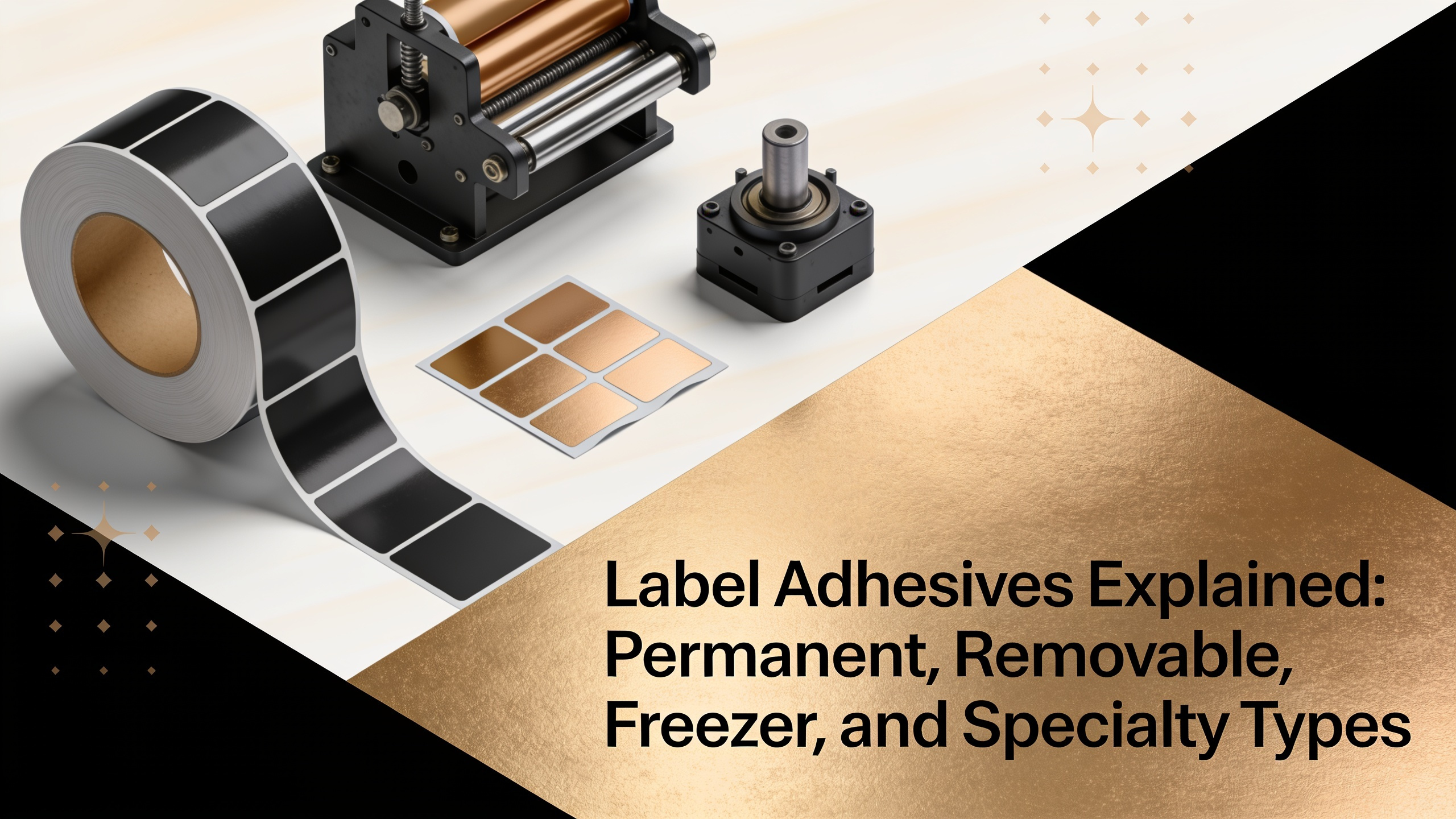
Selecting the right label adhesive determines whether your labels stay put through humidity, cold storage, rough handling, or chemical exposure. The wrong choice causes edge lift, ghosting, or complete failure, often after the product ships. This guide breaks down the major label adhesive types, their performance specs, and how to match them to your substrate and application.
Pressure-sensitive adhesives (PSAs) bond through applied pressure rather than heat, water, or solvents. They rely on viscoelastic flow, the adhesive wets the substrate surface under pressure, creating molecular contact and mechanical interlock with surface irregularities.
Three properties define PSA behavior: tack (initial grab), peel adhesion (force required to remove), and shear (resistance to sliding under load). Balancing these three drives every formulation decision in label adhesive types.
Most label PSAs fall into three chemistries: acrylic (UV and chemical resistant, slower build), rubber-based (high initial tack, lower temperature range), and silicone (extreme temperature performance, premium cost). Each chemistry serves specific end-use conditions.
Permanent adhesives build bond strength over 24 to 72 hours, reaching ultimate adhesion after full cure. Initial tack is typically 4 to 8 N/25mm, climbing to 12 to 20 N/25mm after cure. Once set, removal damages the label face or substrate.
Typical applications include product identification, warehouse logistics, regulatory compliance labels, and shipping. Acrylic permanents dominate here because they resist UV, plasticizer migration, and temperature cycling without yellowing or losing tack.
Key specs to request from your converter:
For high-volume runs on automatic applicators, verify the adhesive's dispensing performance. Some aggressive permanents bleed at die-cut edges, causing matrix breaks and downtime.
Removable adhesives are engineered for clean peel within a defined service window, typically 6 to 24 months. Peel adhesion sits around 1 to 4 N/25mm, low enough to release without residue but high enough to prevent unintended lift.
The permanent vs removable adhesive decision usually hinges on three factors: expected service life, substrate sensitivity (painted surfaces, glass, electronics), and whether the label needs to come off cleanly for reuse or recycling.
Limits matter. Most removables fail outside their tested window, the adhesive crosslinks with UV and heat, becoming progressively harder to remove. After 12 to 18 months on a sunny shelf, a "removable" label often behaves like a permanent.
Wash-off variants are a specialty subset designed for returnable glass containers. They release in hot caustic baths (typically 60°C to 80°C with 1 to 3% NaOH) within 5 to 15 minutes, leaving no adhesive residue or paper fiber on the bottle.
Freezer adhesive labels are formulated to bond at low application temperatures and maintain adhesion through deep freeze cycles. Standard freezer-grade adhesives apply down to -20°C and service to -40°C. Deep-freeze variants apply at -40°C and service to -80°C for cryogenic and pharmaceutical use.
The challenge is wetting. At low temperatures, adhesive viscosity rises sharply, reducing surface contact. Freezer-grade formulations use modified acrylics with low glass transition temperatures (Tg) to maintain flow on contact, even on frosted or condensation-coated substrates.
Critical performance checks for cold-chain labels:
For pharmaceutical cold-chain (-70°C and below), specify cryogenic-rated label stock with documented performance data. Failures in this segment are expensive and regulated.
High tack adhesive grades target low-surface-energy plastics (polyethylene, polypropylene), textured surfaces (corrugated, lumber, powder-coated metals), and curved or flexible substrates. Initial tack values exceed 15 N/25mm, often 20 to 30 N/25mm.
Rubber-based hot melt adhesives lead this category. They flow aggressively under light pressure and grab quickly, ideal for corrugate where porosity and texture defeat standard acrylics. The trade-off is reduced UV stability and a narrower service temperature range, typically -10°C to +60°C.
For LSE plastics specifically, look for adhesives tested against LDPE and PP coupons. Standard acrylic permanents may show 8 N/25mm on stainless steel but only 2 N/25mm on polyethylene, an adhesion failure waiting to happen.
Tire labels, drum labels, and outdoor industrial markings often use rubber-acrylic hybrids that combine aggressive tack with improved weatherability. Expect a price premium of 15 to 30% over standard permanents.
Repositionable adhesives allow multiple lift-and-restick cycles within the first 24 to 48 hours, then build to a permanent bond. Common in promotional labels, sticky notes, and assembly applications where alignment matters.
Security adhesives are engineered to destruct on removal. Two main types dominate:
These are standard for warranty seals, asset tags, calibration stickers, and pharmaceutical anti-counterfeit applications. Specify the residue pattern, void color, and substrate compatibility, some tamper-evident adhesives don't trigger reliably on textured or low-energy surfaces.
Other specialty types include conductive adhesives (for RFID and electronics), removable freezer (rare but available), and food-direct-contact certified adhesives meeting FDA 21 CFR 175.105 or EU 10/2011.
Substrate surface energy is the single most important variable. High-surface-energy substrates (glass, stainless steel, aluminum) accept most adhesives. Low-surface-energy substrates (PE, PP, PTFE, silicone-treated surfaces) require specialized formulations.
Quick reference for common substrates:
Surface preparation matters too. Oils, dust, mold-release residue, and condensation reduce effective bond by 30 to 70%. For critical applications, specify isopropyl alcohol wipe before label application and document it in your work instructions.
Temperature at application is often overlooked. An adhesive rated for +10°C minimum will fail if applied to a 4°C substrate even in a 20°C room, the substrate temperature controls wetting, not ambient.
A clear adhesive specification prevents costly trial-and-error with your converter. Include the following data points in every brief:
Request sample rolls and run adhesion tests under your actual conditions before committing to production volumes. FINAT and TLMI test methods give standardized data, but real-world validation catches edge cases the spec sheet misses.
For regulated industries, ask for documented compliance: FDA letters for food contact, BS5609 Section 2/3 certificates for marine chemical drums, or UL recognition for electrical applications. Verbal claims aren't sufficient for audits.
Can I switch from permanent to removable on the same label stock?
No. Adhesive coating is applied to the face stock during manufacturing, so switching requires a different laminate construction entirely. Plan the adhesive choice before ordering material.
How long do removable labels actually stay removable?
Typically 6 to 24 months under normal conditions. UV exposure, heat, and chemical contact accelerate crosslinking, shortening the clean-removal window. Test under your specific conditions.
Do freezer adhesive labels work at room temperature too?
Yes, most freezer-grade adhesives apply and perform across a wide range, from -40°C up to +60°C or higher. They are not limited to cold-only use.
What is the main difference in permanent vs removable adhesive cost?
Removable adhesives typically cost 10 to 20% more than standard permanents due to more complex formulation. Specialty removables like wash-off or clean-peel can run 30 to 50% higher.
Will a high tack adhesive damage painted surfaces on removal?
Likely yes. High-tack adhesives are designed for permanent installation on rough or low-energy surfaces. For removable applications on painted or sensitive substrates, specify a low-tack removable instead.
Are all label adhesive types food-safe?
No. Only adhesives certified to FDA 21 CFR 175.105 (indirect food contact) or 21 CFR 175.125 (direct contact) are food-compliant. Always request the certification letter for food packaging applications.
What test confirms freezer adhesive performance?
FINAT FTM 1 peel adhesion at the target temperature, plus freeze-thaw cycling per your application. For pharmaceutical cold chain, request data at -80°C with documented application at -40°C.