On this page
- Wash-Off Labels: How They Improve Bottle Recycling
- Sustainable Packaging and Recyclable Plastic: How Reusable PET Bottle Labels Support the Packaging Industry and Improve Recycling of PET
- Sustainable Label Solutions and the Right Wash-Off Label for Sustainable Packaging, Reuse, and Recyclable Materials
- High-Performance Sustainable Label Solutions and the Washing Process for Sustainable Labels
- How Residue from Traditional Labels Hinders Recycling and Reuse in the Packaging Industry
- Packaging Label Solutions: Solving the Stickies Problem with Sustainable Labeling
- Improving Recycling and Reuse via High-Performance Washing Process Efficiency
- Sustainable Packaging Label Solutions for the Reusable PET Bottle and Returnable Containers
- Sustainable Labels Work for Recyclable PET Containers and Returnable Glass
- High-Performance Label Solutions for Fast-Moving Consumer Goods
- Ensuring High-Performance Sustainable Labels Work for Reusable and Recyclable Packaging
- Sustainable Packaging Performance: Label Materials for Recycling and Reuse
- Varnish Selection for Sustainable Label Solutions and the Reusable Washing Process
- Validating Sustainable Labels Work: Recyclable Label Solutions for Sustainable Packaging
- Right Wash-Off Label Trials for Reusable PET Bottle and Returnable Systems
- Metrics for Sustainable Packaging: Supporting Recycling and Reuse Goals
Wash-Off Labels: How They Improve Bottle Recycling
Sustainable Packaging and Recyclable Plastic: How Reusable PET Bottle Labels Support the Packaging Industry and Improve Recycling of PET
The transition from a linear waste model to a circular economy relies heavily on the purity of recycled material streams. For brand owners and packaging engineers, the choice of labeling technology is no longer just about shelf appeal or brand durability. It is a critical component of the packaging end-of-life strategy within the packaging industry and is vital for sustainable packaging.
Standard pressure-sensitive labels often act as contaminants in the recycling process. Unlike traditional labels, wash-off varieties help brands compromise the quality of the recycled resin or cause mechanical failures in reprocessing equipment. This creates a significant bottleneck in the production of food-grade recycled polyethylene terephthalate (rPET) which is essential for bottle recycling and reducing overall packaging waste in the entire life cycle.
Wash-off labels provide a technically viable solution to this pervasive industry challenge. By utilizing specialized adhesive chemistries, these labels detach cleanly from containers during the caustic wash phase. This simple separation mechanism preserves the integrity of the recycled material and increases overall yield for high-performance recycling of sustainable packaging.
Understanding the technical nuances of these label materials is essential for implementation. Success depends on selecting the right combination of face stock, adhesive, and ink systems. Mastering these elements ensures that sustainability goals align with operational reality throughout the circular economy life cycle, making easy recycling possible.
Sustainable Label Solutions and the Right Wash-Off Label for Sustainable Packaging, Reuse, and Recyclable Materials
Wash-off labels are engineered specifically to support the recycling of PET containers and glass bottles. Unlike traditional labels, they are designed to react to specific conditions within an industrial recycling facility. The goal is complete separation of the label from the substrate without leaving any residues on returnable bottles or PET containers, allowing for reuse.
This technology primarily targets the "sink-float" separation stage of the recycling line. In this environment, materials are sorted based on density in a water bath. For this process to work efficiently, the labels must detach and float, while the heavier PET flakes sink to the bottom of the tank for collection, ensuring recycling efficiency for plastic packaging.
Failures at this stage result in significant yield losses. If a label remains attached to the PET flake, that plastic is either lost to the waste stream or contaminate the final recycled output. Wash-off labels are designed to detach cleanly from beverage bottles during the removal process, preventing them from ending up in a landfill.
High-Performance Sustainable Label Solutions and the Washing Process for Sustainable Labels
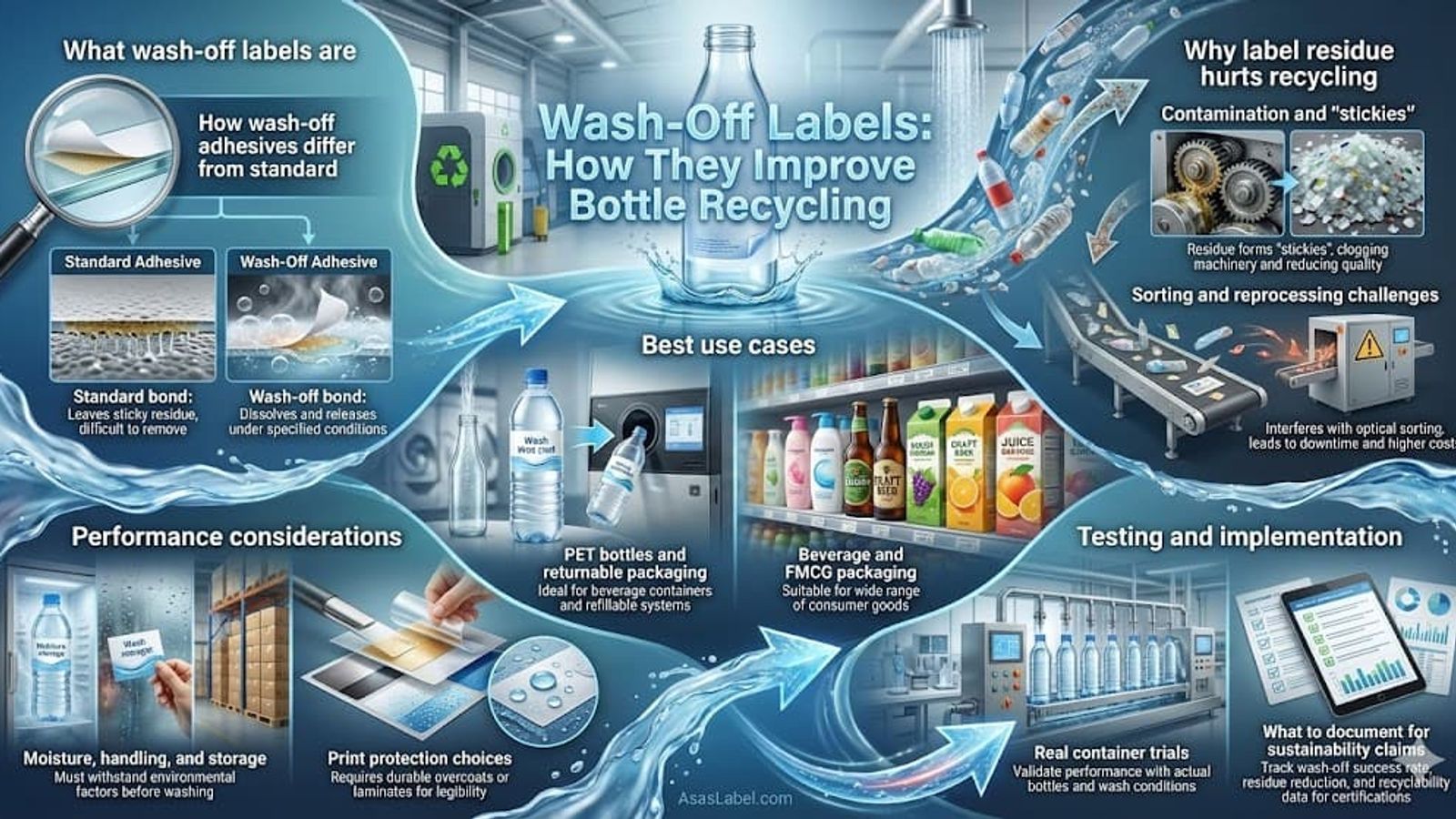
The core innovation lies within the adhesive layer rather than the face stock alone. Standard acrylic or hot-melt adhesives are hydrophobic and designed to resist water. Wash-off labels use adhesives formulated to respond to hot alkaline environments, typically containing sodium hydroxide during the industrial washing and cleaning process.
When submerged in a caustic water bath at temperatures ranging from 65°C to 80°C, the wash-off adhesive undergoes a controlled physical change. It loses its bond strength to the bottle surface. Crucially, the adhesive stays with the label materials rather than transferring to the bottle as residue, which supports recycling and reuse purity.
This process usually involves a multi-layer adhesive construction. Reacting to the heat and alkalinity, the label curls inward. This mechanical curling action reduces the surface area in contact with the bottle, effectively peeling itself off. The label then rises to the surface for removal, leaving no residue behind on the plastic packaging for easy recycling.
The chemistry must balance two opposing forces. It requires high initial tack for pressure-sensitive application and durability during product use. Simultaneously, it needs a precise trigger mechanism to release adhesion completely under cleaning and recycling conditions. This balance prevents premature lifting during humidity exposure or consumer use in the food and beverage and cosmetic sectors.
How Residue from Traditional Labels Hinders Recycling and Reuse in the Packaging Industry
Label residue is a primary contaminant in the plastic reclamation stream. When conventional labels do not separate cleanly, they introduce foreign polymers, inks, and adhesives into the recycled plastic melt. This turns a high-value transparent recyclate into a lower-value, opaque, or gray material that often ends up in a landfill, hurting sustainable packaging efforts.
The economic viability of recycling plants depends on processing speed and output quality. Residue slows down operations and devalues the final product. Even small amounts of residual adhesive can degrade the intrinsic viscosity of the resulting rPET pellets, making it important that the label is designed to detach cleanly from containers.
Brand owners aiming for "100% recyclable" claims must account for the label. If the label hinders the recovery of the bottle, the overall packaging may technically be recyclable, but it is not practically recyclable. This distinction is increasingly important for compliance with regional packaging regulations and helping brands meet sustainability goals through transition to wash-off labels.
Packaging Label Solutions: Solving the Stickies Problem with Sustainable Labeling
In recycling terminology, adhesive residues are often referred to as "stickies." These semi-solid contaminants survive the washing process and enter the extrusion phase. When the plastic is melted down, these stickies do not melt at the same temperature or consistency as the PET, which is why sustainable label solutions are vital.
Stickies cause visual defects in new beverage bottles, appearing as black specks or yellow discoloration. This aesthetic degradation makes the recycled plastic unsuitable for clear PET containers. Manufacturers are then forced to downcycle the material into straps or fibers rather than supporting a true circular economy and reusable containers.
Beyond aesthetics, sticky residue affects chemical safety. Adhesives that burn or degrade during extrusion can release volatile compounds. For food-contact applications, maintaining the chemical purity of the rPET is non-negotiable. Label solutions like wash-off labels mitigate this risk by removing the contaminant source entirely without leaving any residues.
Improving Recycling and Reuse via High-Performance Washing Process Efficiency
Modern material recovery facilities utilize near-infrared (NIR) optical sorters to identify and separate plastics. If a bottle is covered by a large, non-wash-off label, the scanner may identify the label materials instead of the bottle polymer. This sends a PET bottle into the wrong stream, preventing easy recycling and reuse.
During the mechanical recycling phase, residual conventional labels clog filtration screens. Extruders use fine mesh screens to catch impurities before the plastic is pelletized. Adhesive residue blinds these screens rapidly, increasing backpressure and forcing frequent production stoppages for maintenance in the cleaning process.
Filters that require constant changing drive up operational costs for recyclers. By ensuring labels wash off upstream in the sink-float tank, recyclers protect their downstream extrusion equipment. This efficiency encourages recyclers to accept and process bales of labeled bottles, improving the entire life cycle of the packaging material and supporting sustainable plastic usage.
Sustainable Packaging Label Solutions for the Reusable PET Bottle and Returnable Containers
Not every product requires a wash-off label, but for single-use plastics and circular glass bottles, they are vital. The technology is most effective where the primary container has a high recycling market value. Focusing on these high-volume streams yields the greatest environmental impact for the packaging industry and supports recycling and reuse.
Brands utilizing clear PET or HDPE usually see the best return on investment. These polymers have established recycling infrastructure that relies on clean feedstock. Aligning label choice with these existing infrastructure capabilities is a prerequisite for circular design and easy recycling of plastic packaging.
While often associated with beverage bottles, this technology applies to personal care, home goods, and food packaging. Any sector facing pressure to increase recycled content in their packaging must consider how their current labels affect the supply of that recycled material and its recyclability in system containers.
Sustainable Labels Work for Recyclable PET Containers and Returnable Glass
The PET bottle is the gold standard for plastic recycling. To maintain a closed loop where a bottle becomes a bottle again, contamination must be near zero. Wash-off labels allow the PET flakes to sink while the polypropylene or polyethylene label materials float away in the water bath.
Returnable glass bottles and refill systems operate on a wash-and-refill model. Here, the beer bottle or glass container is not ground up but cleaned. The label must be removed completely to allow for fresh branding. Wash-off adhesives facilitate this without leaving gummy residues that require harsh solvents to remove during the washing process.
In returnable bottles, the challenge is ensuring the bottle surface remains pristine. Scratches or ghosting from conventional industrial label removal can weaken the glass or ruin aesthetics. Wash-off label solutions provide a non-abrasive removal process that extends the lifecycle of the glass unit and supports sustainability goals.
High-Performance Label Solutions for Fast-Moving Consumer Goods
Fast-Moving Consumer Goods (FMCG) generate the highest volume of packaging waste. For beverage giants, the speed of the bottling line cannot be compromised. High-performance wash-off labels are compatible with high-speed rotary labelers used in mass production to improve recycling efficiency and support reusable containers.
Product labels designed for the "no-label look" are popular in the beverage sector. Clear-on-clear wash-off labels use materials that maintain brand aesthetics while solving the end-of-life issue. This allows marketing teams to retain premium visual cues without sacrificing sustainability goals or recyclability credentials.
For cosmetic products, personal care, and household cleaners, contamination is often higher due to product residue. A wash-off label ensures that at least the external packaging does not add to the contamination load. This improves the wash water efficiency of the entire cleaning and recycling batch, supporting sustainable practices.
Ensuring High-Performance Sustainable Labels Work for Reusable and Recyclable Packaging
Switching to a wash-off label cannot degrade the consumer experience. The label must remain firmly attached throughout manufacturing, shipping, and retail display. The "wash-off" process must only activate under specific industrial washing conditions, not in an ice bucket or a humid warehouse, ensuring it supports reuse.
Adhesive engineers rigorously test shear strength and tack. The bond must withstand the friction of conveyor belts and the vibration of transport. A label that flags or peels on the shelf damages brand integrity just as much as poor print quality, so labels support must be high-performance throughout the entire life cycle.
Resistance to condensation is particularly important for beverage bottles. Cold-fill lines and refrigerated storage create environments where standard water-soluble adhesives might fail. Unlike traditional labels, modern wash-off adhesives are alkali-soluble, providing resistance to neutral wash water and making labels also work in moisture-heavy zones.
Sustainable Packaging Performance: Label Materials for Recycling and Reuse
Beverage bottles and containers frequently encounter the "ice bucket" scenario. A bottle submerged in ice water for hours must retain its label. Wash-off adhesives are formulated to resist neutral water and low temperatures. They only release when exposed to the high pH and heat of a conventional industrial recycling wash.
Humidity control in warehousing is also a factor. Extreme humidity can soften some pressure-sensitive labels. Converting partners must select formulations with robust environmental resistance and compatibility. This ensures that stock held in non-climate-controlled warehouses does not experience edge lift or premature detachment.
Distribution tests often simulate tropical conditions to validate performance. Packaging engineers should request data on adhesive performance after varying cycles of temperature and humidity exposure. This validation prevents field failures and helps brands maintain a reliable supply chain for sustainable labels.
Varnish Selection for Sustainable Label Solutions and the Reusable Washing Process
The face stock and inks need protection, but the protective layer must not hinder the wash-off process. Heavy laminates can sometimes affect the curl of the label. The mechanical curling action is essential for the peel-off effect, so the laminate must carry the correct tension for the removal process during industrial washing.
Varnishes must be compatible with the caustic wash water solution. If a varnish disintegrates into micro-particles, it pollutes the wash water. Ideally, the ink and varnish should remain bound to the label materials even as it detaches cleanly from containers.
The goal is to keep the wash water clean. If inks bleed out during the wash, they can stain the PET flakes. Specialized primers and top-coats are used to lock the ink to the label, ensuring that the contamination is removed along with the floating label materials during the industrial washing process.
Validating Sustainable Labels Work: Recyclable Label Solutions for Sustainable Packaging
Before full-scale rollout, brands must verify that their labels truly wash off in real-world systems. Relying solely on supplier datasheets is insufficient. Recycling infrastructure varies by region, and local wash temperatures or chemical concentrations may differ across the packaging industry for recyclable and reusable items.
Testing protocols established by organizations like the Association of Plastic Recyclers (APR) or the European PET Bottle Platform (EPBP) serve as the industry benchmark. These protocols simulate the industrial washing, crushing, and drying processes for plastic packaging.
Passing these tests is often a prerequisite for obtaining a "recyclable" certification. It provides third-party verification that the packaging innovation performs as claimed. This data is crucial for internal stakeholders and external sustainability reporting supporting sustainable growth and recycling efficiency.
Right Wash-Off Label Trials for Reusable PET Bottle and Returnable Systems
Lab tests verify chemistry, but line trials verify reality. Trials should involve labeling actual bottles and subjecting them to a pilot recycling line. This reveals how labels also work with the specific bottle geometry, refill requirements, and handling equipment to improve recycling.
Key metrics to observe include the time required for detachment. In a high-throughput recycling plant, the residence time in the wash tank is limited. If the label takes fifteen minutes to detach but the dwell time in the water bath is only ten, the technology fails the recycling efficiency test.
Engineers should also measure the percentage of adhesive remaining on the bottle. Optical scanners can detect residual organic material. The target is typically complete removal, leaving no residue and ensuring the PET flake is chemically pure for rPET production in returnable bottles.
Metrics for Sustainable Packaging: Supporting Recycling and Reuse Goals
Data drives sustainability credibility. When implementing wash-off labels, document the reduction in yield loss. Quantify the improvement in rPET quality resulting from the switch to high-performance sustainable labels that supports recycling and reuse efforts throughout the circular economy.
Life Cycle Assessments (LCA) can be updated to reflect the improved recyclability. A higher quality of recyclate often generates a lower carbon footprint credit for the overall packaging system. This is because high-quality rPET displaces virgin petrochemical production and reduces packaging waste.
Clear documentation aids in extended producer responsibility (EPR) reporting. As governments tax non-recyclable packaging, proving the efficacy of wash-off label solutions can lead to financial savings. It transforms a procurement cost into a strategic asset for regulatory compliance and supporting sustainable recycling.