
Contact Sales Now
Thank you! Your submission has been received!
Oops! Something went wrong while submitting the form.

Contact Sales Now
Thank you! Your submission has been received!
Oops! Something went wrong while submitting the form.

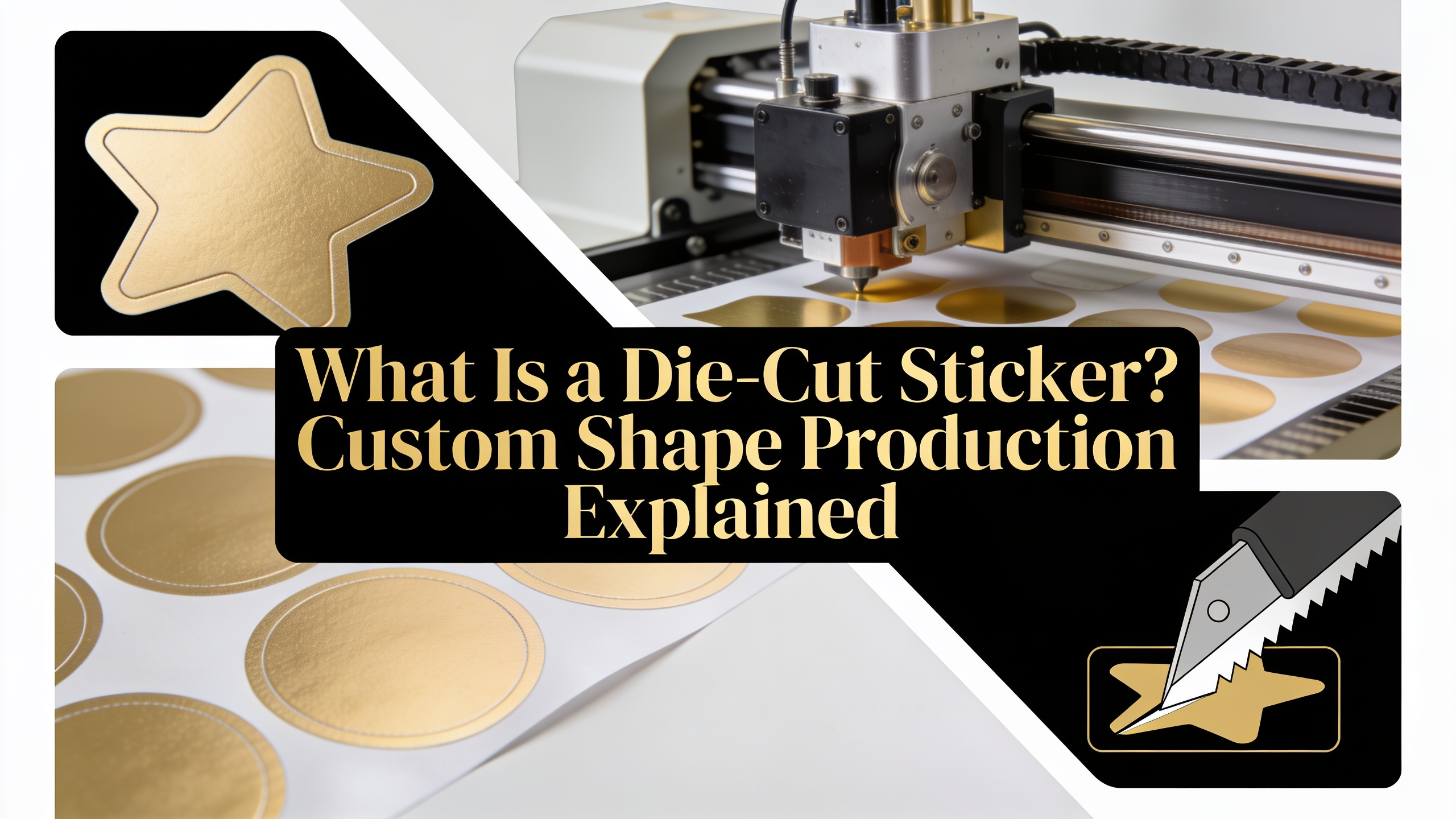
Die-cut stickers are the workhorse of custom branding, product labeling, and promotional merchandise. If you've ever peeled a perfectly shaped logo sticker off its backing, you've handled one. This guide breaks down production methods, tooling economics, material pairings, and briefing standards so you can order with confidence.
So what is a die cut sticker? It's a sticker cut in a custom outline shape where the blade passes through both the facestock (the printed vinyl or paper layer) and the release liner underneath. The result is a fully separated, ready-to-peel unit.
This contrasts with kiss-cut stickers, where the blade only cuts the facestock and leaves the liner intact. Die-cutting produces individual pieces, while kiss-cutting keeps the sticker on a larger backing sheet for easy handling.
What does die cut sticker mean in practical terms? It means the sticker's silhouette matches your artwork exactly, with no excess border unless you designed one in. The shape is the product.
Three primary cutting methods dominate custom sticker production. Each has distinct mechanics, speed profiles, and cost structures that affect your final unit price.
Rotary die cutting uses a cylindrical magnetic or solid steel die that rotates against the material as it passes through the press. It's fast, precise, and ideal for high-volume runs on roll-fed presses.
Flatbed die cutting presses a flat steel-rule die straight down onto stacked sheets. It's slower per unit but works well for thicker substrates, short runs, and prototype quantities where tooling flexibility matters.
Laser cutting uses a focused CO2 or fiber laser beam to vaporize the material along a vector path. No physical die is required, which eliminates tooling costs and allows same-day shape changes.
What are die cut stickers used for? Almost every branded surface application. The custom silhouette is what makes them versatile across industries.
What is die cut stickers' main advantage in these applications? The absence of a background border. A star-shaped logo looks like a star, not a star inside a rectangle. This visual cleanliness elevates perceived brand quality.
The choice between traditional dies and laser cutting comes down to volume, shape complexity, and turnaround requirements. Both produce similar edge quality on standard vinyl, so the decision is economic.
Steel-rule and rotary dies require upfront tooling fees typically ranging from $150 to $600 depending on shape complexity and die type. Once produced, per-unit cutting costs are extremely low, making dies economical past roughly 2,000 to 5,000 pieces.
Laser cutting has zero tooling cost but higher per-piece cutting time. It wins for short runs under 1,000 units, prototype work, frequent shape iterations, and intricate cutouts with fine internal details that would fracture a steel rule.
A quick decision framework:
Whats a die cut sticker order worth optimizing? Any project you'll reprint. Investing in tooling once pays back across every reorder.
Facestock selection drives durability, finish, and price. The material must be compatible with the cutting method, adhesive requirements, and end-use environment.
White vinyl is the default for indoor and outdoor applications. It's flexible, weather-resistant for 3 to 5 years, and cuts cleanly with any method. Available in gloss, matte, and satin finishes.
Clear vinyl creates a "no-label" look where only the printed ink appears against the applied surface. Ideal for glass, transparent packaging, and premium product labels.
Holographic and metallic films add prismatic or foil-like visual effects. These specialty stocks command higher prices but produce eye-catching promotional stickers and security labels.
Paper stocks work for indoor-only applications like envelope seals, event badges, and short-life promotional items. They cut faster but lack water and UV resistance.
Removable and repositionable adhesives pair with die-cut shapes for temporary applications like wall decals, floor graphics, and rental-safe branding.
What are die-cut stickers laminated with? Most outdoor-rated stickers use a clear UV laminate over the printed facestock to extend life, resist scratches, and protect ink from fading. Laminate adds cost but is standard for premium orders.
A clean brief prevents production delays and reprints. Provide these specifications when submitting artwork to your label converter.
Avoid overly intricate cut paths with sharp inside corners under 2 mm radius. These stress the die and produce ragged edges, especially on rotary equipment. Soften tight angles when possible.
Confirm whether you need individually die-cut pieces, die-cut on a roll, or die-cut sheets. Presentation format affects packaging, shipping, and end-user application speed.
Related terms often appear alongside die-cut stickers in vendor quotes and technical specs. Recognizing them helps you compare offers accurately.
What is a die cut sticker versus a kiss cut sticker?
A die-cut sticker is cut through both the vinyl and the paper backing, producing a fully separated piece. A kiss-cut sticker is cut only through the vinyl, leaving the backing intact so the sticker sits on a larger rectangular liner.
Are die-cut stickers waterproof?
Yes, when produced on vinyl facestock with a laminate overlay. Paper-based die-cut stickers are not waterproof and should be limited to indoor use.
What does die cut stickers mean in printing terminology?
It means the sticker's outline was cut using a shaped die or vector-guided laser to match a custom silhouette rather than a standard rectangle or circle.
Can I get die-cut stickers in small quantities?
Yes. Laser cutting and digital flatbed cutting make orders as small as 25 to 100 units economical without tooling fees. Traditional die tooling becomes worthwhile above roughly 2,000 units.
How long do die-cut vinyl stickers last outdoors?
Standard laminated vinyl die-cut stickers last 3 to 5 years outdoors. Premium cast vinyl with UV laminate can extend that to 7 or more years depending on climate and sun exposure.
Is there a minimum size for die-cut stickers?
Most converters produce die-cut stickers as small as 15 mm across. Below that, handling and application become difficult, and fine cut details may not hold up during weeding.
Do die-cut stickers cost more than standard shapes?
Only when custom tooling is required for the first run. Once the die exists, or when laser cutting handles the shape, price differences from standard rectangles are minimal.
What file format is required for the cut line?
A vector file with the cut path on its own named layer or spot color, typically labeled "CutContour" or "Die Line" in AI, EPS, or PDF format.