On this page
- Waterproof Label Materials Compared
- What Waterproof Really Means for Labels
- Water Exposure vs Condensation vs Wiping
- Comparing PP PET and Vinyl Substrates
- Flexibility and Adhesion Stability
- Scuff Tear and Chemical Tolerance
- Which Material Suits Your Product Environment
- Bathroom and Cleaning Products
- Food Containers With Condensation
- Adhesive Choices That Keep Labels Stuck
- Permanent Vs Removable In Wet Areas
- Finishes That Improve Performance
- Lamination for Abrasion and Wipe Resistance
- Quick Selection Matrix
- If Your Product Is X Choose Y
Waterproof Label Materials Compared
Selecting the correct face stock for a wet environment requires looking beyond simple water resistance. The failure mechanism of a label in moisture often involves multiple variables including substrate absorbency, adhesive stability, and ink durability.
Professionals know that a label failing on a shelf due to humidity or condensation damages brand integrity immediately. The distinction between a material that survives a splash and one that survives submersion is chemical. You must match the polymer structure of the label to the stress factors of the environment.
Paper substrates, even those with heavy varnishes, eventually succumb to edge wicking. Moisture penetrates the cut sides of the paper fibers, causing swelling and eventual delamination. For true waterproof performance, synthetic films are the only viable option for commercial applications.
Understanding the interplay between films like Polypropylene (PP), Polyester (PET), and Vinyl (PVC) allows for cost-effective decisions. Over-engineering a single-use water bottle label wastes margin, while under-specifying a shampoo bottle label leads to flagging and peeling.
What Waterproof Really Means for Labels
Start by defining the operational hazard. "Waterproof" in the labeling industry is a functional rating, not a generic guarantee. It indicates that the face stock will not absorb moisture and lose structural integrity when wet.
However, the term often conflates the durability of the material with the durability of the print and the adhesive. A waterproof face stock printed with water-soluble dye inks without lamination will uselessly bleed the moment it gets wet. All three layers must offer moisture barriers.
True waterproof performance implies the label maintains dimension, adhesion, and legibility under sustained moisture. This is distinct from water-resistant labels, which may repel occasional splashes but will degrade under hydrostatic pressure or prolonged dampness.
Consider the lifespan of the waterproof claim. A marine drum label needs to survive saltwater immersion for months (BS 5609 standards). A craft beer label only needs to survive an ice bucket for three hours. The definition relies on the use case.
Water Exposure vs Condensation vs Wiping
Direct liquid exposure is the most obvious threat. This includes submersion in ice chests or standing water in a shower niche. In these scenarios, the hydrostatic pressure tests the bond between the adhesive and the container surface.
Condensation presents a more insidious challenge for labels. When a cold product enters a warm environment, moisture forms on the container surface. If the label was applied to a cold container, condensation can form under the adhesive, preventing initial tack.
If the label is already applied, condensation settles on the top edge. Gravity pulls these droplets down along the adhesive line. Repeated wet-dry cycles cause the adhesive to "milk" or whiten if not specifically formulated for moisture resistance.
Wiping introduces mechanical abrasion to the chemical equation. A cleaning product label is not just wet; it is being scrubbed. The friction forces water into the edges of the label while simultaneously abrading the ink. This requires a laminate barrier, not just a waterproof stock.
Comparing PP PET and Vinyl Substrates
Synthetic substrates form the backbone of waterproof labeling. Unlike wood-pulp papers, these polymers are non-hygroscopic. They physically cannot absorb water into their fibers because they have no fibers to fill.
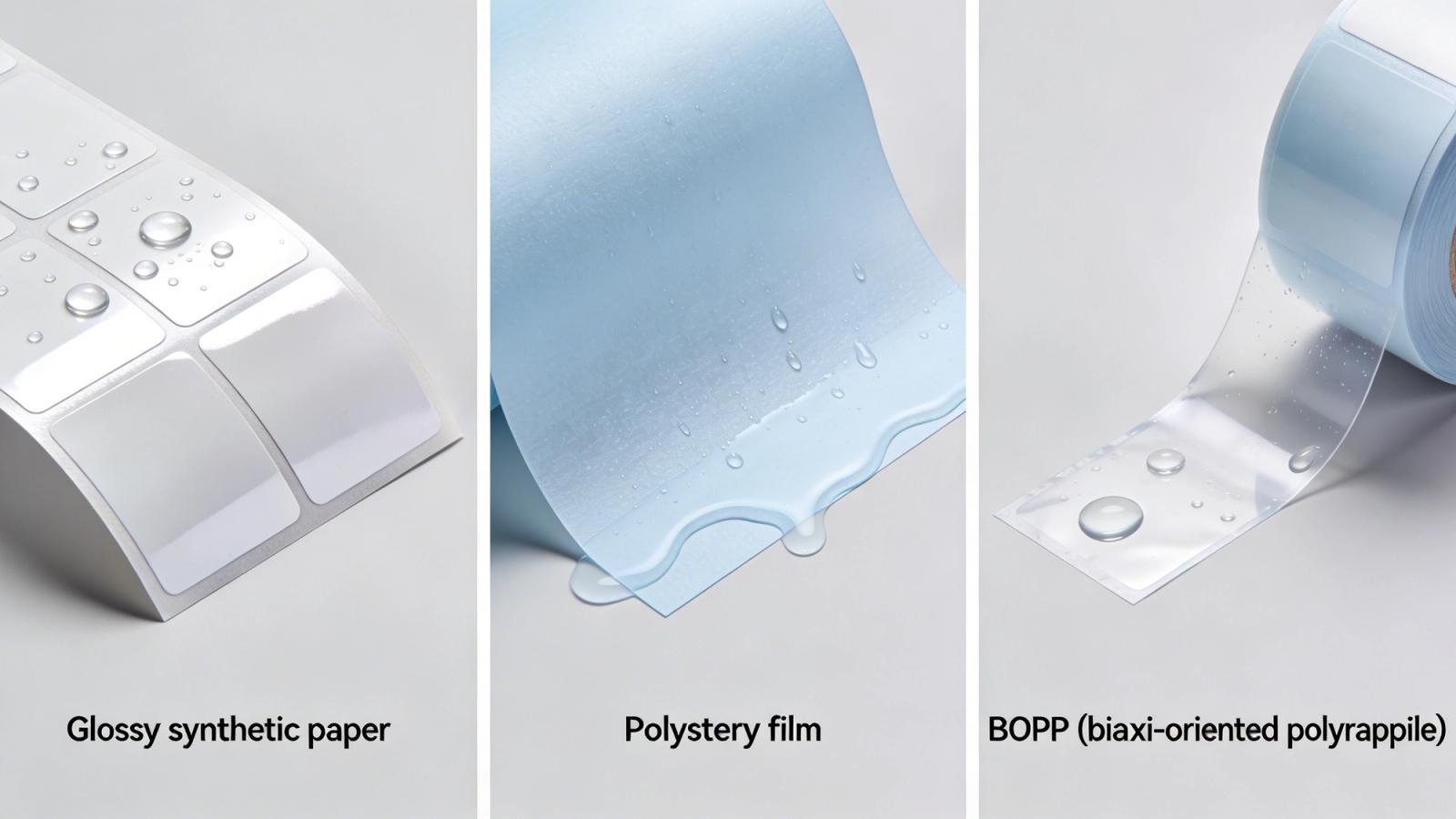
Polypropylene (PP) also known as BOPP (Biaxially Oriented Polypropylene) is the industry standard for most consumer goods. It offers excellent clarity, printability, and cost-efficiency. It is a thermoplastic polymer that resists fatigue well.
BOPP is resistant to many bases and acids, making it suitable for household cleaners. It is generally thinner than vinyl, allowing it to vanish on the bottle for a "no-label" look when using clear stocks.
Polyester (PET) is mechanically stronger and more heat resistant than PP. It is the material of choice for industrial applications, asset tagging, and electronics. It withstands higher temperatures without shrinking or deforming.
PET is often stiffer than PP. While this adds durability, it can limit application on squeezed surfaces. Mylar is a brand name often associated with high-quality PET films used in rigorous environments.
Vinyl (PVC) offers extreme durability and UV resistance. It is thicker and softer than both PP and PET. Its primary strength lies in outdoor weathering. PVC thrives where sunlight and rain are constant factors.
Flexibility and Adhesion Stability
Conformability is the technical term for a label's ability to curve. Stiffness is the enemy of adhesion on a curved surface. A stiff label wants to return to its flat state, creating a "memory" effect that lifts the edges.
Polypropylene (PP/BOPP) excels here. It is semi-conformable. It works comfortably on semi-squeezable tubes and rigid bottles alike. If the consumer squeezes a shampoo bottle, a PP label flexes with the container and returns to shape without wrinkling.
Polyester (PET) is rigid. If applied to a squeezable tube, PET will eventually crack or pop off the surface (tunneling). PET should be reserved for rigid containers, glass jars, or flat surfaces where structural strength is paramount.
Vinyl is highly flexible but heavy. It molds well over complex curves and irregularities. However, its weight requires a more aggressive adhesive to hold it in place against gravity and environmental stressors.
Adhesion stability in wet environments depends on the substrate shielding the adhesive. If the substrate is porous, water destroys the bond from above. Since PP, PET, and PVC are non-porous barriers, they protect the adhesive layer beneath from direct saturation.
Scuff Tear and Chemical Tolerance
Tear resistance varies significantly between plastics. Polypropylene can be torn if a nick is introduced to the edge, but it generally resists stretching. Orienting the film (biaxial orientation) creates strength in both lateral definitions.
Polyester is virtually untearable by hand. You simply cannot rip a standard 2-mil PET label without a cutting tool. This makes it ideal for tamper-evident seals or asset tags where removal should be difficult.
Chemical tolerance is where material selection becomes critical for cleaning products. Labels for wet products often encounter the contents of the bottle. Oils, alcohols, and Limonene (citrus cleaners) act as solvents.
Vinyl is sensitive to certain solvents which can cause it to swell or curl. PET has the highest chemical inertness, surviving contact with harsh industrial chemicals, acetone, and engine oils.
PP provides a good middle ground. It resists water, oils, and most household chemicals. However, for aggressive essential oils or industrial solvents, a PET substrate is the safer engineering choice.
Which Material Suits Your Product Environment
Context determines the correct substrate. Engineers do not select waterproof label material in a vacuum; they select it based on the supply chain and consumer usage patterns.
A label destined for a shower environment faces humidity, heat, and surfactants. A label destined for a craft beer can faces cold, condensation, and abrasion during shipping. These are distinct physical challenges.
Over-engineering leads to waste. Using a heavy-duty vinyl for a disposable water bottle is fiscally irresponsible. Conversely, using a thin BOPP for a 55-gallon chemical drum stored outdoors is a safety hazard.
Bathroom and Cleaning Products
Bathroom environments are high-stress zones for adhesives and substrates. The air is humid, causing moisture to attack the label from the sides. The temperature fluctuates rapidly from hot to cold, causing expansion and contraction of air inside the bottle.
Polypropylene is the dominant choice for bathroom product labels (shampoos, lotions, body wash). Its conformability prevents edge-lift when the bottle is squeezed. White BOPP is standard, but Silver BOPP provides a metallic look that resists rusting.
Cleaning products often contain surfactants intended to break down adhesives. If the product leaks or drips down the side, it attacks the label edge. A laminated PP label is essential here. The laminate seals the print, while the PP resists the chemical attack.
For oily products, such as beard oils or essential oil diffusers, assume spillage will happen. The face stock must be oleophobic (oil-repelling). While PP works, the adhesive needs to be solvent-based to prevent the oil from turning the glue into a localized sludge.
Food Containers With Condensation
Beverage labeling is a battle against condensation. When a beer can or white wine bottle sweats, water droplets form on the surface. If the label is paper components, it turns directly to mush. This is why "wet strength" papers exist, but films are superior.
BOPP is the industry leader for heavy-condensation environments like beverage coolers. It handles the cold well. However, the application temperature matters. The label must be applied before the condensation forms.
Clear BOPP creates the "no-label look" popular on glass beverage bottles. Because the film is waterproof, it does not cloud or haze when wet, provided the adhesive is a water-whitening resistant formulation.
For food containers that undergo freeze-thaw cycles, standard adhesives may crystallize and fail. The facestock (usually PP) remains flexible in the cold, but a freezer-grade adhesive is necessary to maintain the bond during the temperature drop.
Adhesive Choices That Keep Labels Stuck
The substrate is only half the battle. You can have a perfectly waterproof sheet of PET, but if the adhesive is water-soluble, the label will slide off the bottle in the shower. The adhesive layer causes more failures in wet environments than the face stock.
Most standard stickers use emulsion acrylic adhesives. These are water-based. While they are environmentally friendly and cost-effective, they can re-emulsify slightly under prolonged submersion if not cross-linked properly.
For truly waterproof sticker labels, solvent-based acrylic adhesives are superior. The adhesive is dissolved in a solvent, applied, and dried. Once the solvent evaporates, the remaining bond is highly resistant to water, UV light, and chemicals.
Hot-melt rubber adhesives offer very high initial tack (stickiness). They grab wet or difficult surfaces effectively. However, rubber-based adhesives often yellow with UV exposure and can fail if the water carries solvents or oils.
Permanent Vs Removable In Wet Areas
Permanent adhesion in wet environments relies on "wetout." The adhesive must flow into the microscopic texture of the container surface before moisture gets in. Once cured, a permanent waterproof label should require solvent or scraping to remove.
Removable waterproof labels are a contradiction in physics. You want the bond to be weak enough to break, but strong enough to resist water. This is difficult because water acts as a lubricant.
Removable adhesives for wet areas usually employ a high-tack, low-shear microsphere technology. They stick firmly but don't cure into a solid mass. These are commonly used on marketing stickers for appliances or temporary promotional labels on beverage coolers.
Be cautious with "repositionable" adhesives in wet zones. If you lift the label and water gets underneath, the second bond will never hold. Waterproof adhesion generally requires a "one-and-done" application strategy.
Finishes That Improve Performance
The print surface is the weak link. Even if the plastic label holds fast, the inks can scuff off or bleed. Waterproof label material must be paired with surface protection to ensure the branding survives the product lifespan.
Uncoated synthetic films are porous to ink but resistant to water. However, without a topcoat, the ink sits on the surface, vulnerable to abrasion from wet hands, sponges, or adjacent bottles vibrating during shipping.
Varnishes add a liquid coating that cures under UV light. Check specifically for UV-resistant varnishes if the product will be outdoors. Varnish provides basic protection against moisture and rubbing but is thin.
Lamination for Abrasion and Wipe Resistance
Lamination is the gold standard for full waterproofing. This involves applying a secondary layer of clear plastic (usually thin PP or PET) over the printed label. This encapsulates the ink between two layers of plastic.
For products exposed to essential oils, automotive fluids, or heavy cleaning, lamination is non-negotiable. It creates a physical barrier that prevents solvents from ever touching the ink pigments.
Matte lamination offers a sophisticated, textured look and hides fingerprints. Gloss lamination makes colors pop and repels water droplets effectively, helping the label dry faster after exposure.
Selecting a "thermal transfer" printable laminate allows for secondary printing. This is useful if you need to add batch codes or expiration dates to a waterproof label later in the production line.
Quick Selection Matrix
Choosing the right material combination can be simplified by analyzing the primary stress factors. The following mappings provide a baseline for most consumer and industrial applications.
Cost often rises with durability. PP is the baseline for cost-efficiency. PET commands a premium for its heat and tear resistance. Vinyl commands a premium for its thickness and outdoor weathering endurance.
If Your Product Is X Choose Y
If your product is a Squeezable Shampoo Bottle: Choose White or Clear Polypropylene (BOPP). The film flexes without wrinkling. Use a permanent acrylic adhesive to withstand the humidity of the shower.
If your product is an Outdoor Equipment Asset Tag: Choose Silver or White Polyester (PET). The rigidity handles the flat surface, and the material resists UV degradation and extreme temperature shifts. Use a solvent-based adhesive.
If your product is a Craft Beer or Cold Beverage: Choose Clear or Metallized BOPP with a wet-strength adhesive. This withstands the "ice bucket" challenge and condensation without flagging or whitening.
If your product is a Chemical Drum stored outside: Choose Vinyl (PVC) complying with BS 5609 standards if marine shipment is involved. The material must survive saltwater and intense sunlight exposure for extended periods.
If your product is an Essential Oil Dropper: Choose BOPP with a Polypropylene Laminate. The laminate is crucial here; without it, the oil drips will dissolve the ink, leaving you with a blank sticky bottle.