

Contact Sales Now
Thank you! Your submission has been received!
Oops! Something went wrong while submitting the form.

Contact Sales Now
Thank you! Your submission has been received!
Oops! Something went wrong while submitting the form.

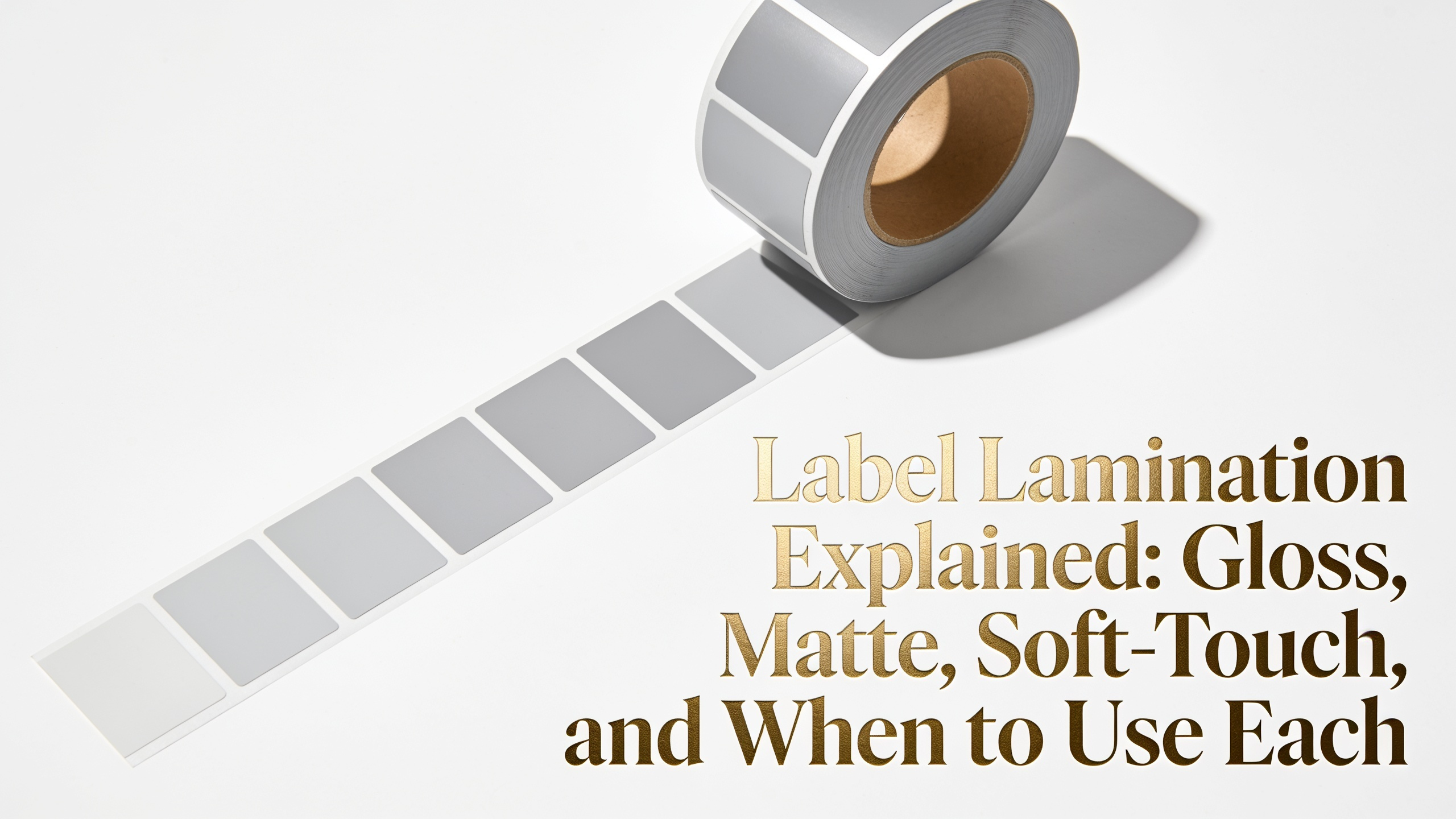
Lamination is the finishing layer that determines how your label looks, feels, and performs on shelf. The right film protects ink, resists moisture, and shapes brand perception. The wrong one dulls color, causes glare, or fails in wet environments.
This guide breaks down gloss, matte, soft-touch, and specialty laminates, compares them with UV varnish, and shows how to specify the correct finish in your production brief.
Lamination is a thin polymer film bonded to the printed face stock using heat and pressure or adhesive. So what is paper laminate? It is a clear or tinted film layer applied over a paper substrate to seal the print surface and reinforce the material.
The film adds three functional layers of value:
If you're asking what is a laminate sheet in label production, it is the roll-form film supplied in BOPP, PET, PVC, or acetate variants. What is laminating sheets in packaging terminology refers to the same pressure-sensitive or thermal films used inline during converting.
Gloss lamination delivers high reflectivity and saturated color reproduction. So what is a glossy finish doing to your artwork? It amplifies contrast, deepens blacks, and makes CMYK pigments read brighter under retail lighting.
Gloss works best for products that need to signal freshness, energy, or clinical cleanliness. Think beverages, sauces, household cleaners, and personal care bottles where visual punch drives purchase decisions.
Common gloss use cases include:
Gloss BOPP is the workhorse film for most consumer goods because it balances cost, clarity, and moisture resistance.
Matte lamination scatters light instead of reflecting it, producing a soft, non-reflective surface. This finish signals craftsmanship, sophistication, and restraint, which is why it dominates artisanal spirits, natural beauty, and specialty food categories.
Matte also improves readability in high-light environments. Ingredient lists, dosage instructions, and legal copy stay legible under fluorescent retail lighting or direct sun without hot spots.
So what is the difference between glossy and matte in practical terms? Gloss maximizes color saturation and reflection; matte minimizes reflection and delivers a tactile, paper-like feel. Gloss shouts, matte whispers.
Consider matte when your brand strategy calls for:
Soft-touch lamination adds a velvet or suede-like surface texture. It feels distinctly different from matte, with a warmer, almost rubberized drag under the fingertip. The tactile signal drives perceived value more than any visual cue.
Soft-touch is favored in luxury spirits, prestige beauty, premium electronics accessories, and gift packaging. The finish pairs exceptionally well with metallic foils, embossing, and spot UV, creating strong visual and tactile contrast.
Other specialty films worth specifying include:
Specialty films typically cost 20 to 60 percent more than standard gloss or matte BOPP, but the brand differentiation often justifies the investment.
UV varnish is a liquid coating cured with ultraviolet light. Lamination is a solid film bonded to the stock. Both protect the print, but they behave differently in cost, protection level, and finish quality.
Choose UV varnish when:
Choose lamination when:
For premium products, many brands combine both: matte lamination as the base with spot UV varnish over logos or key visuals for contrast.
Every finish shifts color perception. Gloss deepens shadows and increases perceived saturation by roughly 10 to 15 percent compared to uncoated stock. Matte flattens the same file, muting reds and warming cool tones slightly.
Soft-touch has the strongest dampening effect on color, often pulling saturation down by 15 to 20 percent. Designers should compensate by boosting chroma at the prepress stage or requesting a wet proof on the final laminate.
Readability also shifts with finish choice:
Always request a laminated proof before signing off. Screen previews cannot predict how a film will interact with ink density and substrate absorption.
A precise brief prevents rework and cost overruns. Give your converter the information they need to quote and produce accurately the first time.
Include these details in every label specification:
Also flag any secondary decoration. Soft-touch films, for example, do not always accept variable data printing or thermal transfer ribbons without a receptive topcoat.
If you're working with cinematography teams or design assets sourced from film production, you may encounter the term open matte. What is open matte format? It refers to a filmmaking framing technique where the full sensor area is exposed, unrelated to label lamination but occasionally confused with matte finish terminology in creative briefs.
Does lamination make labels waterproof?
Yes for short-term water exposure and condensation. The film seals the print surface, but the label edges and adhesive can still fail under prolonged immersion. Specify a PET or BOPP film with a marine-grade adhesive for wet applications.
Can I recycle laminated labels?
It depends on the substrate combination. Paper labels with polymer laminates are generally not curbside recyclable. Mono-material BOPP labels on BOPP containers are recyclable in many streams. Ask your converter for recyclability certification if this matters to your brand.
Is soft-touch worth the extra cost?
Yes for premium and luxury categories. Consumer research consistently shows tactile finishes increase perceived value and shelf dwell time. For commodity products, the ROI is harder to justify.
Which finish resists scratches best?
Gloss BOPP and anti-scratch PET films offer the strongest abrasion resistance. Soft-touch is the most vulnerable to marking and fingerprints, though newer formulations have improved significantly.
Can I combine matte and gloss on the same label?
Yes. Apply matte lamination as the base and add spot UV varnish over selected areas to create high-contrast gloss elements. This is one of the most effective decoration techniques for premium positioning.
How long does laminated label print last?
Indoor shelf life ranges from 3 to 7 years depending on ink, film, and light exposure. Outdoor durability varies from 6 months to 5 years based on film selection and UV inhibitors. Request a durability specification sheet from your converter.
Does matte lamination reduce barcode scan rates?
No when contrast is properly maintained. Matte films can actually improve scan reliability by eliminating glare that confuses laser scanners. Ensure the barcode has minimum 80 percent contrast ratio between bars and background.