
Contact Sales Now
Thank you! Your submission has been received!
Oops! Something went wrong while submitting the form.

Contact Sales Now
Thank you! Your submission has been received!
Oops! Something went wrong while submitting the form.

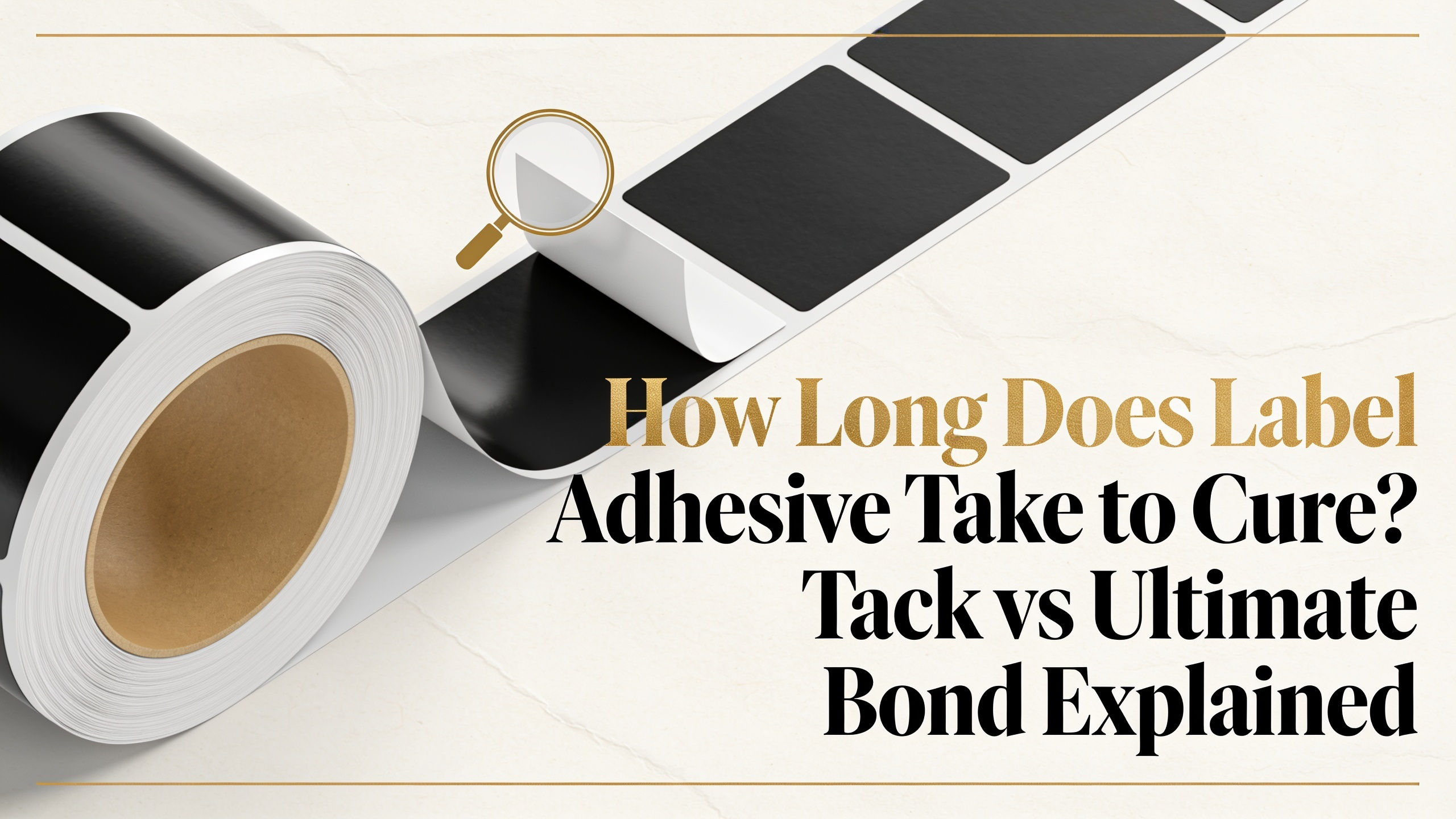
Initial tack refers to the immediate grab strength when a pressure-sensitive label first contacts a substrate. It's the light stickiness that holds the label in position within seconds of application, but it represents only a fraction of the adhesive's final holding power.
Ultimate adhesion, by contrast, is the maximum bond strength reached after the acrylic or rubber-based adhesive has fully wetted out the surface. This process involves polymer flow into microscopic surface irregularities, creating mechanical anchoring alongside chemical adhesion.
The gap between these two states matters enormously in production. A label may feel firmly attached at initial tack, yet peel cleanly off if stressed. Full cure typically delivers 3 to 5 times the holding force of initial tack.
Semantically, converters also refer to this progression as "green tack" (early phase) versus "dwell strength" or "final bond." Knowing the difference prevents costly rework and returns.
So how long does glue take to dry on a pressure-sensitive label? The answer depends on chemistry, but general benchmarks apply across most commercial PSA formulations used in labeling.
The standard label adhesive cure time cited across the industry is 72 hours for permanent acrylics on standard substrates. This is when peel adhesion values reported on technical data sheets are measured.
For craft applications, users often ask how long does tacky glue take to dry when compared to PSA labels. Tacky craft glues typically skin over in 15 to 30 minutes and cure fully in 24 hours, which is a slower initial set but similar full-cure window to acrylic label stock.
Temperature is the single largest variable. Adhesive polymers flow more readily above 70°F (21°C), accelerating wet-out. Below 50°F (10°C), cure can stall entirely, and cold-chain labels require specialized formulations rated for those conditions.
Humidity plays a subtler role. Water-based emulsion adhesives require moisture evaporation, so high ambient humidity extends drying. Excessively dry air, however, can cause premature skinning that traps unreleased water beneath the film.
Surface energy of the substrate directly controls wet-out. High-energy surfaces such as glass, steel, and treated films accept adhesive readily. Low-energy plastics like polyethylene and polypropylene resist flow, extending effective cure time and reducing peak adhesion.
Additional factors that shift how long glue takes to dry on labels:
Rougher substrates require longer dwell because the adhesive must flow into deeper valleys. A textured HDPE container may need double the cure time of smooth glass to reach comparable peel values.
Edge lift is the number one field failure for prematurely handled labels. When a label is stressed before full cure, the adhesive hasn't yet flowed into surface irregularities, leaving edges vulnerable to mechanical peeling forces.
Curved surfaces amplify the problem. The face stock's memory tries to return to a flat state, generating continuous stress at the label edges. Only a fully cured bond can resist this restoring force over the product's shelf life.
Cold chain products present particular risk. Labels applied at ambient temperature and immediately moved to refrigeration halt the cure process. The bond locked in at that moment may be as low as 30% of the specified ultimate adhesion.
Common symptoms of premature handling include:
These defects are almost always preventable with proper dwell time. Rushing labeled goods into distribution is the most common root cause of adhesion complaints traced back to end-user handling.
Most label converters and adhesive manufacturers recommend a minimum 24-hour dwell before shipping non-critical products. This allows the adhesive to reach roughly 80% of its ultimate bond strength under normal warehouse conditions.
For premium applications, extend dwell to 72 hours. This includes wine and spirits labels, cosmetics, pharmaceuticals, and any product destined for humid or refrigerated environments. The additional time ensures the bond can resist long-term environmental stress.
Recommended dwell protocols by application:
Application pressure at labeling also reduces required dwell. A firm squeegee or roller pass forces immediate adhesive contact with the substrate, cutting effective cure time by 20 to 30% versus hand-applied labels.
Environmental staging matters as well. Keep freshly labeled goods in a controlled area between 65°F and 75°F with moderate humidity during dwell. Avoid stacking that creates uneven pressure on labeled surfaces before cure completes.
Document your dwell protocol as part of quality control. Batch tracking with application timestamps prevents accidental early shipment and provides traceability if adhesion issues surface downstream.
How long does glue take to dry on a label applied to glass?
On clean glass, a standard acrylic PSA reaches usable bond within 1 hour and full cure within 24 hours. Glass is a high-energy surface, so it represents the fastest cure scenario for most label adhesives.
Can I speed up label adhesive cure time?
Yes. Increased application pressure, elevated ambient temperature (75 to 85°F), and low humidity all accelerate cure. Some converters use warm-air tunnels post-application to reduce dwell requirements in high-volume production lines.
How long does tacky glue take to dry compared to PSA label adhesive?
Tacky craft glue takes 15 to 30 minutes to set and 24 hours to cure fully. PSA label adhesive has instant initial tack but requires 24 to 72 hours for ultimate bond. The chemistries differ, but cure windows overlap.
Is 24 hours enough dwell time before shipping labeled products?
Yes, for most standard applications on smooth, clean substrates in ambient conditions. For cold storage, humid environments, or low-surface-energy plastics, extend dwell to 72 hours to guarantee full label adhesive cure time.
Does refrigeration stop adhesive cure?
Yes. Below 40°F, most PSA polymers become too rigid to flow. Cure effectively halts and resumes only when the product returns to warmer temperatures. Always complete dwell at room temperature before cold exposure.
Why do my labels look stuck but peel off easily hours later?
This is the classic initial tack versus ultimate adhesion gap. The label bonded enough to hold position but was disturbed before the adhesive fully wetted out. Extending dwell before handling resolves this issue in nearly all cases.
Does label size affect cure time?
No, cure time is a function of adhesive chemistry and environmental conditions, not label dimensions. However, larger labels face more edge stress, so any partial cure creates larger visible defects on bigger formats.
What's the shelf life of unapplied label stock?
Most PSA label rolls carry a 1 to 2 year shelf life when stored between 60°F and 75°F at 40 to 50% relative humidity. Aged stock may show reduced tack and extended effective cure time upon application.