

Contact Sales Now
Thank you! Your submission has been received!
Oops! Something went wrong while submitting the form.

Contact Sales Now
Thank you! Your submission has been received!
Oops! Something went wrong while submitting the form.

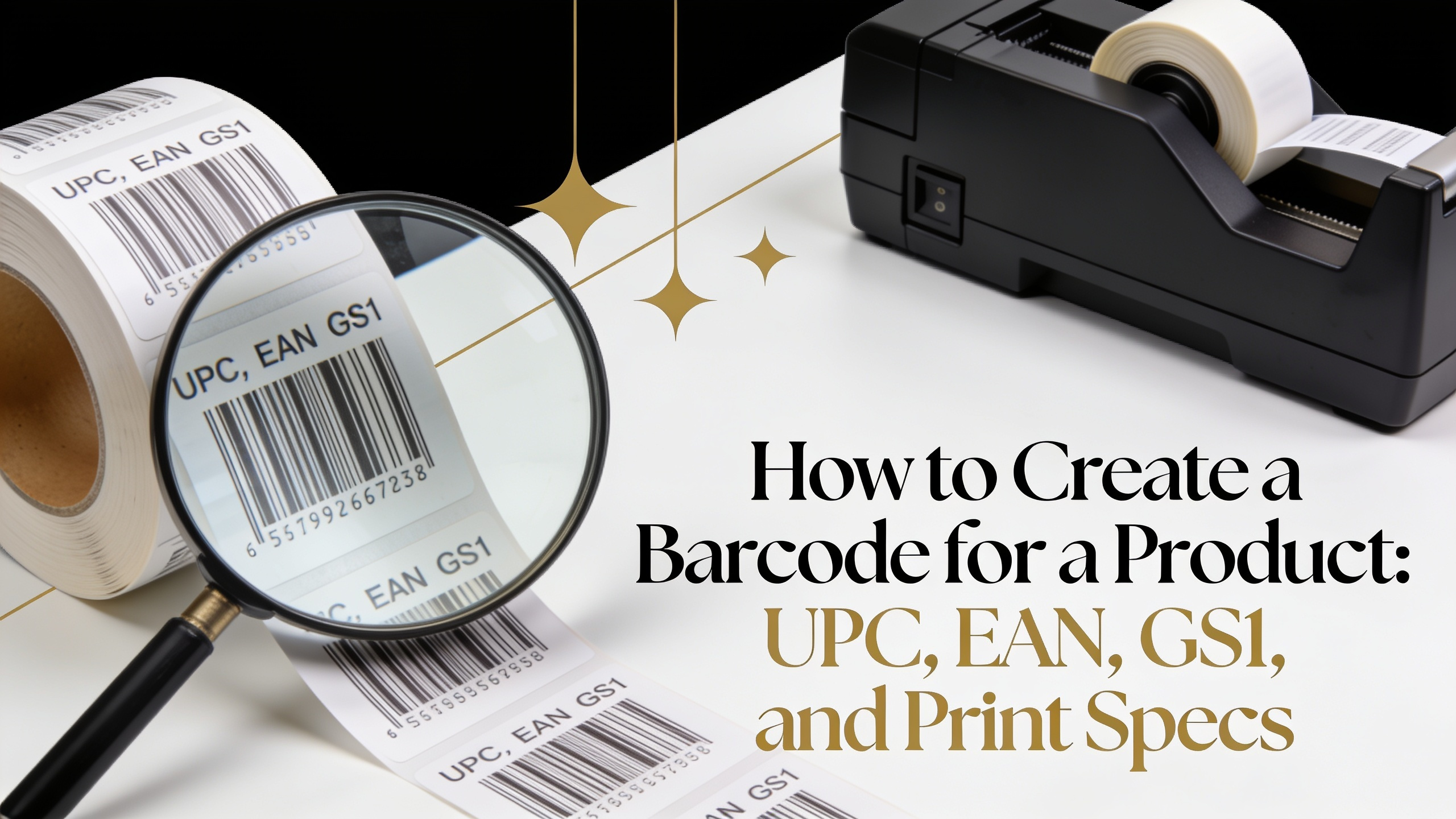
Creating a scannable barcode for retail requires more than clicking "generate" in a free online tool. Retailers, distributors, and marketplaces demand GS1-registered identifiers, verified print quality, and specific dimensional tolerances. This guide walks through the exact process to produce a compliant, scannable barcode ready for production.
Before you generate any barcode symbol, you need a GS1 Company Prefix. This unique numeric string identifies your brand within the global GS1 database and forms the foundation of every GTIN (Global Trade Item Number) you assign to a product.
Register directly through your regional GS1 office (GS1 US, GS1 UK, etc.). Prefix length varies from 6 to 10 digits, depending on how many products you need to encode. Fewer digits in the prefix means more available product numbers.
Avoid resellers offering "cheap UPC codes" scraped from dissolved companies. Amazon, Walmart, Target, and Kroger cross-check GTINs against the official GS1 registry. Unregistered codes get flagged, delisted, or rejected during onboarding.
Once assigned, you build each GTIN by combining your prefix with a product reference number and a calculated check digit. This is the core identifier before you decide how to make the barcode graphic itself.
The barcode symbology depends on the market, package level, and data you need to encode. Selecting the wrong type causes scan failures at point-of-sale or in warehouse workflows.
For consumer units sold on a shelf, use UPC-A or EAN-13. For master cartons and logistics units, use ITF-14. For regulated goods, healthcare, or supply chain traceability, use GS1-128 or GS1 DataMatrix.
If you sell on Amazon, note that FNSKU labels replace the manufacturer barcode when using FBA. However, you still need a valid GTIN to create the listing in the first place.
Once you have the GTIN, you convert it into a scannable symbol. This is where most people ask how do you generate a barcode without introducing print errors. The answer depends on volume and precision requirements.
For low-volume needs, GS1's own barcode generator (via GS1 US Data Hub or the GEPIR portal) produces compliant symbols directly from your registered GTIN. Output includes EPS or PNG files at correct proportions.
For larger catalogs, dedicated software handles bulk generation:
Wondering how to create barcode in Excel? Install a barcode font like Code 128 or IDAutomation's UPC font, then apply it to a cell containing the correctly formatted string. Note that UPC-A and EAN-13 require a start/stop character and calculated check digit, so use a formula or add-in rather than typing raw digits.
For anyone asking how to make barcode files without software installs, Zebra's free Barcode Generator and Orca Scan's web tool produce single symbols quickly. Always export as vector (EPS or SVG) when possible to preserve edge sharpness during scaling.
A barcode is only useful if scanners read it reliably. GS1 defines strict tolerances that must survive printing, laminating, and handling. These are non-negotiable for retail acceptance.
X-Dimension is the width of the narrowest bar or space. For UPC-A and EAN-13 at retail POS, the nominal X-dimension is 0.33 mm (13 mils). Acceptable range is 80% to 200% of nominal magnification.
Symbol Height should not be truncated. A UPC-A at 100% magnification measures roughly 37.29 mm wide by 25.93 mm tall. Cutting height below 75% risks scan failure at omnidirectional scanners.
Quiet Zone is the mandatory blank margin on both sides of the symbol. For UPC-A and EAN-13, allow at least 9× the X-dimension on the left and 7× on the right. Skipping this is the most common cause of no-scan.
Contrast requires dark bars on a light background. Aim for a Print Contrast Signal above 70%. Black on white is safest. Avoid red, orange, or yellow bars—laser scanners at 660 nm see them as background.
Substrate and finish directly influence how a scanner interprets bar edges. The same digital file can pass verification on matte paper and fail on glossy film.
Matte finishes diffuse reflected light evenly and generally scan best. This is the default choice for shipping labels, food packaging, and pharmaceutical labels.
Gloss and metallic finishes create specular reflection that can blind the scanner's photodiode. If you need gloss for branding reasons, apply a matte varnish or window over the barcode area.
Transparent or clear labels require a white underprint behind the barcode zone. Without it, the underlying container color becomes the background and contrast collapses.
Thermal transfer ribbons on synthetic stock produce the sharpest edges for variable data like GS1-128 with batch codes. Direct thermal fades over time and is unsuitable for products with long shelf life or heat exposure.
Even with correct artwork, print production introduces defects. ISO/IEC 15416 (linear) and ISO/IEC 15415 (2D) define the grading system used by every major retailer's quality audit.
Grades run from A (4.0) to F (0.0). Most retailers require a minimum grade of C (1.5) at the point of verification. Amazon, Walmart, and major grocery chains routinely reject shipments with F-graded symbols.
Typical failure modes include:
Use a certified verifier such as Axicon, REA, or Webscan rather than a consumer scanner. A phone scanning app confirms readability but does not measure print quality against ISO tolerances.
Desktop thermal printers work fine for prototyping and low volumes. For consistent grade-A output across long runs, commercial label converters handle the process end-to-end.
Consider commercial printing when:
A commercial converter also handles die-cutting, lamination, and adhesive selection matched to your product's storage conditions. This eliminates the guesswork behind how to print a barcode that survives cold chain, moisture, or abrasion.
For anyone still exploring how to create your own barcode workflow, start small with GS1 registration and a verified prototype. Scale to a commercial partner once your SKUs and volumes justify it.
Do I need GS1 registration for barcodes used only inside my warehouse?
No. Internal barcodes for stock movement, picking, or asset tracking can use Code 128 or QR without GS1 involvement. Registration is only required when products cross into retail or regulated supply chains.
Can I generate a UPC barcode for free?
Yes, once you own the GTIN. The symbol image itself is free to generate through any compliant tool. The cost is the GS1 Company Prefix licence, not the graphic file.
Is a QR code the same as a barcode for retail?
No. QR codes are 2D symbols mainly used for marketing links and consumer engagement. Retail point-of-sale still requires linear UPC-A or EAN-13 at checkout, though GS1 Digital Link is transitioning some categories to 2D.
What resolution should barcode artwork be?
Vector formats (EPS, SVG, PDF) are preferred. If raster is required, use 600 DPI minimum. Lower resolutions cause pixelated bar edges that fail verification.
Can I resize a barcode to fit my package?
Yes, within limits. UPC-A and EAN-13 accept 80% to 200% magnification. Never scale non-uniformly—stretching one axis destroys the module ratios and makes the symbol unscannable.
How long does GS1 registration take?
Typically 1 to 3 business days after payment. Prefixes are issued digitally, and you can begin assigning GTINs immediately upon receipt.