
Contact Sales Now
Thank you! Your submission has been received!
Oops! Something went wrong while submitting the form.

Contact Sales Now
Thank you! Your submission has been received!
Oops! Something went wrong while submitting the form.

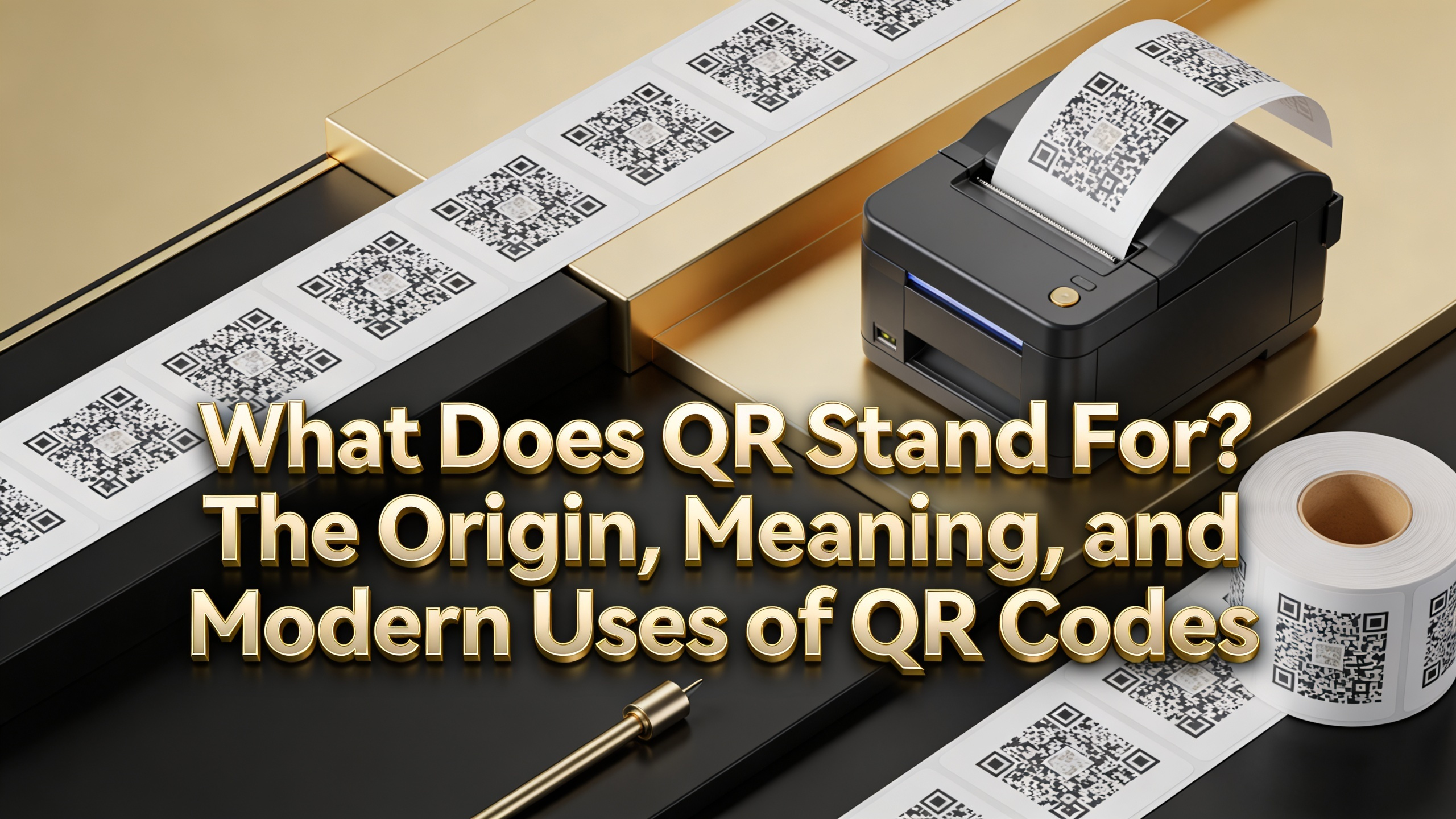
QR stands for Quick Response. The name reflects the code's primary design goal, which is rapid data readability at high speed, far faster than traditional one-dimensional barcodes used in retail and logistics.
So when people ask what does qr stand for, the answer is straightforward. The "QR" in QR code refers to the scanner's ability to decode information almost instantly, regardless of angle or partial damage to the code itself.
This naming wasn't marketing fluff. It was a technical promise, one that shaped how the code was engineered from the ground up by its inventors at Denso Wave in Japan.
QR codes were created in 1994 by Masahiro Hara and a small engineering team at Denso Wave, a subsidiary of Denso Corporation, a major Toyota Group supplier. The original purpose was tracking automotive parts during manufacturing.
Traditional barcodes could only hold around 20 alphanumeric characters. Assembly lines needed more data per scan, and workers needed faster reads. Denso Wave set out to build a two-dimensional code that could store significantly more information without slowing production.
Hara reportedly drew inspiration from the board game Go, with its grid of black and white stones, when designing the matrix pattern. The three distinctive square markers in the corners allow scanners to detect orientation instantly, even at odd angles.
Denso Wave released the QR code specification publicly and chose not to enforce its patent rights for standard usage. That single decision is why QR codes spread globally instead of remaining locked inside Japanese factories.
The "Quick Response" name was a direct response to factory floor frustrations. Workers using linear barcodes had to scan multiple codes per component, slowing assembly throughput and increasing error rates during high-volume production runs.
Denso Wave engineers targeted three specific performance gains when answering what does qr code stand for in practical terms:
The position detection patterns (the three corner squares) are the technical reason for the speed. They let the decoder lock onto the code's boundaries in milliseconds, then read the data modules inside without orientation guesswork.
Linear barcodes like UPC, EAN, and Code 128 encode data along a single horizontal axis. QR codes are two-dimensional matrix codes, storing data both horizontally and vertically across a square grid of black and white modules.
This dimensional shift creates major capability gaps. A standard UPC barcode holds 12 digits. A single QR code can hold thousands of characters, including URLs, contact details, payment instructions, or product authentication tokens.
Key technical differences worth noting:
For manufacturers and brand owners, this means a QR code on packaging can carry batch numbers, manufacturing dates, authentication keys, and a consumer-facing URL simultaneously, something no linear barcode can do.
QR codes moved far beyond factory floors. Today they sit on product labels, restaurant tables, transit tickets, and shop windows worldwide. The COVID-19 period accelerated mainstream adoption dramatically, especially in contactless payments and menu access.
Brands now print QR codes directly on labels to link consumers to product origin stories, ingredient transparency pages, recycling instructions, and warranty registration forms. For a label manufacturer like ASAS Label, this is one of the fastest-growing print finishing requests.
Smart packaging often pairs a QR code with serialized data, giving each individual unit a unique identifier rather than a shared SKU code, which enables track-and-trace at the item level.
WeChat Pay and Alipay turned QR codes into the dominant payment method across China, with over a billion daily users. Western platforms like PayPal, Venmo, and Stripe followed with their own QR-based payment flows for small merchants.
Marketers embed QR codes in print ads, billboards, direct mail, and product packaging to bridge offline media with digital landing pages. Dynamic QR codes also let teams track scan analytics — location, device type, scan time — without changing the printed code itself.
Anti-counterfeit programs use encrypted QR codes paired with serialized databases. When a consumer scans the code, the system verifies whether the unit is genuine. Luxury goods, pharmaceuticals, and premium spirits rely heavily on this approach.
For anyone still wondering what does qr in qr code stand for, the "Quick Response" naming feels especially relevant in authentication, where verification needs to happen in seconds at retail checkout or customs inspection.
Yes. QR codes are free to use, generate, and print without licensing fees. Denso Wave holds the patent but has publicly waived enforcement for standard QR code usage, and the format is now an ISO standard (ISO/IEC 18004).
You can generate static QR codes using free online tools, open-source libraries like qrcode in Python, or built-in design software functions in Adobe Illustrator and Canva. Static codes never expire and have no scan limits.
Dynamic QR codes, on the other hand, typically require a paid subscription. They route through a redirect service, which is what enables editing the destination URL after printing and tracking scan analytics in real time.
Common cost considerations for businesses:
The Denso Wave trademark on the term "QR Code" still exists, but the code format itself is open. This dual structure — open format, trademarked name — is what allowed the technology to scale globally while keeping the brand recognizable.
The "QR" stands for Quick Response. It was named by Denso Wave engineers in 1994 to emphasize the scanner's ability to read the code at high speed compared to existing one-dimensional barcodes used in manufacturing.
Masahiro Hara and his team at Denso Wave, a Japanese subsidiary of Denso Corporation, invented the QR code in 1994. The original goal was tracking automotive parts more efficiently on Toyota assembly lines.
Yes. "QR Code" is a registered trademark of Denso Wave. However, the company does not enforce its patent rights on the code format itself, which is why anyone can generate and use QR codes without paying royalties.
A single QR code can hold up to 7,089 numeric characters, 4,296 alphanumeric characters, 2,953 bytes of binary data, or 1,817 Kanji characters, depending on the version and error correction level selected during generation.
Yes. QR codes use Reed-Solomon error correction with four selectable levels (L, M, Q, H). At the highest level, up to 30% of the code can be damaged, dirty, or obscured and still be decoded successfully.
Static QR codes never expire because the data is encoded directly into the pattern. Dynamic QR codes can stop working if the subscription service hosting the redirect is canceled or the destination URL is removed.
The meaning is identical — Quick Response. In payment apps, the name reflects the design intent perfectly, since transactions need to authorize within seconds at the point of sale or peer-to-peer transfer.
QR codes themselves are neutral carriers, meaning security depends on what they link to. Encrypted, signed, or serialized QR codes used for authentication are highly secure. Generic QR codes pointing to URLs can be spoofed if printed by malicious parties.
Yes, and it's increasingly standard practice. ASAS Label integrates QR codes into custom label designs for packaging, authentication, traceability, and consumer engagement programs across food, beverage, cosmetics, and industrial product categories.