On this page
- UV Protection Label: Fade Resistant Sticker Solution and UV-Resistant Label Material to Protect from Sunlight
- UV Rays and Color Fading: How Ultraviolet Light and UV Damage Destroys Label Integrity
- Fading with UV, Cracking, and Adhesive Failures in Outdoor Gear
- Weatherproof Labels: Which Label Material and Vinyl Substrates Survive Long-Term UV Exposure
- Polyester and Vinyl: UV Resistance and Durability Against Harmful Aging
- UV Protection Coating and Spray: Are Protective Weatherproof Labels and UV Protectant Necessary?
- UV-Resistant Laminate vs. Coating: Resisting UV Damage and Color Fading with UV Protection
- Gloss vs. Matte Finish: How Exterior Resistance Impacts Long-Lasting Protection
- UV Resistant Print: Ink Formulation and Resin Strategies to Reduce Fade
- Color Fading and UV Damage: Vulnerability of Specific Print Pigments to UV Rays
- Long-Lasting Readability: How to Resist Ultraviolet Aging and Reduce Fade
- Outdoor Application Best Practices: Using Acrylic Adhesive to Help Prevent Aging and Humidity Damage
- Surface Energy and Spray Preparation: Techniques for Water-Resistant and Marine Protection
- UV Protection Checklist: Establishing a Robust UV-Resistant Testing Solution to Last in the Exterior
- Simulated Weathering and UV Resistance: Testing for Automotive and Marine Durability
UV Protection Label: Fade Resistant Sticker Solution and UV-Resistant Label Material to Protect from Sunlight
Outdoor labeling requires rigorous engineering to withstand environmental aggression. Ultraviolet radiation acts as the primary catalyst for material degradation in exterior applications. Standard labeling solutions and common sticker products fail rapidly when exposed to the full spectrum of sunlight, which is why uv protection is a necessity for signage.
Understanding the mechanism of photodegradation is essential for specifying durable asset tags and safety signage. The failure of a label often results in compliance violations or lost asset traceability. Manufacturers must prioritize material science and uv-resistant components over standard aesthetic choices to reduce the risk of harmful aging.
Selecting the correct combination of substrate, adhesive, and ink determines the lifespan of the identifying mark. A systematic solution to UV resistance prevents premature fading and structural failure. This guide examines the technical requirements for weathering the elements and ensuring a durable label for outdoor use.
UV Rays and Color Fading: How Ultraviolet Light and UV Damage Destroys Label Integrity
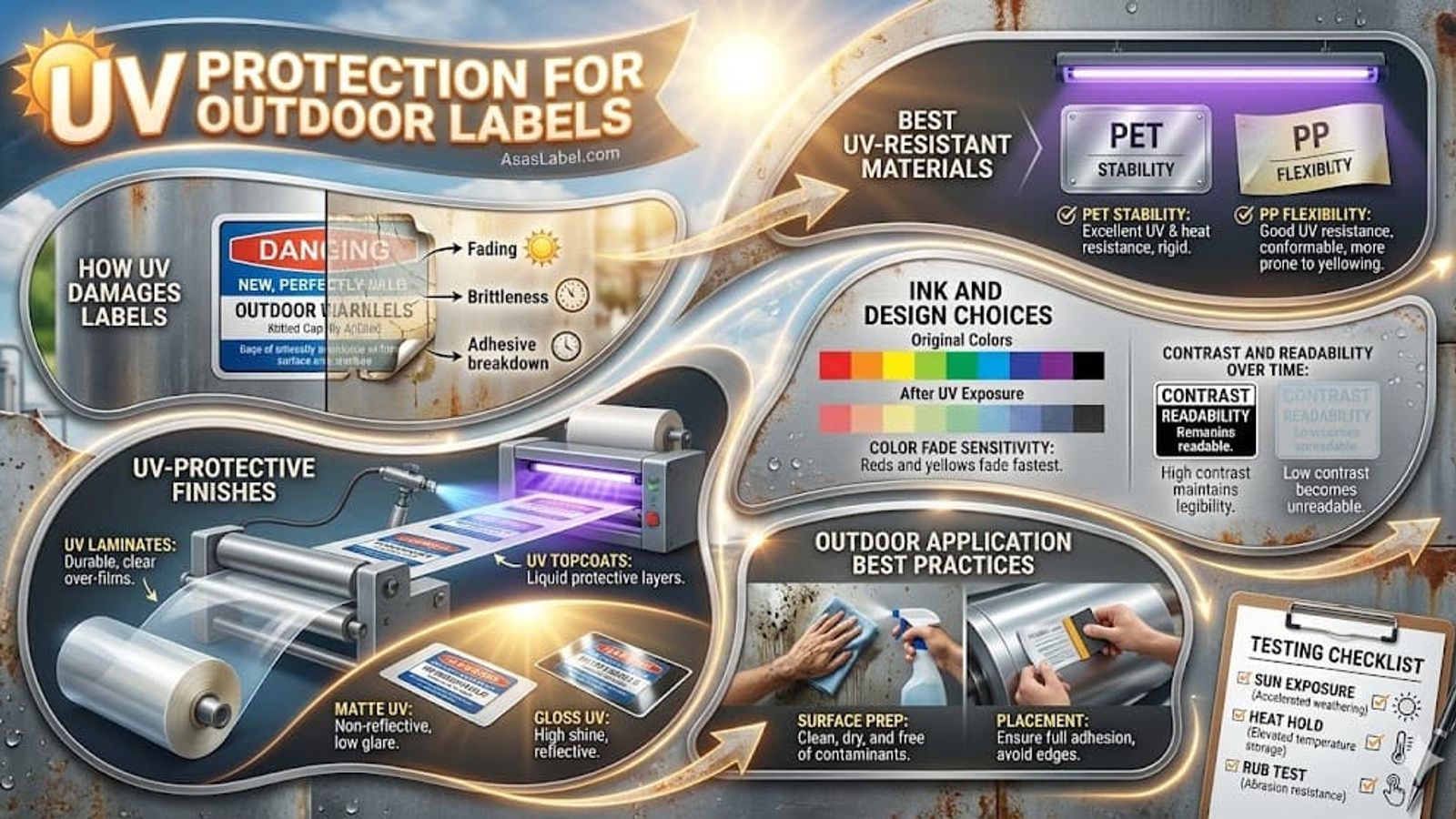
Solar radiation attacks the molecular bonds of organic polymers found in label materials. This process, known as photo-oxidation, severs the polymer chains that provide structural strength. The energy creates free radicals within the material matrix, which leads to uv damage and can prolong the degradation of the entire solution.
These free radicals react with oxygen to further break down the material chemically. The result is a rapid loss of physical properties and visual clarity. Without specific stabilizers, most thermoplastics degrade within months of exposure to direct sunlight. Using a uv protectant or resin-based coating can help prevent this rapid aging.
The intensity of degradation varies based on geographic location and angle of exposure. Labels facing the equator or positioned at varied angles receive higher concentrations of UV energy. Manufacturers must account for the worst-case scenario during the material selection phase to ensure weatherproof labels last in the exterior.
Fading with UV, Cracking, and Adhesive Failures in Outdoor Gear
Visual fading often serves as the first indicator of label failure. Chromophores in the ink absorb UV energy and undergo chemical changes that alter their light-absorbing properties. This results in the "bleaching" effect commonly seen on old signage where color fading has taken hold due to ultraviolet exposure.
Brittleness follows closely behind visual degradation. As polymer chains shorten due to scission, the face stock loses its elasticity. The material becomes prone to stress cracking, especially if applied to curved outdoor gear or materials that expand and contract with temperature fluctuations.
Adhesives are equally vulnerable to UV penetration. Light passes through the face stock and attacks the bonding interface. Rubber-based adhesives oxidize and lose tack, causing the label to lift. Acrylic adhesive formulations may harden excessively, losing the ability to flow and bond with the surface of the asset.
Chalking is another symptom of severe UV damage. The binder holding the pigment or the material surface disintegrates, leaving a powdery residue. This residue obscures the printed data and renders barcodes unreadable, significantly reducing the durability of the durable label.
Weatherproof Labels: Which Label Material and Vinyl Substrates Survive Long-Term UV Exposure
The choice of face stock dictates the fundamental lifespan of an outdoor label. Paper products are strictly non-viable for outdoor applications regardless of coatings. Synthetic films like vinyl and polyester offer the necessary chemical resistance and durability required for industrial environments.
Engineers categorize films based on their polymer structure and expected service life. The goal is to match the material lifespan with the lifecycle of the asset it identifies. Over-specifying adds unnecessary cost, while under-specifying guarantees failure and rapid color fading with uv rays.
Resistance to environmental stress cracking is a critical metric for outdoor substrates. The material must withstand UV load while simultaneously enduring temperature cycling. Only specific engineered plastics maintain dimensional stability and uv resistance under these dual stresses.
Polyester and Vinyl: UV Resistance and Durability Against Harmful Aging
Polyethylene Terephthalate (PET), commonly known as polyester, is the industry standard for durability. It possesses an inherently high melting point and excellent resistance to oxidation. Polyester labels and films resist shrinking and maintain tensile strength over years of solar exposure in marine and industrial settings.
Polyester labels are ideal for flat surfaces and high-energy applications. They offer superior dimensional stability, ensuring that critical data remains legible. However, their rigidity can be a drawback on highly curved or irregular surfaces where vinyl labels might be more appropriate.
Polypropylene (PP) offers a more flexible alternative essential for squeezable containers or curved radii. While flexible, standard PP degrades faster under UV light than PET. It requires significant additions of UV stabilizers during manufacturing to survive outdoors and resist harmful aging.
Vinyl (PVC) occupies a middle ground, offering extreme durability and conformability. Cast vinyl is preferred over calendered vinyl for long-term outdoor use. Historically, vinyl has been the go-to for outdoor applications and decals, though specific label protectors are required to prevent shrinkage and edge curl.
UV Protection Coating and Spray: Are Protective Weatherproof Labels and UV Protectant Necessary?
Relying solely on the face stock and ink provides insufficient protection for multi-year applications. A barrier must be placed between the print and the solar source. Protective finishes act as a sacrificial layer that absorbs or reflects harmful radiation and prevents moisture ingress.
These barriers also provide abrasion and chemical resistance. In industrial environments, outdoor labels often face physical contact alongside sun exposure. A protective top layer serves a dual function of UV blocking and physical shielding, acting as a long-lasting barrier for exterior signage.
The application method of the finish, such as a spray or a laminate, affects the total cost and durability. Converters must balance the thickness of the protection with the flexibility requirements of the final product. Too thick a laminate can cause the label to lift from curved surfaces due to the memory effect.
UV-Resistant Laminate vs. Coating: Resisting UV Damage and Color Fading with UV Protection
Over-laminates offer the highest level of protection available. A clear polyester or PVDF film, typically 1 to 2 mils thick, is bonded over the printed surface. This film creates an airtight seal and barrier that prevents oxygen from accelerating the photo-oxidation of the inks.
High-quality UV laminates contain UV absorbers and light stabilizers. These additives dissipate UV energy as low-level heat, preventing it from reaching the ink capabilities beneath. This extends the lightfastness of the print by several years compared to unprotected adhesion and reduces color fading.
UV varnishes provide a thinner, liquid-applied coating cured by UV light during production. While cost-effective, varnishes offer less physical protection than laminates. They are susceptible to scratching, which can create entry points for moisture and uv damage over time.
For applications requiring 5+ years of life, a laminate is mandatory. Varnishes are generally suitable for applications with a 1 to 3-year expected lifespan. The thickness of the laminate solution correlates directly with the duration of the long-lasting protection.
Gloss vs. Matte Finish: How Exterior Resistance Impacts Long-Lasting Protection
The surface finish influences how the label interacts with solar radiation. Gloss finishes reflect a significant portion of the light spectrum. This reflection reduces the total energy absorbed by the label, potentially extending its last and providing better exterior resistance.
Gloss laminates also tend to be clearer, providing higher contrast for barcode scanning. However, high reflectivity can cause reading errors with certain scanners in direct sunlight. The glare can obscure human readability at specific angles in automotive or marine environments.
Matte finish options diffuse light rather than reflecting it. This diffusion cuts glare, improving readability in direct sunlight. However, the microscopic texture that creates the matte finish can trap dirt and pollutants over time, which may accelerate aging if not cleaned.
From a purely structural standpoint, gloss finishes often retain their integrity longer. The smooth surface sheds water and particulate matter more effectively. Matte finish varieties may show polishing or "burnishing" effects after repeated abrasion in industrial settings.
UV Resistant Print: Ink Formulation and Resin Strategies to Reduce Fade
The chemistry of the imaging technology is as critical as the substrate. Standard localized office printing technologies like Direct Thermal rely on heat-sensitive chemicals that turn black instantly in sunlight. These are unusable for outdoor applications and fail to resist fade.
Industrial printing utilizes pigment inks to achieve lightfastness. Unlike dyes, which are liquid solutions, pigments are solid particles suspended in a carrier. These solid particles are significantly more resistant to UV breakdown and help prevent fading with uv exposure.
Thermal Transfer printing with resin ribbons is a dominant technology for variable data. The resin melts into the face stock, creating a durable bond and a waterproof solution. When paired with the correct reception coating, resin thermal transfer offers excellent outdoor permanence and resistance.
Color Fading and UV Damage: Vulnerability of Specific Print Pigments to UV Rays
Not all pigments possess equal resistance to UV radiation. The "Blue Wool Scale" measures the lightfastness of colorants. Yellow and red pigments are notoriously unstable and occupy the lower end of the resistance spectrum, often succumbing to uv damage first.
Red pigments are often the first to fade, turning pink or vanishing entirely. This poses a safety risk for warning labels, where red indicates danger. Formulators must use expensive, automotive-grade organic pigments to achieve red durability and prolong the life of the sticker.
Black pigments, typically carbon-based, act as natural UV absorbers. Black ink is inherently the most stable color choice. It generally outlasts the substrate itself, maintaining legibility and contrast long after other colors have shifted due to sunlight.
Blue and green pigments generally offer better stability than reds but less than black. When designing outdoor labels, restricting the color palette to black and UV-stable spot colors reduces the risk of partial information loss and ensures the label remains legible.
Long-Lasting Readability: How to Resist Ultraviolet Aging and Reduce Fade
Legibility depends on the contrast ratio between the background and the text. As the white face stock yellows due to UV exposure, the contrast ratio diminishes. This yellowing reduces the grade of barcodes, potentially causing scan failures and aging issues.
Inverse printing (white text on a black background) can sometimes offer better longevity. Since the black background protects the substrate beneath it, the label structure remains sound. However, if the black fades, the text may bleed optically and reduce readability.
Size matters for outdoor durability. Fading effectively thins the stroke width of characters. Using bold fonts and larger point sizes compensates for the inevitable edge fading that occurs over years of exposure to uv rays.
High-contrast designs withstand the weathering process better than subtle color gradations. Sharp boundaries between ink and substrate allow for continued readability even as the absolute color values shift and density decreases, helping prevent total information loss.
Outdoor Application Best Practices: Using Acrylic Adhesive to Help Prevent Aging and Humidity Damage
The most durable label material will fail if the application process is flawed. The initial bond strength determines the label's ability to resist environmental cycling and moisture. Contaminants on the application surface create weak points where humidity and moisture can ingress.
Moisture ingress leads to hydraulic pressure behind the label during freeze-thaw cycles. This pressure creates "tunneling" or lifting, allowing UV light to attack the adhesive from the underside. A perfect initial seal is the primary defense against this failure mode and helps prevent aging.
Solvent acrylic adhesive requires time to "wet out" or flow into the surface texture. Full bond strength typically is not achieved until 24 to 72 hours after application. Before this period, the sticker is vulnerable to environmental stress and humidity.
Surface Energy and Spray Preparation: Techniques for Water-Resistant and Marine Protection
Surface energy, measured in dynes/cm, dictates how well an adhesive flows. High-surface energy materials like metals and glass are easy to bond. Low-surface energy (LSE) plastics like polyethylene repel standard adhesives and require a different solution.
For outdoor LSE applications, specialized high-tack acrylic adhesive is required. Standard adhesives will eventually degrade and release from LSE surfaces when exposed to heat and UV fluctuations. The adhesive must be chemically compatible with the substrate's thermal expansion for water-resistant success.
Cleaning is non-negotiable for marine and industrial applications. Isopropyl alcohol (IPA) is standard for removing oils and dust. Industrial degreasers may leave a residue that inhibits bonding and must be rinsed thoroughly before label material placement.
Application temperature is a critical constraint. Most solvent acrylics have a minimum application temperature of 40°F to 50°F. Applying labels below this threshold prevents the adhesive from wetting out, resulting in immediate or delayed failure and poor uv resistance.
UV Protection Checklist: Establishing a Robust UV-Resistant Testing Solution to Last in the Exterior
Predicting the lifespan of a label requires accelerated aging protocols. Real-time testing is impractical for products with a 10-year warranty. Laboratories simulate years of damage in weeks using specialized weathering chambers to ensure signage remains uv-resistant.
These chambers control irradiance, temperature, and humidity. They differ from standard heat ovens by introducing broad-spectrum UV light and moisture condensation cycles. This combination replicates the synergistic effect of rain and sun to protect the long-lasting sticker.
Validation testing should be specific to the end-use environment. A label destined for a marine environment requires salt fog testing. A label for desert machinery requires intense UV exposure combined with abrasive sand testing to ensure it will last.
Simulated Weathering and UV Resistance: Testing for Automotive and Marine Durability
ASTM G154 is the standard practice for operating fluorescent light apparatus for UV exposure of nonmetallic materials. It subjects the labels to alternating cycles of UV light and moisture at controlled temperatures. This effectively accelerates photo-degradation and tests the solution.
The Xenon Arc test is another critical benchmark. It simulates the full spectrum of sunlight, including visible and infrared light. This is crucial for testing pigment stability and heat accumulation, not just UV degradation for automotive and marine use.
Mechanical rub tests verify ink anchorage after aging. A "MEK Rub Test" or a standard Crockmeter test determines if the ink has become brittle or powdery. If the ink wipes away after UV exposure, the protective topcoat or laminate has failed to protect the print.
Mandrel bend tests assess flexibility after aging. Aged labels are bent around a metal rod. If the label cracks or delaminates, it indicates the material has lost its plasticizers and will fail on curved outdoor gear or signage surfaces.
Finally, checking for edge lift is essential. After thermal cycling, any retraction of the film reveals exposed adhesive. Exposed adhesive attracts dirt, creating a dark aging ring around the label that eventually leads to complete delamination of the weatherproof labels.