

Contact Sales Now
Thank you! Your submission has been received!
Oops! Something went wrong while submitting the form.

Contact Sales Now
Thank you! Your submission has been received!
Oops! Something went wrong while submitting the form.

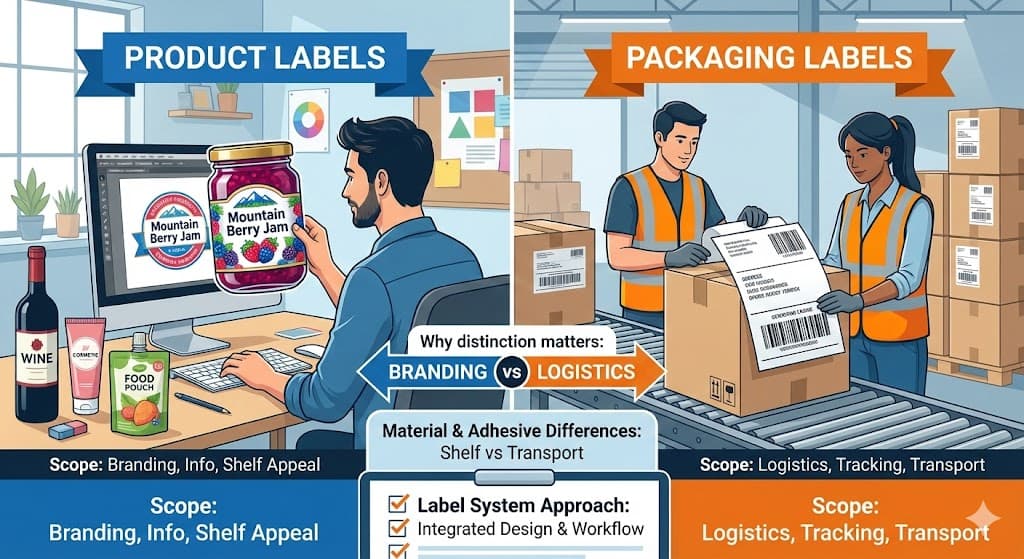
Product labeling refers explicitly to the identification attached to the immediate primary unit. This is the item the consumer touches, holds, and eventually uses. The primary function here revolves around brand communication, regulatory compliance, and consumer instruction. These labels provide essential information and are part of the product identity. Understanding product labels is key to an effective product presentation in label and packaging design.
In manufacturing terms, this label adheres to the primary packaging. Whether it is a glass bottle, a plastic tube, or a flexible pouch, the label serves as the interface between the brand and the buyer. It must carry static data such as the brand logo, product name, and net weight. Labels help consumers make informed choices by providing product information about new product features.
Regulatory adherence is a critical component of this scope. Depending on the industry, the product label must display nutritional facts, ingredient lists, or hazard warnings. For pharmaceuticals, this includes dosage instructions and active ingredients. Errors here lead to mandatory recalls rather than just shipping delays. Labels must meet strict labeling regulations to ensure safety and compliance.
Visual appeal drives the engineering of these labels. They utilize high-resolution graphics, foil stamping, or embossing to secure shelf presence. The material choice implies quality. A peeling or faded product label suggests a compromised product inside, damaging consumer trust permanently. Visually appealing labels are a cornerstone of label design strategies that influence purchase decisions.
This scope also includes tamper-evident features. Seals that bridge the cap and the container fall under product labeling because they secure the unit's integrity. They are designed interactions that occur only when the end-user creates the value exchange by opening the item. This type of label is essential for consumer safety and product information clarity.
Packaging labeling targets the secondary and tertiary layers of the supply chain. These labels adhere to cartons, master cases, and pallets. The primary audience for these labels is not the consumer but the logistics network. This includes warehouse scanners, automated sorters, and retail stockers. Packaging typically serves to protect a product while labeling is the process of identifying product packaging units.
The core objective shifts from persuasion to precision. These identification markers must convey routing information, batch numbers, and quantity counts. Clarity and machine-readability take precedence over aesthetics. High contrast black-and-white barcodes are the standard visual language here. Packaging materials and labeling and packaging systems must align to ensure regulatory compliance.
Variable data drives the content of packaging labels. Unlike the static artwork of a product label, shipping labels change with every unit or batch. They contain dynamic tracking numbers, GS1-128 shipping container codes, and specific destination addresses that generate at the moment of dispatch. Labels provide a critical tracking label for product containers across the supply chain.
Durability in this context relates to the supply chain environment. The label must withstand friction on conveyor belts, compression during stacking, and varying humidity levels in transit. If a packaging label fails, the inventory becomes invisible to the management system, resulting in lost stock. Labels indicate the amount of product within secondary packaging units.
Compliance here aligns with logistics standards rather than consumer protection laws. Adherence to carrier requirements, such as UPS, FedEx, or international shipping standards, is paramount. Failure to comply results in chargebacks, returned shipments, or significant delays at customs borders. Labeling requirements apply to all products sold to maintain labeling standards.
Distinguishing between these label types prevents resource misalignment. Product labels require high-cost substrates and expensive printing processes like digital or flexographic printing to achieve brand fidelity. Labeling is essential for purchase decisions as well-designed product labels influence the perceived standard of a product.
Conversely, applying low-grade thermal paper to a premium product devalues the brand. Packaging label materials usually prioritize variable data print speeds over longevity or texture. Placing a direct thermal logistics label on a product facing sunlight will cause the information to turn black and illegible. Labels are often the first point of contact for consumers.
Operational workflows differ significantly for each category. Product labels usually apply during the manufacturing or filling phase using high-speed rotary applicators. This process requires precise placement tolerance to ensure the artwork aligns perfectly with the container geometry for visual symmetry. Effective packaging and label design must consider product labeling and packaging as a unified design process.
Packaging labels apply further down the line, often at the "end of line" or palletizing station. The application speed is dictated by shipping volume rather than filling speed. Print-and-apply systems here must communicate in real-time with the ERP system to pull correct shipping data. Packaging vs labeling distinctions are essential for consumer safety and ensuring compliance.
Data architecture requirements also necessitate this separation. Product label data is largely static and managed by marketing and legal teams. Packaging label data is dynamic, managed by logistics and IT operations. Merging these streams without clear distinction leads to version control chaos. Informative labeling and product label compliance are now legal requirements in many product categories.
Inventory management strategies diverge as well. Companies often order product labels in bulk to reduce unit costs, storing them as inventory. Packaging labels, often blank canvas stock, are consumed on-demand. confusing these stock keeping units leads to production stoppages. Labeling mistakes can be costly during the labeling process for any custom labels.
Consider a luxury skincare serum. The glass bottle features a "prime label" made of a silver metalized film. It uses a permanent acrylic adhesive to ensure it never flags or peels, maintaining the premium look in a humid bathroom environment. This is the product label. Custom labels like paper labels often carry brand labels and a logo and product name.
That same bottle goes into a small unit carton, which is then packed into a corrugated master case containing 24 units. The label on this master case is a 4x6 inch white paper label. It features a scannable barcode and text stating "Fragile – Liquid." This is the packaging label. Descriptive labels provide essential product details for product labeling and packaging efficiency.
In the food industry, a jar of pasta sauce bears a high-gloss, multi-color paper label detailing the recipe and nutritional table. This label must withstand the heat of the filling process or the condensation of a cold storage environment. It sells the flavor. Food products and food labeling require correct labeling to convey information accurately.
The pallet holding 500 jars of sauce gets a tertiary label. This SSCC (Serial Shipping Container Code) label enables the receiving warehouse to scan one barcode and enter all 500 jars into their inventory. It has no marketing copy, only logistical data essential for cross-docking. Different types of product labels like grade labels indicate specific quality tiers.
In consumer electronics, the box containing a smartphone often serves dual purposes but distinct labeling remains. The back of the retail box has the product label with serial numbers and regulatory marks (FCC/CE). The outer brown shipper box used for delivery holds the carrier label with the address. Product labels explained help in understanding product labels and packaging vs shipping needs.
Garment retail showcases this distinction through tags. The hangtag with the price and brand story is the product label equivalent. The polybag holding the shirt usually has a simple sticker with a barcode and size application. This sticker is the packaging label, meant solely for inventory picking efficiency. Labels typically feature essential product details and important information.
Material selection for product labels prioritizes aesthetics and environmental resistance specific to the product's use. For squeezy tubes, polyethylene (PE) or polypropylene (PP) films are necessary. These substrates flex with the container, preventing the label from wrinkling or lifting during consumer use. Sustainable packaging and recycled packaging are becoming various labeling trends in package design.
Packaging labels typically utilize standard paper facestocks. Since corrugated boxes do not flex significantly, rigid paper is cost-effective and functional. The focus is on high contrast for barcode readability. Expensive films are rarely used unless the shipping environment is extreme, such as open-air chemical drums. Types of packaging determine the product’s packaging and labeling durability.
Adhesive chemistry varies drastically. Product labels often require "permanent" adhesives that build a bond over time, or conversely, "removable" adhesives for items like glassware where the consumer wants a clean peel. The adhesive must resist product contents, such as oils or harsh cleaners, if spilled. Labeling information is essential for consumer safety in product labeling and packaging.
Packaging label adhesives are formulated for "initial tack." They must grab the dusty, fibrous surface of recycled cardboard immediately. There is no need for clean removal; often, a tamper-evident tear is preferred to show if a shipping label was swapped during transit. Product labels must help convey information while labels help protect the brand.
Lamination and varnishes play different roles. Product labels receive UV varnishes or laminates to protect the ink from abrasion and handling oils. This keeps the branding pristine. Packaging labels rarely receive topcoats unless thermal transfer ribbons are used for chemical resistance. Labels provide essential product information and essential product details.
Direct thermal vs. thermal transfer printing highlights this divide. Packaging labels frequently use direct thermal technology (heat-sensitive paper) for short-lifecycle shipping labels. Product labels typically use thermal transfer (ribbon-based) or ink-based printing for long-term image stability against heat and light. Labels are cost-effective for promotional labels and informative labeling.
Implementing a successful labeling strategy requires a "systems approach" rather than viewing labels as isolated stickers. The software controlling product label artwork typically resides within Product Lifecycle Management (PLM) tools. This ensures that every revision of the ingredient list is tracked and approved. Labels to include essential product info are part of labeling standards for custom product labels.
Packaging label systems integrate directly with Warehouse Management Systems (WMS). When a packer scans a pick list, the printer should automatically generate the correct shipping label. This automation eliminates manual entry errors, which are a primary source of shipping disputes. Proper labeling helps labels serve their importance of product tracking role.
The hardware configuration on the floor must match the label type. Product labeling lines use applicators capable of millimeter-precision at high speeds. These machines often use vision systems to verify the label is present and straight before the unit moves to the boxer. Design options for a well-designed label help make a product stand out on the shelf.
Packaging labeling hardware focuses on versatility. Print-and-apply arms must adjust to boxes of varying heights or apply labels around corners (corner-wrap) for visibility from two sides. The tolerance for placement is looser, but the requirement for data verification is stricter. Product packaging design must align with the labeling process for effective packaging.
Data synchronization prevents the "orphan product" scenario. If the product label SKU does not map correctly to the packaging label barcode, retailers cannot receive the stock. EDI (Electronic Data Interchange) protocols rely on the perfect alignment of these two data sets. Differences between the two highlight why labeling is essential for product packaging design.
Sustainability initiatives are now merging these systems. Brands are looking for linerless label solutions for both product and packaging applications to reduce waste. However, the equipment modifications required for linerless application differ significantly between the high-speed product lines and the variable-speed packaging lines. Ensuring compliance is a legal requirement for ongoing compliance with various labeling requirements.
Separate your label stock definitions. Ensure your procurement team understands the difference between packaging and labeling materials for "marketing components" (product labels) and "MRO supplies" (packaging labels). Labels provide essential brand value. This prevents ordering the wrong stock for the wrong application.
Map out the compliance needs for each layer. Does the primary unit need multi-language text? Does the shipping case require specific hazmat diamonds or lithium battery warnings? Treat these as separate product labeling and packaging projects to ensure label compliance.
Conduct aging tests. Apply product labels to the actual container and subject them to hot/cold cycles. Apply packaging labels to your specific corrugated boxes and test for flagging after 24 hours. Cardboard dust is a notorious cause of label failure in package design.
Decide where variable data is printed. If you need lot codes on product labels, do you laser etch the bottle or overprint the label? For packaging, determine if direct thermal shelf life is sufficient or if thermal transfer is needed for durability in product packaging.
Test barcodes in the environment they will be scanned. A shiny product label might reflect laser scanners, causing read errors. A low-contrast packaging label might fail in dim warehouse lighting. Adjust quiet zones and contrast accordingly for effective product labels.
Consider the recycling stream. Does the product label wash off during PET recycling? Does the packaging label prevent the cardboard box from being pulped? Choose adhesives and face stocks that support your sustainability goals in label and packaging design.
Ensure the GTIN on the product maps to the correct quantity on the case label. Automate this link in your ERP to prevent human error during packing. A mismatch here causes chargebacks from major retailers, undermining the importance of product delivery. Label printing accuracy is paramount.