

Contact Sales Now
Thank you! Your submission has been received!
Oops! Something went wrong while submitting the form.

Contact Sales Now
Thank you! Your submission has been received!
Oops! Something went wrong while submitting the form.

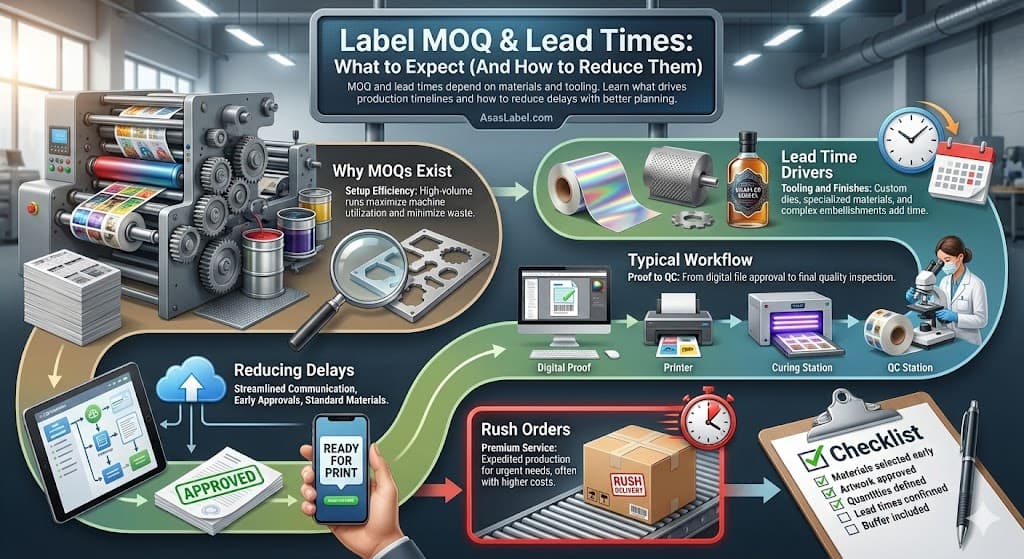
Procurement teams and supply chain managers often view Minimum Order Quantities (MOQ) and lead times as arbitrary hurdles. They are actually critical calculations derived from the operational realities of label manufacturing. Understanding the logic behind these figures allows for better negotiation and inventory planning.
Efficiency in narrow web converting relies on continuous movement. Stopping a press erodes profit margins explicitly. Manufacturers set MOQs to ensure that the revenue generated from a run covers the static costs incurred before the machine even starts printing.
Lead times are equally mathematical. They represent the cumulative duration of raw material acquisition, pre-press processing, physical production, and finishing. By dissecting these components, buyers can identify bottlenecks and optimize their ordering cadences for smoother fulfillment.
Minimum Order Quantities are primarily a function of fixed cost amortization. Every production run incurs baseline expenses regardless of whether operations produce five hundred labels or five million. These costs must be absorbed by the unit price to maintain financial viability for the converter.
In flexographic printing, these fixed costs are substantial. Producing photopolymer plates requires varying chemical or thermal processing times. Mounting these plates onto cylinders demands precision labor. Mixing specific PMS inks involves formulation and verification time.
If a converter runs a job below the calculated MOQ, they lose money on the setup. The machine usage time combined with labor costs outweighs the profit margin of the finished goods. The MOQ acts as a breakeven safeguard for the manufacturing facility.
Digital printing alters this equation but does not eliminate it. While digital presses negate the need for plates, they still require file processing, color calibration, and machine heating. There is also a minimum click charge associated with press maintenance that dictates the floor for order volume.
Material usage also dictates operational thresholds. Master rolls of substrate come in specific lengths and widths. Converters must utilize a significant percentage of this stock to justify breaking a master roll. High waste-to-output ratios on small runs force higher MOQs.
Inventory carrying costs play a secondary role. If a converter stocks a niche material for a specific client, they may enforce an MOQ that matches the material purchase order. This prevents the accumulation of dead stock in the warehouse that ties up capital.
Setup efficiency is the primary driver of unit economics. In label converting, "makeready" refers to the material consumed while aligning the press. Operators must register colors, adjust tension, and align die cuts before a single sellable label is produced.
During this calibration phase, hundreds or thousands of feet of material may become waste. This is standard matrix waste and setup scrap. If the total order is small, the ratio of waste to finished product ruins the efficiency rating of the job.
Operators aim to minimize changeover times between jobs. A changeover involves washing ink stations, swapping anilox rolls, and changing die stations. High MOQs encourage longer runs, which dilute the downtime associated with these heavy mechanical changes.
Batching similar jobs allows converters to lower effective MOQs. If multiple SKUs use the same die size and material, the setup cost is shared. This is common in "gang runs" where efficiency is gained by grouping orders, optimizing the makeready process across several clients.
Lead times act as a buffer against supply chain volatility and capacity constraints. They are rarely static figures. A stated lead time of ten business days accounts for the queue of jobs already scheduled on the manufacturing floor and the necessary transit of raw materials.
Capacity planning is a zero-sum game. A press can only run at a certain speed, typically measured in feet per minute. Once the production schedule is full for a week, any new order pushes the lead time out further, regardless of the complexity of the art.
Raw material availability is often the hidden variable. While converters stock house materials like semi-gloss paper or white BOPP, specialty substrates must be ordered from the mill. Mill lead times can fluctuate wildly based on global pulp availability or adhesive chemical shortages.
Secondary operations add significant time. If a label requires off-line finishing, such as specialized slitting or inspection, the product must move between departments. Each movement creates a queueing delay, adding days to the total production timeline.
Shipping logistics also factor into the "received by" date. Production lead time ends when the pallet leaves the dock. Transit time is additional. Buyers often conflate the two, leading to misalignment on delivery expectations and inventory stock-outs.
Custom tooling is a major bottleneck for initial orders. If a specified size or shape does not match an existing die in the converter's library, a new rotary die must be CNC machined. This fabrication process generally takes several business days before the die even arrives at the plant.
Hard tooling, such as solid rotary dies, offers longevity but requires longer fabrication times. Flexible dies are faster to produce but still require magnetic cylinders of the correct repeat size. If the cylinder is unavailable, the lead time extends significantly.
Embellishments introduce complexity. Hot foil stamping requires the manufacturing of a metal stamp. Embossing requires male and female die sets. Each of these tools must be manufactured by third-party specialists, adding uncontrollable variables to the timeline.
Varnishes and laminates usually have minimal impact unless they are specialized. However, spot varnishes require their own relief plates. This effectively adds another "color" station to the setup, increasing the prepress and registration time required on the floor.
Screen printing units, utilized for tactile high-build effects, require the burning of screens. This is a wet process involving drying times. Integrating rotary screen modules into a flexo press run slows down the maximum run speed, extending the hours needed on press.
Understanding the life of a label order effectively demystifies the timeline. The clock starts upon the final approval of the artwork and the receipt of a clean purchase order. Any ambiguity in these two documents pauses the manufacturing clock immediately.
Order entry teams first validate pricing and inventory. They allocate the required footage of raw material to the job. If the material is not on the floor, a requisition enters the purchasing system. This administrative phase can consume twenty-four hours.
Prepress engineers then take over. They analyze the digital art files for printability. This involves checking for bleed, safe zones, and color separations. They modify the files to account for the distortion that occurs when plates wrap around a cylinder.
The proofing cycle is the most common source of avoidable delay. The converter generates a PDF proof or a hardline color proof. The client must review this for content accuracy and color expectations. Production scheduling cannot proceed without this sign-off.
Once approved, the file moves to the plate-making department. Lasers ablate the image onto the photopolymer material. These plates are washed, dried, and inspected for defects. A microscopic flaw here results in a print defect, necessitating a remake.
The job is then staged. Inks are mixed to exact formulas. Anilox rolls are selected based on the required ink volume. The mounting department adheres the plates to the print cylinders using mounting tape, ensuring precise registration alignment using video cameras.
The press run executes the physical transformation. The operator monitors ink density and registration throughout the run. Automated vision systems often scan the web for defects, flagging issues in real-time to prevent the shipment of bad product.
Post-press operations constitute the final hurdle. Large master rolls from the press are moved to slitter-rewinders. Here, the matrix is stripped if not done inline, and the web is slit into individual lanes. Rolls are cut to the specific outer diameter or count requested.
Quality Control (QC) personnel perform a final audit. They check against the approved proof, verify barcode readability, and test adhesion properties. Only after QC sign-off is the product boxed, labeled, and prepared for logistics pickup.
Buyers can actively suppress lead times by standardizing their requirements. Choosing a "house material" ensures the substrate is always in stock. This eliminates the multi-day wait for material delivery from paper mills or film suppliers.
Utilizing existing die sizes is another powerful lever. Converters possess libraries containing thousands of dies. Designing a label to fit a 4x6 inch existing die, rather than a 4x6.125 inch custom size, saves hundreds of dollars and days of tooling lead time.
Forecasting is the ultimate efficiency tool. Sharing anticipated volume requirements for the quarter allows converters to pre-order material. In some cases, they may print anticipated stock during a lull in production, creating a "make-and-hold" arrangement for instant shipping.
Consolidating SKUs reduces changeover friction. If a brand orders four varieties of vanilla, chocolate, strawberry, and mint simultaneously, the converter can run them continuously. They only need to change the plates and inks, not the substrate or die, speeding up throughput.
Artwork organization is critical. Submitting native vector files with fonts outlined and pantones assigned prevents back-and-forth communication. Delays often stem from unusable raster images or undefined colors that force the prepress department to request unpredictable revisions.
Expediting production is possible but comes with operational consequences. To rush an order, a converter must break their existing schedule. This implies pulling a scheduled job off a press, cleaning the machine, and setting up the rush job.
This disruption causes a cascade of delays for other clients. Therefore, rush charges are not just punitive; they compensate for the overtime labor required to recover the lost schedule time. It forces the plant to run extended shifts or weekends.
Rush orders are highly contingent on material status. If the specific paper or film is not on the floor, no amount of money can overcome the physics of shipping raw stock from a supplier. Substitution of materials is often necessary to meet a hard deadline.
Digital printing is the preferred method for rush production. Because there are no physical plates to manufacture, the startup time is negligible. A digital press can theoretically begin printing minutes after the file passes pre-press inspection.
This speed makes digital ideal for gap-fill orders. If a brand is out of stock and waiting on a large flexo run, a small digital run can bridge the inventory gap. The unit cost is higher, but the speed to market creates value by preventing stock-outs.
However, finishing bottlenecks remain. Even digitally printed labels must be die-cut on a finishing line. If the die is not in stock, the digital advantage is nullified. Laser die-cutting systems can mitigate this but are slower than rotary dies.
Confirm the artwork is in vector format (AI, EPS, or PDF) with all fonts converted to outlines. This prevents rejection during the pre-flight stage.
Verify the exact Pantone (PMS) colors required. References to "make it look like the website" cause delays for color matching and physical proofing.
Define the rewind direction strictly. Applicator machines require labels to come off the roll in a specific orientation (e.g., copy out, right side first). Incorrect winding requires re-running the job.
Check the core size and outer diameter specifications. These are dictated by the co-packer's labeling equipment. Errors here result in unusable rolls that cannot be mounted on applicators.
Clarify any special adhesive requirements immediately. Application on frozen goods, textured surfaces, or tight diameters requires specific adhesive chemistries that may have longer lead times.
Group orders to meet MOQs. If individual SKUs fall below the threshold, combine them into a single purchase order to reach the aggregate footage required for a production run.
Approve proofs immediately upon receipt. The production clock is paused until that email approval is received. Delays in checking your email translate directly to delays in receiving your product.