
Contact Sales Now
Thank you! Your submission has been received!
Oops! Something went wrong while submitting the form.

Contact Sales Now
Thank you! Your submission has been received!
Oops! Something went wrong while submitting the form.

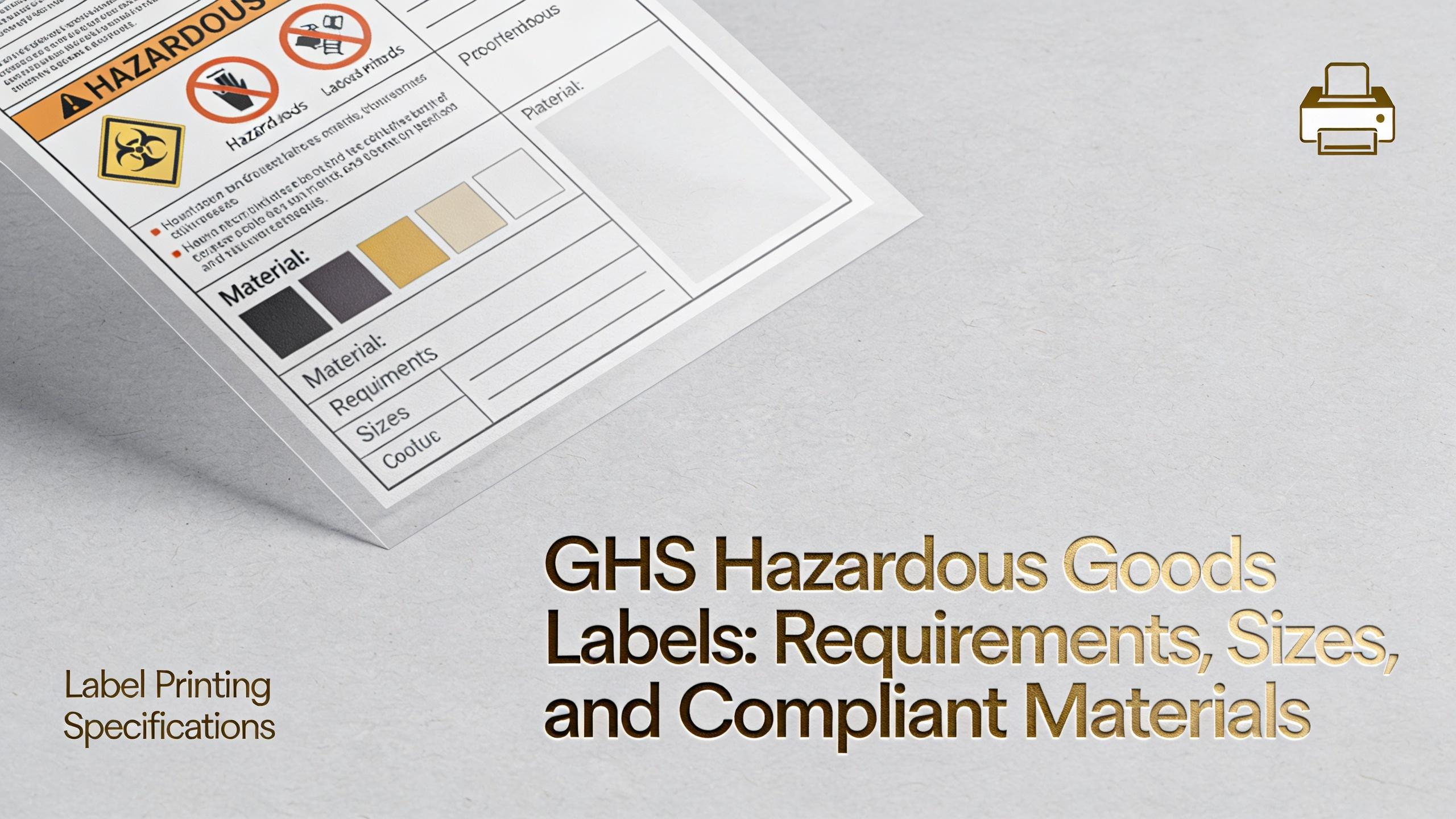
Chemical manufacturers, distributors, and packagers operate under strict labeling rules that govern every drum, tote, and bottle leaving the facility. Getting GHS labels wrong triggers fines, shipment rejections, and supply chain delays. This guide breaks down the technical specifications you need to meet.
The Globally Harmonized System standardizes chemical hazard communication across borders. Adopted by OSHA under HazCom 2012 and aligned with EU CLP Regulation, GHS replaces fragmented national systems with unified pictograms, classifications, and label formats.
Non-compliant ghs labels expose shippers to penalties from OSHA, DOT, and international port authorities. Fines reach $15,000 per violation in the United States, with shipment seizures common at EU and UK ports of entry.
Beyond regulatory pressure, accurate hazardous goods labels protect workers handling drums, IBCs, and bulk containers. Misclassified chemicals cause exposure incidents, fires, and groundwater contamination that destroy brand reputation overnight.
Every GHS-compliant label must display six core components in a specific arrangement. Missing any element renders the label non-compliant regardless of print quality or durability.
Pictograms must measure at least one-fifteenth of the minimum label dimension. The red border requires sufficient width to be clearly visible—hairline borders fail inspection in most jurisdictions.
Signal words appear in bold uppercase. Only one signal word per label is permitted, even when multiple hazard classes apply. Danger overrides Warning when both would otherwise be required.
GHS specifies minimum label dimensions tied directly to package capacity. Undersized labels fail compliance even when all required elements appear correctly.
Chemical drum labels for 55-gallon (208 L) containers must meet the 105 x 148 mm minimum. Most manufacturers exceed this baseline to accommodate multilingual content required for international shipments.
Pictogram dimensions scale proportionally. On a standard drum label, each pictogram should measure no smaller than 25 x 25 mm to satisfy the one-fifteenth rule with margin for inspection tolerance.
BS5609 is the British Standard certification required for chemical labels on packages shipped by sea. The IMDG Code references BS5609 as the benchmark for marine-grade label performance.
The standard tests two performance areas. Section 2 evaluates the substrate and adhesive after three months of seawater immersion. Section 3 tests the printed image for abrasion, UV exposure, and chemical resistance.
BS5609 labels must remain legible and adhered after the full test protocol. Only the combination of certified substrate, adhesive, ink, and printer qualifies—swapping any component voids certification.
Verify your printer holds current Section 3 certification for the specific ink and printer model used on your job. Substrate-only certification is insufficient for compliant marine shipments.
Substrate selection determines whether labels survive transit, storage, and end-use exposure. Paper-based labels fail almost immediately on chemical containers.
Polyester (PET) delivers the highest performance for bs5609 labels. White topcoated PET resists solvents, acids, and prolonged UV exposure. Standard thickness ranges from 50 to 75 microns for drum applications.
BOPP (biaxially oriented polypropylene) offers a cost-effective alternative for indoor and short-duration outdoor use. BOPP handles water and mild chemicals but degrades faster than polyester under aggressive solvents.
Vinyl films conform to curved surfaces like small bottles and irregular containers. Cast vinyl outperforms calendared vinyl for long-term applications and resists shrinkage on plastic drums.
Specialty films include destructible vinyl for tamper evidence and metallized polyester for premium chemical product lines. Match the film to the specific exposure profile of your application.
The adhesive carries equal weight to the substrate. A premium polyester face stock paired with the wrong adhesive will lift, curl, or detach within weeks.
Surface energy matters. Polyethylene and polypropylene containers have low surface energy that defeats general-purpose adhesives. Specify the container resin when ordering labels to ensure proper adhesive matching.
Allow 24 to 72 hours for full adhesive cure before exposing labeled containers to harsh conditions. Premature stress on uncured adhesive is the leading cause of field label failure.
Selecting a printer for ghs label requirements goes beyond price comparisons. Audit potential suppliers against these criteria before placing your first order.
Custom printers with chemical industry experience anticipate compliance issues. They flag undersized pictograms, suggest substrate upgrades for aggressive chemicals, and verify H-code and P-code combinations against GHS classification tables.
Lead times for certified ghs labels typically run 5 to 10 business days for standard orders. Build buffer time into procurement schedules, especially for bs5609 labels requiring specialty stock.
Document storage and reorder workflows reduce friction. Established printers maintain artwork files, production specs, and certification records, allowing rapid reorders without re-proofing.
Are GHS labels and HazCom labels the same thing?
Yes. OSHA's HazCom 2012 standard adopted GHS labeling requirements, making the terms functionally identical in the United States workplace context.
Do all chemical drum labels need BS5609 certification?
No. BS5609 is required only for packages transported by sea. Domestic ground shipments and air freight do not require BS5609, though many shippers standardize on it for flexibility.
Can I print GHS labels in-house on a standard color laser printer?
No. Toner-based laser output lacks the chemical and UV resistance required for compliant hazardous goods labels. Use thermal transfer or industrial inkjet on certified substrates.
Does the red pictogram border need to be a specific shade of red?
Yes. GHS specifies a red border that is clearly visible. Most printers match Pantone 485 C or equivalent CMYK builds to ensure consistency and inspection acceptance.
How many languages must appear on a GHS label?
This depends on destination. EU shipments require labels in the official language(s) of each member state where the product is sold. Multilingual labels increase size requirements proportionally.
Can secondary containers in the workplace use simplified labels?
Yes. OSHA permits workplace labels on secondary containers that include the product identifier plus words, pictures, or symbols providing general hazard information, provided the original container retains full GHS labeling.
What's the difference between hazard statements and precautionary statements?
Hazard statements (H-codes) describe the nature of the hazard. Precautionary statements (P-codes) describe recommended measures to prevent or respond to exposure. Both are required on compliant labels.
How long do BS5609-certified labels last in outdoor storage?
Properly specified polyester labels with marine-grade adhesive last 2 to 5 years in outdoor exposure, depending on UV intensity and chemical contact frequency. Verify warranty terms with your supplier.