
Contact Sales Now
Thank you! Your submission has been received!
Oops! Something went wrong while submitting the form.

Contact Sales Now
Thank you! Your submission has been received!
Oops! Something went wrong while submitting the form.

Choosing between die-cut and kiss-cut stickers affects unboxing experience, application speed, and unit cost. Both use precision cutting dies, but the depth of the cut changes everything about how the sticker looks, peels, and performs in the field.
This guide breaks down the technical differences, real production scenarios, and pricing logic so you can order with confidence. If you already know sticker basics, this will move fast.
A die-cut sticker is cut all the way through both the vinyl face and the paper backing. The result is a single sticker shaped exactly like the artwork, with matching contours on the liner underneath.
A kiss-cut sticker is cut only through the top vinyl layer, leaving the paper backing intact. The excess vinyl (the "matrix") stays around the design, and the backing forms a larger rectangular or custom border.
Both processes use the same cutting equipment — either steel-rule dies, rotary dies, or digital blade plotters. The only variable is blade depth and pressure calibration.
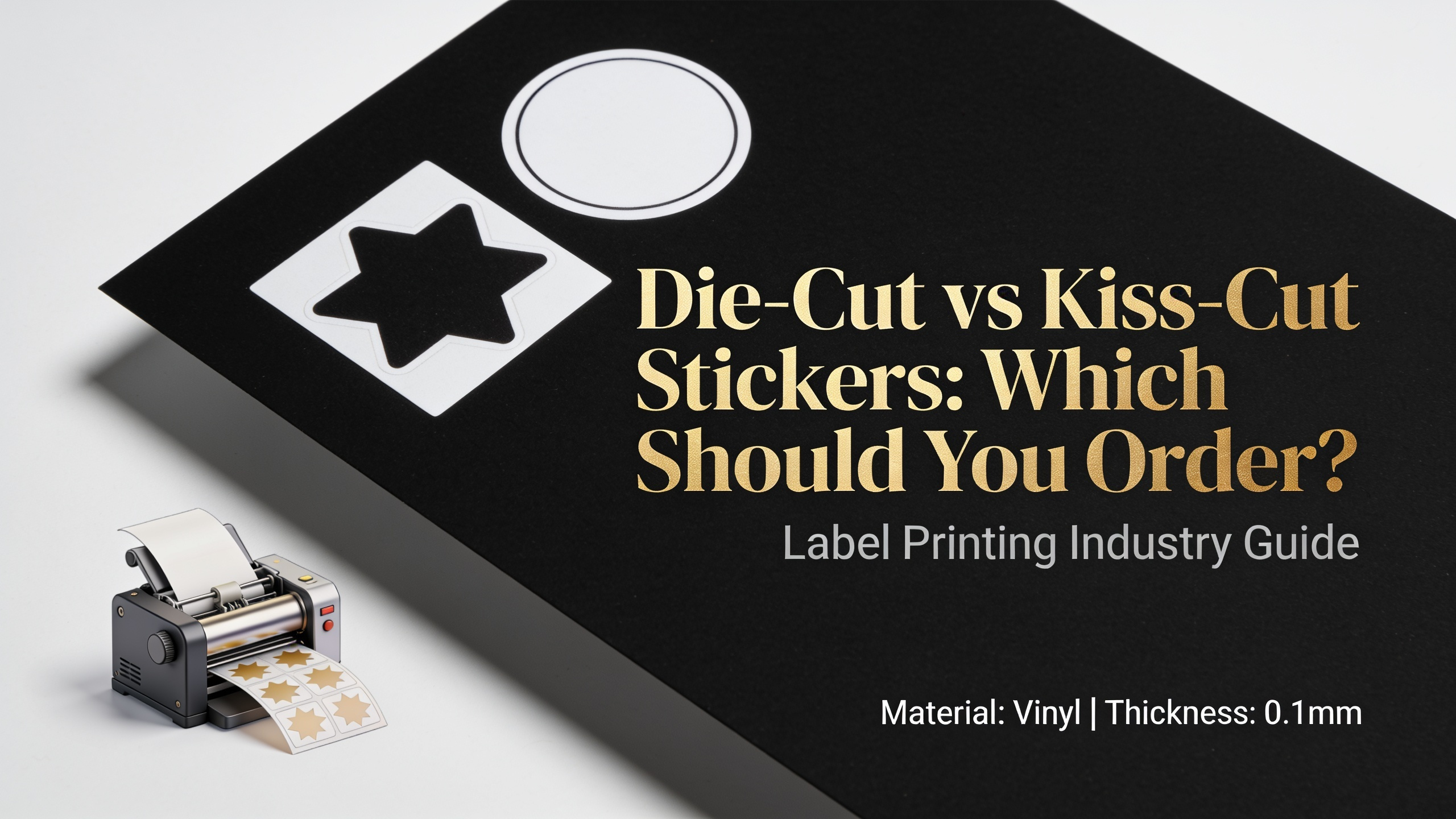
Picture a star-shaped logo. In a die-cut version, you hold a star. The backing is star-shaped. The vinyl is star-shaped. Nothing extra exists around the design.
In a kiss-cut version, you hold a rectangle (or any shape larger than the star). The star is scored into the vinyl, but the surrounding vinyl remains attached to the liner until you peel the star out.
Key visual markers to identify each type:
So what is the difference between die cut and kiss cut visually? Die-cut removes the negative space entirely. Kiss-cut keeps it as a border you can print on, brand, or trim later.
Die-cut stickers are the standard for single-piece promotional handouts, laptop stickers, product labels, and bumper stickers. Each unit stands alone. The clean silhouette signals premium quality and is ideal for retail packaging or influencer kits.
Kiss-cut stickers dominate when you need multiple designs delivered together. Sticker packs, brand collateral, planner accessories, and character sets all use kiss-cut sheets because you can peel individual pieces from a shared backing.
Common kiss-cut applications:
Common die-cut applications:
When comparing what is kiss cut vs die cut in terms of purpose, think one-piece premium versus multi-piece practical.
Peel behavior is where the die cut vs kiss cut decision matters most for end users. Die-cut stickers require lifting a corner of the entire sticker and backing separately. The user must find the edge where vinyl meets liner.
Kiss-cut stickers peel differently. The user pushes or flexes the backing, and the pre-cut sticker lifts cleanly while the surrounding vinyl matrix stays behind. This makes kiss-cut faster to apply, especially for small or intricate shapes.
Small die-cut stickers under one inch can be frustrating to peel because the edges are hard to grip. Kiss-cut solves this problem entirely — the oversized backing gives your fingers something to hold.
Peel performance factors to consider:
Die-cut stickers typically cost more per unit at low volumes. The cutting process is more precise, waste is higher (the matrix is discarded), and packaging individual pieces adds handling time.
Kiss-cut stickers reduce material waste and streamline production. A single sheet holding six designs uses one liner instead of six, cutting substrate costs significantly. Fulfillment is also faster — one sheet ships in place of multiple singles.
Cost variables to weigh before ordering:
For bulk promotional runs, die-cut wins on perceived value. For sticker packs and multi-design orders, kiss-cut wins on production economics.
Match the format to your customer's expectations. A skateboard brand selling one hero logo should die-cut. A stationery brand selling twelve seasonal icons should kiss-cut them on a single sheet.
Retail shelf presence also matters. Kiss-cut sheets display well in flat packaging and hang tabs. Die-cut singles work better in bowls, jars, or as bagged giveaways at events.
Ask three questions before finalizing your order:
Both die-cut and kiss-cut work with standard sticker substrates — white vinyl, clear vinyl, holographic, glitter, matte, and gloss. Neither format restricts your material palette.
Lamination behaves slightly differently. On die-cut stickers, laminate is trimmed with the sticker outline. On kiss-cut stickers, laminate covers the entire sheet including the vinyl border, protecting the unpicked pieces during storage.
Weatherproofing and UV resistance depend on ink and laminate specs, not on cut type. A die-cut and a kiss-cut sticker made from the same vinyl will perform identically outdoors.
Are kiss-cut stickers cheaper than die-cut?
Usually yes, especially for multi-design orders. Kiss-cut consolidates production onto fewer liners and reduces waste. For single-design bulk runs, the price gap narrows significantly.
Can I use kiss-cut for outdoor stickers?
Yes. Once peeled and applied, a kiss-cut sticker performs exactly like a die-cut sticker. Outdoor durability depends on the vinyl and laminate, not the cutting method.
Do die-cut stickers look more premium?
Yes, generally. The contoured backing and lack of excess vinyl signal higher production value, which is why most retail-facing brands prefer die-cut for single-hero designs.
Which format is better for small stickers?
Kiss-cut is better for stickers under 1.5 inches. The oversized backing makes tiny designs easier to grip and peel without damaging edges.
Can I mix die-cut and kiss-cut in one order?
Yes, most manufacturers including asaslabel.com allow mixed-format orders. This is common for brands that want a hero die-cut plus a supporting kiss-cut sheet.
Is what is the difference between die cut and kiss cut only about the backing?
No. The difference includes cut depth, waste, peel behavior, unit cost, and end-use scenarios. The backing is just the most visible signal of the underlying process difference.
Do sticker sheets always use kiss-cut?
Yes. Sticker sheets by definition require multiple designs on a shared backing, which is only possible with kiss-cutting. Die-cut sheets would separate into individual pieces immediately.
How do I decide between die cut vs kiss cut for my brand launch?
Look at your product mix. Single logo or icon means die-cut. Multi-design collection or themed pack means kiss-cut. If you sell both, order both — the tooling and setup work independently.