On this page
- Cosmetic Labeling Requirements
- Distinguishing Regulatory Necessities from Design
- Ensuring Consumer Transparency and Safety
- Mandatory Elements of the Packaging
- Constructing the Ingredient Listing
- Net Quantity and Traceability
- Identifying the Responsible Party
- Pictograms and Symbols
- Period After Opening Implementation
- Requirements for Warning Statements
- High Risk Errors to Avoid
- Final Compliance Verification Checklist
Cosmetic Labeling Requirements
Distinguishing Regulatory Necessities from Design
Navigating the landscape of cosmetic labeling requires a distinct shift in mindset from marketing to compliance. While brand aesthetics drive formulation and packaging design, regulatory frameworks dictate the architecture of the label itself. Manufacturers must understand strict liability regarding misbranding and adulteration before a product hits the shelf.
The primary objective of label regulations is to prevent consumer deception and ensure product safety. In the United States, the FDA does not pre-approve label designs. The onus falls entirely on the brand owner to adhere to the Federal Food, Drug, and Cosmetic Act (FD&C Act) and the Fair Packaging and Labeling Act (FPLA).
Failure to distinguish between artistic variance and legal mandates can result in costly recalls. A label is not merely a branding vehicle but a legal document that communicates specific data points. Domain-specific accuracy is required for every claim, weight declaration, and identifying mark printed on the container.
Ensuring Consumer Transparency and Safety
The convergence of safety data and consumer information forms the backbone of label compliance. This section of the packaging serves as the primary interface between chemical formulation and end-user application. You must disclose potential risks associated with the use of the cosmetic product clearly and prominently.
Transparency goes beyond listing chemicals. It involves clearly stating the intended function of the product without overstepping into drug claims. If a cosmetic product affects the structure or function of the body, it is classified as a drug. This triggers a separate, more rigorous set of labeling requirements.
Safety information also encompasses durability and shelf life. Consumers need immediate visual cues regarding when a product is no longer safe to use. This prevents adverse reactions caused by bacterial growth or chemical degradation in expired formulas. Accuracy here acts as a liability shield for the manufacturer.
Mandatory Elements of the Packaging
The physical layout of a cosmetic package is divided into specific regulatory zones. The Principal Display Panel (PDP) and the Information Panel trigger different requirements. You cannot place mandatory information arbitrarily; it must be located where consumers are most likely to see it under customary conditions of purchase.
The PDP is the part of the label most likely to be displayed to the customer at the retail shelf. It must contain the statement of identity and the net quantity of contents. The statement of identity must be in bold type and reasonably related to the product's formulation, such as "Moisturizing Lotion" or "Facial Cleanser."
Secondary packaging, such as an outer box, must also carry specific information. If the inner container is housed in a box, the outer packaging becomes the primary source of regulatory data. Discrepancies between the inner container and outer packaging constitute a compliance violation and render the product misbranded.
Constructing the Ingredient Listing
The declaration of ingredients is perhaps the most scrutinized aspect of cosmetic label compliance. You must list ingredients in descending order of predominance by weight. This provides a clear hierarchy of the formulation's composition. Ingredients present at a concentration of one percent or less may be listed in any order after those present at concentrations of more than one percent.
Industry standards mandate the use of International Nomenclature of Cosmetic Ingredients (INCI) names. Common chemical names or trade names are not acceptable substitutes. Using INCI ensures uniformity across global markets and allows consumers to identify allergens or sensitizers regardless of the brand origin.
Color additives require specific handling within the ingredient list. They can be listed at the very end of the declaration regardless of the amount present. In the case of color cosmetics like eyeshadows or lipsticks marketed in a range of shades, you may use a "may contain" statement to encompass all colors used in the product line.
Detailed attention must be paid to "trade secret" ingredients. You cannot simply omit an ingredient to protect a formula. The FDA has a formal petition process for granting trade secret status. Unless the FDA grants this specific approval, every component must be declared on the label to avoid misbranding charges.
Botanicals must be listed by their proper INCI names, which usually involves the Genus and species followed by the plant part and the type of preparation. For example, generic "Aloe Vera" is insufficient; it must be listed as "Aloe Barbadensis Leaf Juice" or the relevant derivative. Precision prevents ambiguity regarding the raw material source.
Net Quantity and Traceability
The net quantity of contents declaration facilitates value comparison for the consumer. This declaration must appear within the bottom 30 percent of the Principal Display Panel. It must be distinct, separated from other printed information, and printed in a font size dictated by the surface area of the panel.
You must express the net quantity in both freedom units (avoirdupois ounces) and metric units (grams or milliliters). This dual declaration ensures compliance with the Fair Packaging and Labeling Act. For semi-solids like creams or gels, weight is the standard measure, whereas liquids require fluid measure.
Batch codes and lot numbers are critical for post-market surveillance and traceability. While not always explicitly mandated on the PDP, they are essential for Good Manufacturing Practices (GMP). A legible batch code allows for the rapid identification of specific production runs in the event of a contamination issue or recall.
This alphanumeric code serves as the link between the finished good and the manufacturing records. It should be printed indelibly on the immediate container and the outer packaging. Without this traceability, a safety issue could necessitate recalling an entire brand's inventory rather than a single compromised production run.
Identifying the Responsible Party
Every cosmetic label must identify the entity responsible for placing the product on the market. This includes the name and business address of the manufacturer, packer, or distributor. If the address listed is not the manufacturer, the label must use a qualifying phrase such as "Manufactured for" or "Distributed by."
The address must be complete and current. It typically includes the street address, city, state, and zip code. However, if the firm is listed in a current city directory or telephone directory, the street address may be omitted, though including it is best practice for clarity.
For imported products, the country of origin must be clearly stated in English. This is a requirement enforced by US Customs and Border Protection as well as the FDA. The country of origin declaration must be conspicuous and placed in close proximity to the manufacturer's location information.
Pictograms and Symbols
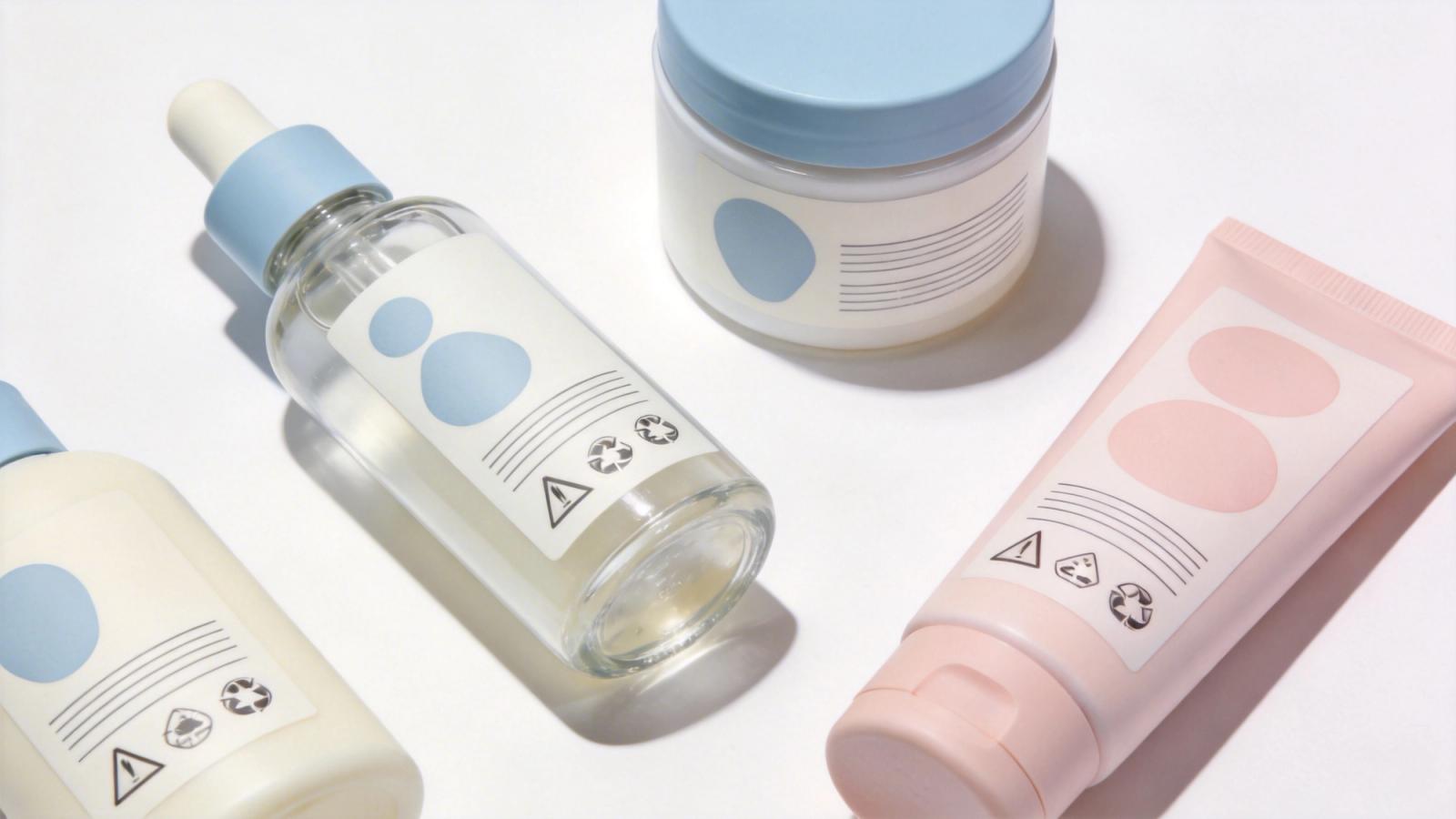
Modern cosmetic labeling relies heavily on standardized symbols to convey information efficiently across language barriers. These pictograms save valuable label space while communicating critical usage and safety data. Recognizing and correctly applying these symbols is a key component of global visual compliance.
You should prioritize vector quality when printing these symbols to ensure legibility. Blurry or undersized icons fail to meet the "conspicuous" requirement of regulatory statutes. The symbols must be large enough to be easily recognized by the consumer without magnification.
Period After Opening Implementation
The Period After Opening (PAO) symbol is essential for products with a shelf life of more than 30 months. It typically depicts an open jar with a number and the letter "M" either inside or next to it. This indicates the number of months the product remains safe for use after the packaging seal is broken.
This symbol addresses the degradation of preservatives and the potential for microbial contamination once the product is exposed to air and skin contact. It differs entirely from a standard expiration date, which applies to the product's stability in an unopened state.
Determining the correct PAO value requires stability testing and challenge testing. You cannot arbitrarily assign a timeframe. The data must support the claim that the preservative system remains effective for the duration indicated on the icon.
Requirements for Warning Statements
Certain cosmetic categories carry inherent risks that necessitate explicit warning statements. These warnings must be prominent and conspicuous, likely to be read and understood by the ordinary individual under customary conditions of purchase and use. Failure to include required warnings automatically renders the product misbranded.
Aerosol cosmetics require specific flammability warnings and instructions on safe storage. The label must warn against spraying near eyes or on broken skin. Pressurized containers also require warnings regarding puncture risks and exposure to heat, detailing specific temperature thresholds to avoid explosion.
Tanning products that do not contain sunscreen require a very specific block of text. This warning must state that the product does not protect against sunburn. It must explain that repeated exposure of unprotected skin while tanning may increase the risk of skin aging and cancer.
Products containing alpha hydroxy acids (AHAs) also trigger specific labeling protocols. Because these ingredients increase sunlight sensitivity, the label must advise consumers to use sunscreen and limit sun exposure. This "Sunburn Alert" is a crucial mitigation strategy for products intended for exfoliation.
If the safety of a cosmetic product has not been adequately substantiated through testing, the label must bear a specific warning: "Warning: The safety of this product has not been determined." This protects the consumer and alerts them that the formulation lacks standard toxicological verification.
High Risk Errors to Avoid
The most frequent compliance pitfall is the inadvertent creation of drug claims. Using language that suggests a physiological change or therapeutic effect pushes a product out of the cosmetic category and into the drug category. Words like "restores," "stimulates," or "repairs" often trigger this reclassification.
A cosmetic cleanses, beautifies, promotes attractiveness, or alters appearance. A drug treats, cures, mitigates, or prevents disease, or affects the structure and function of the body. Claims of "treating acne" or "regenerating cells" are drug claims. Such errors lead to FDA warning letters and potential import detentions.
Another common mistake involves font size and contrast. Mandatory information must be in a type size sufficient to be read easily. If the background pattern obscures the text, or if the font height falls below statutory minimums based on container size, the label is non-compliant.
Incorrect ingredient nomenclature remains a persistent issue. Brands often try to make chemical names sound more "natural" or marketing-friendly. However, regulations require the standardized INCI name. Inventing names for proprietary blends without listing the actual components is a violation of declaration rules.
Final Compliance Verification Checklist
Before finalizing any print run, a systematic audit of the artwork is mandatory. Relying on graphic designers who may not be versed in regulatory affairs is risky. A granular review process ensures that every pixel serves a legal purpose.
Verify that the Principal Display Panel occupies the correct surface area of the package. Ensure the Statement of Identity is in bold and parallel to the base of the package. Confirm that the Net Quantity of Contents is in the bottom 30 percent of the PDP and uses both metric and imperial units.
Check the Information Panel for the "Distributed by" statement. Ensure the address is complete and accurate. Verify that the ingredient list uses correct INCI nomenclature and follows the descending order of predominance. Confirm that color additives and "features" ingredients are placed correctly.
Scan the text for potential drug claims. Remove any language that implies therapeutic or medical benefits. Ensure all necessary warning statements regarding flammability, sun sensitivity, or specific usage hazards are present and legible.
Finally, review the legibility and contrast of all text. Ensure that the font size meets the minimum height requirements for the size of the container. Confirm that the background design does not interfere with the readability of required information. This final pass prevents costly re-labeling efforts.