On this page
- Product Label Compliance Basics
- Start With Two Questions: What Is It, and Where Is It Sold?
- What Almost Every Label Must Carry
- Category Rules Stack on Top
- Food and Beverages
- Cosmetics and Personal Care
- Dietary Supplements
- Household and Industrial Chemicals
- Pharmaceuticals
- Legibility Is Part of Compliance
- The Label Has to Last as Long as the Product
- Common Compliance Mistakes
- Pre-Press Compliance Checklist
- Where Your Printer Fits In
Product Label Compliance Basics
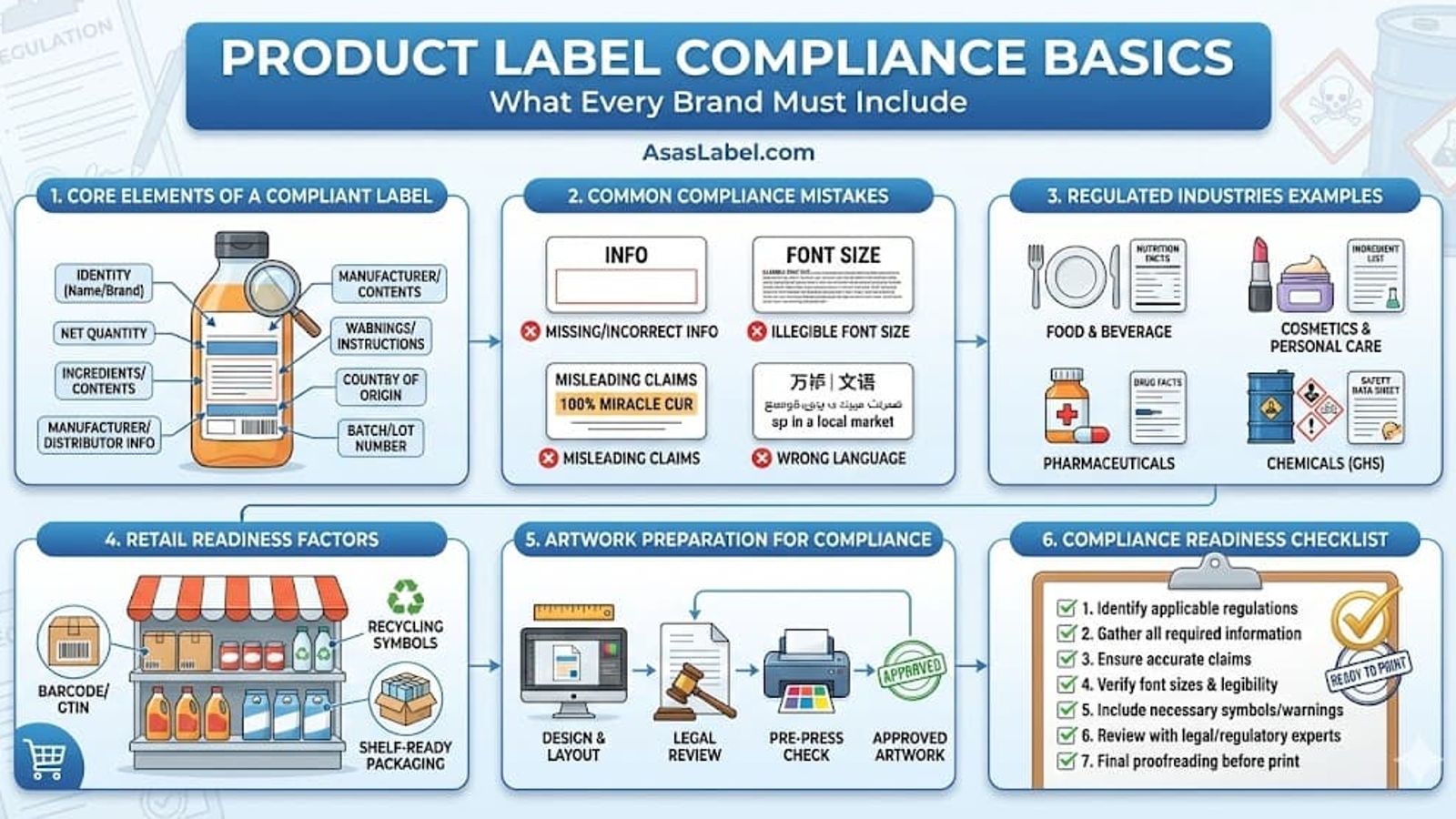
A product label does two jobs at once. It sells, and it declares. The selling half is judged by shoppers; the declaring half is judged by regulators, retailers, and customs officers, and it is the half that stops a shipment when it goes wrong. A label can look perfect and still be non-compliant because one mandatory field is missing, too small, or in the wrong language.
This guide covers the compliance baseline that applies across product categories: how to work out which rules apply, the information almost every label must carry, how category rules add to it, and a checklist to run before artwork goes to print. For checking the printed labels themselves once they come off the press, see the label quality control checklist.
Start With Two Questions: What Is It, and Where Is It Sold?
The rules a label must follow depend on two things: the product category and the market where it is sold. Food, cosmetics, dietary supplements, household and industrial chemicals, and medicines each have their own regulations, and a label written for one category rarely satisfies another.
The market decides which version of those rules applies. Compliance follows the point of sale, not the factory: a product made in the UAE and exported to Europe must meet European labelling rules, and an imported product sold in the UAE must meet GCC requirements. In the GCC that usually means standards issued by the GCC Standardization Organization (GSO), adopted and enforced by each member state, with Arabic required on the label.
When one design serves several markets, work to the strictest requirement in each category, then check every market on its own. Standards are revised over time, so confirm you are working from the current edition, and record the requirement in a label spec sheet so the next reprint does not rely on memory.
What Almost Every Label Must Carry
Exact wording, placement, and format vary by category and market, but the same core information appears on nearly every regulated label. Use this as the field list to fill in before layout begins:
- Product identity — a clear name that tells the buyer what the product is, not only the brand name.
- Net quantity — weight, volume, or count, in metric units and in the position the market requires.
- Responsible party — the name and address of the manufacturer, packer, importer, or distributor. Many markets also require the local importer.
- Country of origin — where the product was made, which is not always where it was packed.
- Batch or lot code — the link back to a specific production run, which makes a targeted recall possible.
- Dates — production, expiry, or best-before, where the category requires them and in the format the market prescribes.
- Directions and warnings — how to use, store, and dispose of the product safely.
- The required language — in the UAE and the wider GCC, that means Arabic, with other languages allowed alongside it.
Retail barcodes are a special case. Retailers and distributors require them, and they must scan reliably, but for most consumer products they are a commercial requirement rather than a legal one. Medicines are the main exception: many markets now mandate serialised 2D DataMatrix codes on medicine packs for traceability. For barcode formats and print specifications, see what a UPC label is.
Category Rules Stack on Top
The core fields are the foundation. Each category then adds its own requirements, and these are where most rejections happen.
Food and Beverages
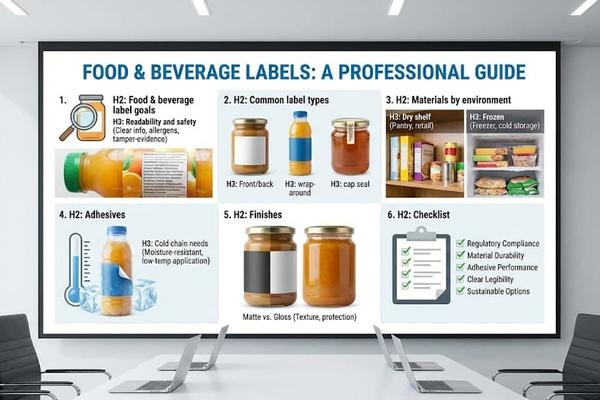
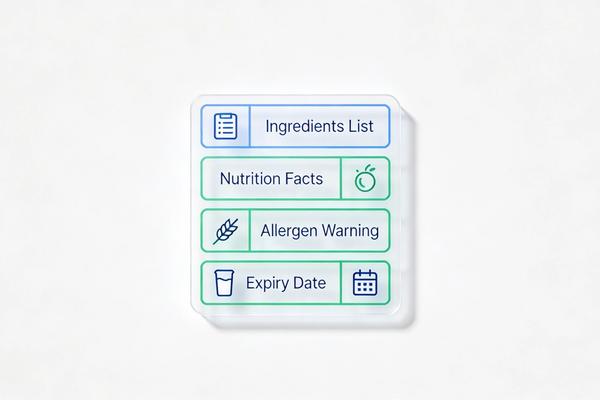
Food labels carry the most mandatory information: ingredients in descending order of weight, allergen declarations, nutrition information, and date marking. In the GCC, GSO 9 governs the labelling of prepackaged food and GSO 2233 covers nutrition labelling. Our food label compliance basics covers the essentials, and the UAE and GCC food labelling guide covers import and export detail.
Cosmetics and Personal Care
Cosmetic labels list every ingredient using INCI names, the international naming system for cosmetic ingredients, rather than trade or common names. They also carry a shelf-life mark: an expiry date or a period-after-opening symbol, depending on the product and the market, plus any precautions for use. See cosmetic labeling requirements for the full list.
Dietary Supplements
Supplement labels sit between food and medicine. They need a clear statement of the ingredients and amounts per serving, directions for use, and warnings, and what the label may claim about health is tightly restricted. Our guide to supplement labels covers the practical detail, including tamper evidence.
Household and Industrial Chemicals
Hazardous chemicals follow the Globally Harmonized System (GHS). A GHS label carries six elements: a product identifier, supplier identification, a signal word, hazard statements, precautionary statements, and hazard pictograms. For how each element works, see GHS labels explained.
Pharmaceuticals
Medicines carry the strictest requirements of all: bilingual Arabic and English text in the GCC, batch numbers and dates on every pack, serialisation for traceability, and tamper-evident features. Our pharmaceutical labels guide explains what regulators expect.
Legibility Is Part of Compliance
Mandatory information only counts if a person can read it. Several regulations set minimum type sizes; European food rules, for example, require an x-height of at least 1.2 mm for mandatory information, or 0.9 mm on very small packs. Even where no size is specified, regulators expect required text to be clearly legible and not hidden.
In practice, legibility is lost in a few predictable ways: text set too small or too light, low contrast against the background, small white text reversed out of a dark colour where ink can fill the letters, and mandatory text placed across a seam, a fold, or a tight curve. Our guide to label typography covers type choices that stay readable in print.
Bilingual labels need their space planned from the start. Arabic reads right to left and often takes a different amount of space than the English, so give both languages room in the layout rather than squeezing one in at the end.
The Label Has to Last as Long as the Product
A label that is compliant on the day it is applied can stop being compliant in use. If moisture, oil, abrasion, cold storage, or sunlight make the ingredients, warnings, or dates unreadable, the information has effectively gone.
Match the label material, adhesive, and finish to the conditions the product will face, from a shower shelf to a freezer or a chemical store. For how chemicals and handling break labels down, see chemical exposure and label degradation.
Common Compliance Mistakes
- Reusing a label for a new market without checking that market’s own requirements.
- Missing the local importer or distributor details that the destination market requires.
- Quantities in the wrong units, or a net quantity statement that is too small or in the wrong place.
- Allergens that are not identified in the way the market requires.
- Ambiguous dates, such as an all-numeric date that can be read two ways.
- Claims without proof, such as organic, halal, or health claims made without the certification or evidence behind them.
- Mandatory text placed where it cannot be read, whether too small, too low in contrast, or across a seam or curve.
- Printing an outdated file after the formula, supplier, or regulation has changed.
Pre-Press Compliance Checklist
Before artwork is approved for printing, check each item against the requirements for your category and every destination market:
- Confirm the product category and every market the label will be sold in.
- Check that each mandatory field is present, complete, and correct.
- Check the ingredients or composition against the current formula.
- Confirm net quantity, units, and position against the market’s rules.
- Check that the date and batch areas have space for coding, and that the date format is unambiguous.
- Review every language version, with Arabic checked by a fluent reader.
- Confirm that every claim on the label is backed by certification or evidence.
- Check type sizes, contrast, and placement for legibility.
- Confirm the barcode number and its position on the container.
- Get sign-off from whoever is responsible for regulatory approval before you approve the proof.
Where Your Printer Fits In
Responsibility for what the label says sits with the brand owner and, for imported goods, the importer. The printer’s job is to make sure that information comes out legible, in the right place, and on a material that lasts. Checking content and checking print quality are separate steps, and both need to happen.
Before printing, we send a proof for your approval, and we can advise on materials and finishes that keep mandatory information readable for the life of the product. To start a project, request a quote.