On this page
- Food Label Compliance Basics
- Which Rulebook Applies to Your Market
- The Mandatory Fields, in One Place
- Ingredients and Allergens
- The Nutrition Panel
- Net Content, Dates, and Lot Codes
- Layout and Readability Rules That Bite
- Type Size and Legibility
- How Finish and Substrate Affect Text Clarity
- Bilingual and Multi-Market Labels
- The Mistakes That Cause Reprints
- Your Pre-Press Compliance Checklist
- Frequently Asked Questions
Food Label Compliance Basics
A food label is a regulated document that happens to carry your branding. Get the artwork wrong and the consequences are not aesthetic: a shipment held at the port, a batch rejected by a retailer, a recall, or a relabelling exercise done by hand across thousands of units. Almost all of it is preventable at the artwork stage, and almost none of it is fixable after the run.
This is the practical baseline — which rulebook applies, what has to appear, how it has to be laid out, and a checklist to run before a file goes to press. For the full GCC and export detail, see food and beverage label requirements for UAE and GCC export.
Which Rulebook Applies to Your Market
Compliance is defined by where the product is sold, not where it is made. A single production run destined for three markets is subject to three sets of rules, and the label has to satisfy all of them at once.
In the GCC, the core reference is GSO 9 on the labelling of prepackaged foodstuffs, with GSO 2233 covering nutritional labelling. Both are adopted as national standards across the member states, and local authorities add registration and approval steps on top. The requirement that most often surprises exporters is language: Arabic is mandatory, and other languages may be added alongside it but never instead of it.
For the United States, the FDA governs the Nutrition Facts panel, ingredient declaration, allergen labelling under FALCPA, and net quantity statements. For the European Union, Regulation (EU) 1169/2011 sets mandatory particulars, allergen emphasis within the ingredient list, and minimum type sizes. Each has its own panel format, and none of them is interchangeable with the others.
The practical approach for a multi-market SKU is to design to the strictest requirement in every category, then confirm each market separately. Standards are revised, so verify against the current edition rather than the version you used last year — this is exactly the kind of detail worth writing into a label spec sheet so it survives staff changes.
The Mandatory Fields, in One Place
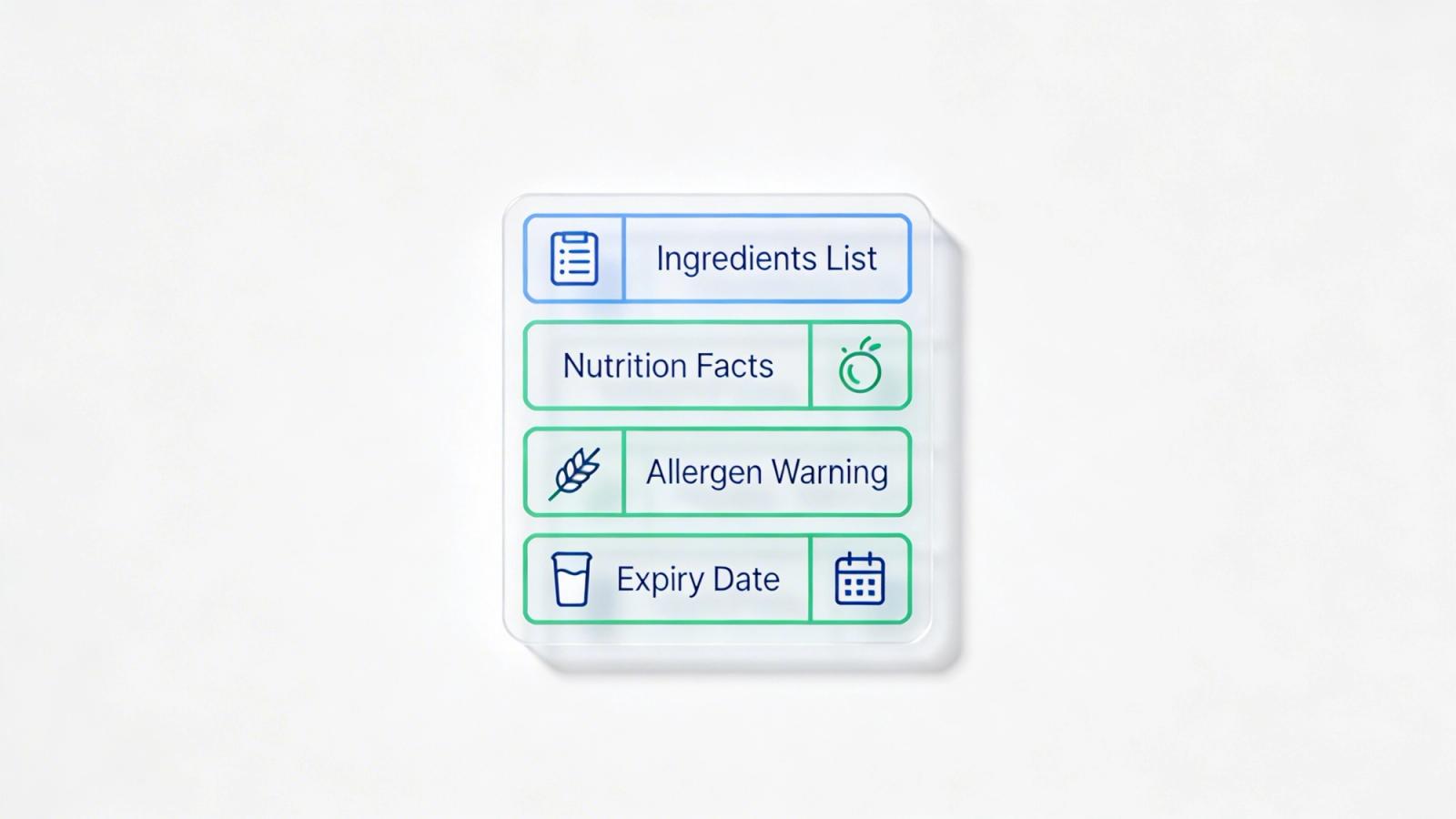
The exact wording and placement vary by market, but the same information categories appear almost everywhere. Treat this as the field list to populate before layout begins, not as a legal text:
- Product name — a true description of the food, not only a brand name.
- Ingredient list — in descending order of weight at the time of manufacture.
- Allergen declaration — identified in the ingredient list and, where required, emphasised or restated.
- Nutrition information — in the panel format the destination market prescribes.
- Net content — weight or volume, in the units and position the market requires.
- Date marking — production and expiry, or best-before, in the prescribed format.
- Lot or batch code — the traceability link back to a specific production run.
- Manufacturer, packer, or importer — name and address, with the local importer often mandatory.
- Country of origin — where produced, which is not always where packed.
- Storage and handling — refrigeration, freezing, or after-opening instructions.
- Preparation instructions — where the food is not ready to eat as supplied.
- Retail barcode — commercially essential rather than legally mandated, and worth verifying before the run.
Ingredients and Allergens
Ingredients are declared in descending order of weight as measured when the product was made, using names a consumer would recognise. Compound ingredients need their own components broken out once they pass the threshold the market sets, and additives are declared by function plus name or number.
Allergens are the highest-risk field on the label, because an error there is a safety issue rather than a paperwork issue. The internationally common list covers cereals containing gluten, crustaceans, eggs, fish, peanuts, soybeans, milk, tree nuts, and sulphites above the specified threshold. Several markets extend it — the United States now includes sesame among its major allergens — so the list is market-specific and needs checking per destination.
How allergens are presented matters as much as whether they appear. The EU requires emphasis within the ingredient list itself, typically by bold or a contrasting type style, rather than only a separate "contains" line. Design for that from the start: an emphasis rule applied late tends to break line breaks and reflow the panel.
Precautionary statements about possible cross-contact are generally voluntary and separately regulated. They are not a substitute for controlling cross-contact in production, and using them to cover uncertainty can create its own compliance exposure.
The Nutrition Panel
Nutrition panels are prescribed formats, not design elements. Rounding rules, mandatory nutrients, serving size definitions, reference intakes, and the order of rows are all specified, and the panel is one of the few places on a label where "close enough" is visibly non-compliant.
Panel content follows from the recipe, so it has to be recalculated whenever the formulation changes — including substitutions made for supply reasons that never reach the marketing team. A quiet ingredient swap that leaves the nutrition panel untouched is one of the more common ways a compliant label becomes non-compliant.
Reserve the panel space early. It is inflexible in a way the rest of the layout is not, and it is far cheaper to design the front around a correctly sized panel than to compress the panel later to recover space.
Net Content, Dates, and Lot Codes
Net content is regulated in units, format, and placement, and is usually required on the principal display panel with a defined minimum type size that scales with package size. Declare net rather than gross weight, and use the units the destination market specifies rather than converting to a familiar one.
Date marking has a production-side dimension that artwork often misses. Dates and lot codes are applied on the line — by thermal transfer overprint, inkjet, or laser — which means the label needs a clear, unvarnished, correctly sized area for them to land on. A code printed over a varnish or a busy graphic smears, fades, or becomes unreadable.
GCC rules are strict about date integrity: dates must be applied as part of the original packaging, and covering, altering, or re-stickering them is prohibited. Plan for the code area at layout stage, and confirm with the printer that the finish over it is compatible with your coder.
Lot codes are what make a recall narrow instead of total. A legible, correctly formatted lot code that ties a unit back to a production run is the cheapest insurance on the label.
Layout and Readability Rules That Bite
Most markets separate the label into the principal display panel — what a shopper sees on shelf — and the information panel, and they assign specific fields to each. Product name and net content generally belong on the principal panel; ingredients, nutrition, and contact details generally belong on the information panel. Moving a mandatory field to the "nicer" side of the pack is a common and avoidable failure.
Legibility itself is a requirement, not a courtesy. The text has to be clear, indelible, and readable against its background under normal conditions of purchase. Reversed type set small, text placed over a photograph, and low-contrast colour pairings all fail that test regardless of the point size used.
Type Size and Legibility
Minimum type sizes are specified by x-height rather than point size, because point size varies between typefaces. EU rules set a minimum x-height of 1.2 mm for mandatory particulars, dropping to 0.9 mm where the largest surface of the pack is under 80 cm². FDA rules express the equivalent requirement in inches, with 1/16 inch as the general floor for ingredient statements and larger minimums for some fields.
Design implications follow directly. Choose a typeface with a generous x-height and open counters rather than a condensed display face; keep tracking neutral; leave line spacing intact. Never solve a copy-fit problem by dropping the ingredient list below the minimum — reduce the copy, enlarge the label, or add a panel.
Small containers are where this becomes real. When the mandatory content genuinely does not fit, the answer is a structural one: a wrap-around label with more surface, a peel-and-reveal booklet, or an extended-content format. Compressing type until it technically fits is a reprint waiting to happen.
How Finish and Substrate Affect Text Clarity
A compliant file can still produce a non-compliant label if the material fights the text. High-gloss varnish creates glare that makes small type hard to read at shelf angles; heavy texture breaks up fine letterforms; clear film without a white flood leaves text competing with the product behind it.
For dense information panels, a matte or satin finish is usually the safer choice, with gloss reserved for the brand-facing side of the pack. The label finishing guide covers the trade-offs, and the materials guide covers substrate behaviour in chilled, frozen, and humid conditions.
Environment is part of legibility. A label that is perfectly readable in the studio can fail after condensation in a chiller, freezer transfer, or oil contact in a kitchen. If the pack lives in moisture, the material and adhesive have to be specified for it — see moisture-resistant labels.
Bilingual and Multi-Market Labels
Arabic is mandatory on food labels across the GCC, which makes bilingual layout the normal case rather than a special one. Both languages have to be fully legible; an Arabic panel set smaller than the English one to save space is a common finding during inspection.
Arabic sets right-to-left and needs a proper Arabic typeface with correct shaping — not an English font with substituted glyphs. Give it its own line spacing rather than inheriting the Latin setting, since Arabic letterforms need more vertical room to stay clear at small sizes.
Translate the regulated fields exactly. Allergens, storage instructions, and preparation steps are safety information, and a loose or marketing-flavoured translation of them is a real hazard. Have translated regulated content reviewed by someone who knows the destination market, not only the language.
Where a single artwork serves several markets, a modular layout pays for itself: keep the market-specific block in one place so a change for one destination does not force a redesign of the whole panel. The label design guide covers structuring artwork this way.
The Mistakes That Cause Reprints
The same handful of errors account for most food label reprints:
- The ingredient list not updated after a recipe or supplier change.
- An allergen present in a sub-ingredient but never declared.
- Nutrition values recalculated for a new formulation but never sent to artwork.
- Net content stated in the wrong units, or placed off the principal display panel.
- No clear, uncoated area for the production line to apply the date and lot code.
- The Arabic panel set smaller than the Latin one, or shaped incorrectly.
- Mandatory text below the minimum x-height after a late copy-fit squeeze.
- Barcode quiet zone lost to a background colour or the die line.
- An importer address left over from the previous market on an export run.
- A finish over the information panel that glares, or one the coder cannot print on.
Your Pre-Press Compliance Checklist
Run this before the file is released, and keep the completed version with the job. It is the record that makes the next production run repeatable and the next audit answerable.
- Confirm every destination market for this SKU, and the current edition of the standard that applies in each.
- Verify the ingredient list against the current approved recipe, in descending weight order, including sub-ingredients.
- Check the allergen list against the destination market list, and confirm the required emphasis or restatement is applied.
- Recalculate nutrition values against the current formulation and confirm the panel format matches the market.
- Confirm net content, units, position, and minimum type size on the principal display panel.
- Confirm date format and that a clean, coder-compatible area is reserved for date and lot code.
- Confirm manufacturer, importer, and country of origin details are correct for this destination.
- Measure the x-height of every mandatory field against the market minimum.
- Check contrast and legibility of all mandatory text at final size, on the actual substrate.
- Confirm both language versions are complete, correctly shaped, and equally legible.
- Verify the barcode, including quiet zones measured against the die line, on a printed proof.
- Sign off a physical proof on production material, applied to the actual container, under retail lighting.
A pre-production quality control pass covers the print-side half of this. Between the two, almost everything that causes a food label reprint is caught while it is still a file.
Frequently Asked Questions
Does a small pack get an exemption from the full information?
Some markets reduce requirements for very small surfaces, and some permit reduced type sizes, but exemptions are narrow and specific. Confirm the exemption in the standard for that market before relying on it, and consider an extended-content label instead.
Can we put the Arabic on a separate sticker applied later?
Treat this as a last resort and confirm it with the destination authority first. Over-stickering is scrutinised, particularly anywhere near dates, and a properly printed bilingual label is cheaper than hand-applying stickers to a container load.
Who is responsible if the label is wrong — us or the printer?
The brand owner is responsible for the content. The printer is responsible for reproducing the approved file faithfully. That division is exactly why a signed physical proof on production material matters to both sides.
How often should compliance be re-checked on an existing SKU?
Whenever the recipe, supplier, pack size, or destination market changes, and on a periodic review regardless, because standards are revised. An unchanged label in a changed regulatory environment is still a non-compliant label.
Does a QR code count towards mandatory information?
Generally no. Digital links are typically treated as additional information, with mandatory particulars still required on the pack itself. Check the destination market before moving any regulated content off the label.