
Contact Sales Now
Thank you! Your submission has been received!
Oops! Something went wrong while submitting the form.

Contact Sales Now
Thank you! Your submission has been received!
Oops! Something went wrong while submitting the form.

Modern brand protection relies heavily on the physical layer of packaging security. A security label serves as the primary interface between a product and the consumer or inspector. They are no longer simple stickers but complex engineering feats designed with tamper-evident features to defend against sophisticated counterfeiting rings.
The efficacy of a security strategy depends on the seamless integration of material science and data management. Brands must move beyond aesthetic considerations to evaluate the functional resilience of their security label solution. This ensures that the physical tag acts as a robust barrier against illicit trade, tampering and counterfeiting, and gray market diversion.
Supply chain integrity demands a multi-layered approach to asset tagging. A single layer of security is rarely sufficient in the current global marketplace. Effective security labels combine overt elements for quick visual verification with covert features for forensic analysis and legal enforcement, helping to protect product authenticity throughout the supply chain.
Security labels are functional components engineered to validate authenticity or indicate interference. They utilize specialized substrates, proprietary adhesives, and advanced printing techniques to enhance security. Unlike standard packaging labels, their primary function is risk mitigation rather than mere information delivery or branding.
These labels work as a lock on the product packaging. The complexity of the lock depends on the value of the goods and the capability of the threat actors. High-performance labels incorporate advanced security features that are difficult to replicate using standard darker market printing equipment, ensuring product safety.
Substrates play a critical role in the definition of a security label. Materials such as ultra-destructible vinyl or frangible paper effectively prevent label removal. If an attempt is made to peel the label, the material fractures into tiny pieces, which is a key feature of destructible labels, rendering the label useless for reuse on counterfeit products.
Adhesive chemistry is equally important in this definition. Security adhesives are formulated to bond aggressively to specific surface energies. Whether applied to coated cardboard, glass, or plastic, the bond must be stronger than the face stock material itself to ensure structural failure if someone tries to remove it.
The printing technology defines the third layer of security. Variable data printing allows for unique serialization and security numbers, giving every single unit a distinct identity. High-resolution micro-text and hologram patterns add barriers that standard digital copiers cannot reproduce with sufficient clarity, often including barcode security for better traceability.
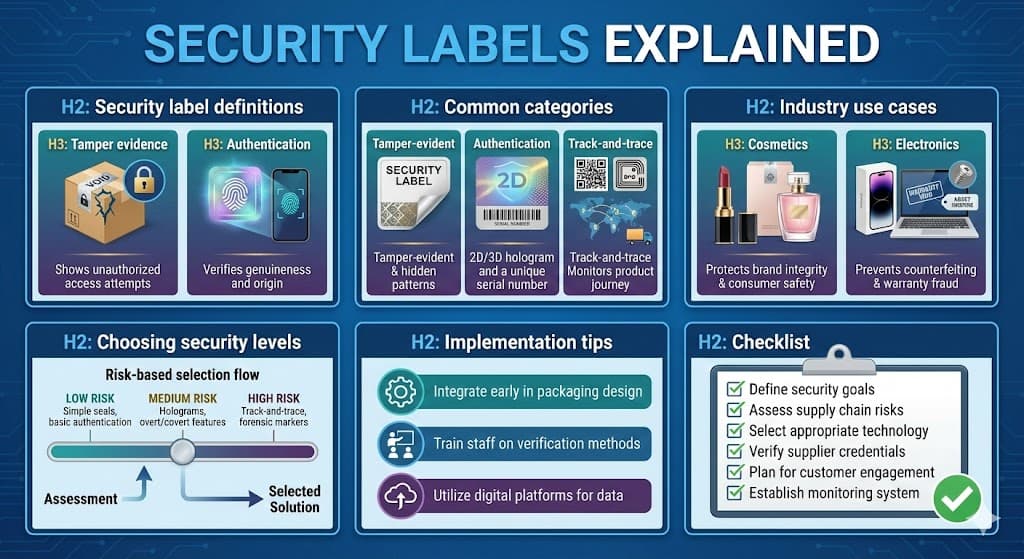
It is vital to distinguish between tamper evidence and authenticity as they solve different problems. Tamper-evident labels answer the question of integrity. They communicate whether the package has been opened, altered, or compromised since it left the manufacturing facility, preventing unauthorized access.
Tamper-evident security labels rely on physical destruction mechanisms. Common examples include void labels that leave a "VOID" or "OPENED" message on the packaging surface when removal is attempted. This residue alerts the consumer or retailer that the product is no longer pristine, protecting against a security breach.
Authentication focuses on legitimacy and provenance. These features of security labels answer the question of origin. An authenticity label proves that the item was manufactured by the authorized brand owner. A package can remain perfectly sealed (intact integrity) yet still be a total counterfeit if it lacks unique security markers.
Authentication utilizes sophisticated security technologies like holograms, optically variable devices (OVDs), and taggants. These labels provide a layer of security that is difficult to forge. While a tamper-evident label protects the contents, the authentication feature protects the intellectual property and the brand reputation itself.
Combining these two functions creates the most robust security label solution. A label that verifies origin through a hologram and simultaneously destroys itself upon removal prevents a genuine label from being harvested and placed on a fake product. This dual-functionality is the industry standard for high-risk goods and valuable assets.
Protective labeling is categorized by the method of verification and the technology employed. The primary division lies between overt and covert security features. Overt features are visible to the naked eye and intended for immediate validation by consumers to check product integrity without special tools.
Holograms and color-shifting inks fall into the overt category. These optically variable features change appearance based on the viewing angle. They provide an intuitive verification method to use security labels effectively, but can sometimes be simulated by advanced counterfeiters, requiring integrated security updates.
Covert categories include features hidden from normal view. UV-luminescent inks, which only appear under black light, are standard covert tools. These allow customs officials and field investigators to verify products discreetly without alerting the suspect or relying on consumer knowledge of security measures.
Forensic markers represent the highest level of security. These utilize molecular taggants or DNA markers embedded in the ink or substrate. Detecting these requires laboratory equipment or proprietary handheld scanners, providing evidence admissible in court for legal action against those who counterfeit products.
Another label type involves destructible substrates used specifically for warranty enforcement. These labels are often made of acetate or fragile vinyl. They prevent consumers from opening electronics to swap internal components while labels help brands ensure the device is original and unopened.
Track-and-trace converts a static label into a dynamic digital asset. This category focuses on supply chain visibility and traceability rather than just physical verification. By assigning a unique serial number or QR codes to each label, brands can monitor the movement of unit-level items globally.
Barcode labels and Data Matrix codes are the standard vehicles for this data. When scanned, these 2D barcodes connect to a cloud database. This connection allows for real-time authentication and provides data on where the scan took place, helping identify unauthorized diversion routes and signs of interference.
RFID (Radio Frequency Identification) and NFC (Near Field Communication) represent the premium tier of track-and-trace. These security tags allow for non-line-of-sight scanning. Implementing RFID enables rapid inventory management and automated shipping verification, drastically reducing human error and helps to prevent theft.
Serialization software prevents code duplication. Sophisticated algorithms generate random, non-sequential serial numbers that are impossible to guess. If a counterfeiter copies a valid QR code, the system flags the anomaly when the same code is scanned in two different geographic locations simultaneously.
This digital layer aids in combating gray market diversion. If a product designated for a specific market receives a scan in a prohibited region, the brand owner is alerted. The labels work as a tool for enforcing distribution agreements and maintaining global pricing structures for a trusted security label.
The application of security labels varies significantly across industries based on regulatory requirements and risk profiles. The pharmaceutical industry operates under strict serialization mandates. Labels here must ensure patient safety and provide a high level of security to comply with regulations.
Automotive parts manufacturers use security labels to ensure vehicle safety. Counterfeit brake pads or airbags pose lethal risks. Labels used in this sector must withstand extreme environments, including high heat, grease, and hydraulic fluids, without losing adhesion or the ability to protect product integrity.
The spirit and wine industry faces high risks of refilling fraud. High-value bottles are often retrieved from trash, refilled with cheap alcohol, and resealed. Security tax stamps and capsule seals that break upon opening are essential security labels to protect against this type of revenue loss.
Agrochemicals employ security labels to protect crop yields. Fake fertilizers and pesticides can destroy harvests. Labels in this sector often use multi-page booklets containing safety data, integrated with overt authentication features to reassure farmers of the chemical's potency and origin, effectively acting as a security label solution.
Cosmetics and personal care high-value items require a balance of security and aesthetics. The packaging is a major part of the consumer experience. Security labels must not detract from the brand image or leave sticky residue that ruins the premium feel of the container while they protect product authenticity.
Diversion is a massive issue in cosmetics. Distributors often sell professional-grade products on unauthorized online marketplaces. Coding and barcode labels help brands conduct test buys to identify the rogue distributor. Often, these labels are made of transparent substrates to blend seamlessly with the package design.
Electronics rely heavily on warranty void labels. These are placed over screw holes or chassis seams. The primary goal is to prevent the harvesting of genuine internal parts or the return of goods that have been tampered with by third-party repair shops, ensuring product integrity.
Use cases in electronics also involve component authentication. Batteries and chargers are frequent targets for counterfeiting, posing fire risks. Holographic labels on battery packs provide a quick visual check for consumers to ensure they are using safe, OEM-certified power sources, which is a key feature of electronic security.
Both sectors benefit from near-field communication (NFC) labels. In cosmetics, an NFC tap can provide product tutorials, adding value while verifying authenticity. In electronics, NFC can register the device for warranty instantly, linking the physical hardware to the user’s digital profile and providing a higher level of security.
Choosing the right security label requires a comprehensive risk assessment. Brands must calculate the cost of doing nothing versus the cost of implementation. If the potential revenue loss or liability from counterfeits exceeds the investment in labels, a high-level security label solution is justified.
Analyze the sophistication of the threat. If the counterfeiters are using advanced printing presses, a simple hologram is insufficient. In such cases, a combination of OVDs and forensic taggants is necessary to stay ahead of the technical capabilities of the criminal enterprise and protect product from sophisticated threats.
Consider the product lifespan and value. Low-value, fast-moving consumer goods may only require simple tamper-evident tape or basic void labels. High-value durable goods require permanent, serialized authentication labels that remain legible for years throughout the supply chain.
Evaluate the checking environment. Who is verifying the label? If consumers are the primary inspectors, overt features like color-shifting ink are best. Is the product checked by customs officers? Then covert UV features or handheld scanner-readable barcode security are required to choose security labels wisely.
Think about the "arms race" aspect of security. Static security features eventually get compromised. The chosen security labels serve the brand best when they allow for periodic design refreshes or technology upgrades without requiring a complete overhaul of the packaging production line.
Successful implementation starts with the application surface. The substrate of the packaging dictates the adhesive choice. A label designed for a cardboard box may fall off a textured plastic surface. Testing adhesive on the actual production packaging is a non-negotiable step to ensure you choose the right security label.
Application temperature and environmental conditions matter. Labels applied in freezing warehouses require different adhesives than those applied in humid tropical facilities. Failure to account for these variables results in premature label failure and a compromised security label solution.
Automated application speeds must be considered. High-speed production lines require release liners that can withstand tension without tearing. The security cuts in a destructible label must be engineered so the label doesn't break during the machine dispensing process, helping to make security labels work efficiently.
Employee and stakeholder training is critical. A security feature provides no value if the people handling the product do not know how to validate it. Retailers, distributors, and consumers need clear instructions on what to look for and how to interpret the security labels help provide visual cues for authenticity.
Software integration must be robust. If using track-and-trace, the serialization data must sync flawlessly with the ERP system. There should be a defined protocol for what happens when a fake code is detected, including automated alerts to the brand protection team to prevent theft and further tampering.
Define the primary goal clearly. Determine if the priority is anti-counterfeiting, anti-diversion, or tamper evidence. Mixing up these priorities can lead to purchasing the wrong technology for the specific threat facing the brand, so understanding security needs is paramount.
Select the appropriate substrate and adhesive. Ensure the material will destruct upon removal and stick permanently to the product surface. Conduct aging tests to ensure the adhesive does not dry out or fail over the shelf life of the product, which is a key feature of hybrid labels.
Layer the security technologies. Combine at least one overt feature for the public with one covert feature for investigators. This creates a balanced defense that is easy to check but difficult to replicate, ensuring you have effective security labels to suit your business.
Plan the data management strategy. If using QR codes or serialization, ensure the backend infrastructure is secure. The database holding the valid serial numbers is just as valuable as the physical product and must be protected from data security threats.
Establish a monitoring program. A label is a tool, not a solution. Set up a schedule for market surveys and test buys. Use the intelligence gathered from the labels to take legal action or adjust distribution channels, which helps security labels act as a constant deterrent.
Review and update regularly. Security is not a one-time project. Schedule annual reviews of the label technology. Engage with vendors to learn about new substrates or inks that can keep the brand one step ahead of counterfeiters and help you choose the right security label for the future.