
Contact Sales Now
Thank you! Your submission has been received!
Oops! Something went wrong while submitting the form.

Contact Sales Now
Thank you! Your submission has been received!
Oops! Something went wrong while submitting the form.

Label legibility is a non-negotiable metric in supply chain efficiency. When an identifying marker degrades during transit, the cost extends beyond the label itself. It impacts inventory accuracy, scanning speeds, and ultimately, the perception of your brand quality and the effectiveness of your custom labels.
High-handling environments expose packaging to persistent mechanical stressors. These industrial settings operate on friction, repetitive contact, and abrasive surfaces. Durable labels that fail to withstand these forces become a liability essentially immediately, which is why choosing the right material is paramount.
Achieving durability requires a holistic approach to material science. It is not merely about choosing a thicker paper. It involves the precise calibration of label materials, ink anchorage, and protective top layers to ensure your labels stand the test of time.
Engineers and procurement specialists must understand the specific failure points of label composition. Without this understanding, you risk over-engineering the solution or, worse, under-specifying the protection needed for labeling needs in harsh conditions. Proper material selection ensures labels remain intact throughout the product lifecycle.
Physical degradation of a label usually stems from two distinct mechanical forces. The first is abrasion, often referred to as scuffing. This occurs when a broad surface rubs repeatedly against the label face, requiring scratch-resistant solutions to maintain readability.
The second force is scratching. This is a concentrated, sharp-force trauma that cuts through the ink layer and potentially the substrate. Understanding the difference is vital because label materials resistant to scuffing may still be vulnerable to sharp scratches if you choose the wrong type of label.
Ink adhesion plays a pivotal role in this failure. If the ink, whether flexographic or screen printing, does not bond chemically with the face stock, minimal friction will dislodge it. This is often an issue of surface tension compatibility between the ink and the custom labels substrate.
Environmental factors exacerbate physical stress. Humidity softens paper fibers, making them more susceptible to tearing under friction. Cold temperatures can make certain adhesives and varnishes brittle, leading to cracking and flaking upon impact in harsh environments.
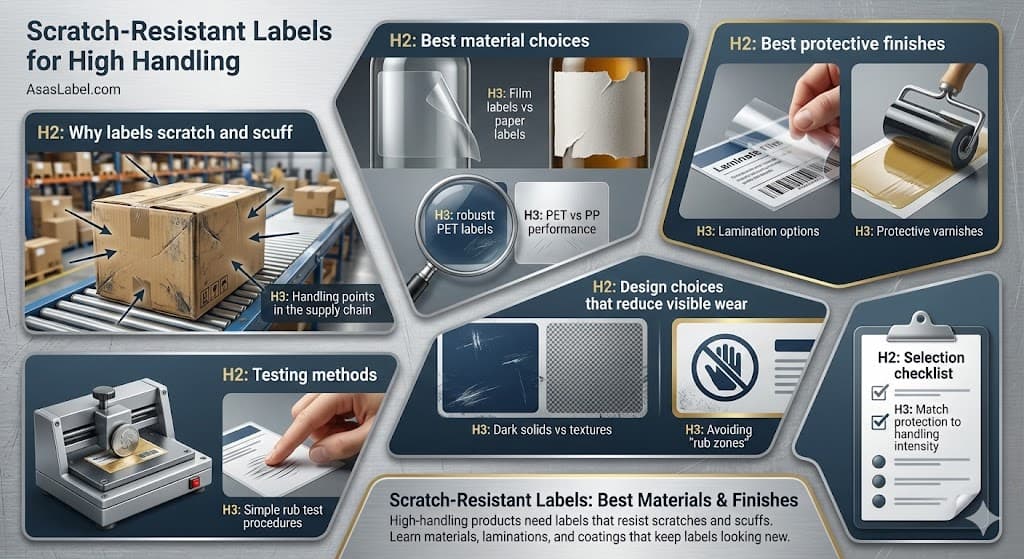
The journey of a product involves predictable zones of high friction. Conveyor belts represent a primary source of linear abrasion. During accumulation, packages often slide against guide rails or other boxes, creating a sanding effect on the label surface that demands durable materials.
Palletizing creates significant compressive and shearing forces. When pallets are shrink-wrapped, the plastic film exerts pressure. If the pallet shifts during transit, that film rubs incessantly against the outer labels, causing "burn" or ink transfer, which can be mitigated by choosing the right label material.
Manual picking processes introduce oils and moisture from human hands. This chemical exposure can soften topcoats. Subsequent friction from sliding the unit into a bin or shipping carton accelerates the degradation of the printed information unless you use chemical-resistant labels.
Automated sorting systems utilize high-speed diverters and pusher arms. These disparate mechanical components strike the package with immediate force. If the label is positioned at the impact point, the shear force can delaminate the protective coating, making scratch-resistant properties essential for label longevity.
The face stock is the foundation of any scratch-resistant strategy. Using a substrate with low internal bond strength guarantees failure in high-handling scenarios. The material selection must possess inherent tensile strength and surface hardness to ensure your labels stand out.
Surface smoothness is a technical variable that influences durability. A smoother surface allows for better laminate wet-out and ink laydown. Rough surfaces create microscopic peaks and valleys where ink can be easily abraded from the high points, making it difficult for labels to last.
Synthetic label materials are the industry standard for high-durability applications. They offer dimensional stability that organic paper labels simply cannot match. This stability prevents the label surface from distorting under pressure, which preserves the integrity of the ink layer above it for long-lasting labels.
Paper labels rely on a mesh of wood pulp fibers. When subjected to abrasion, these fibers lift and separate. This structural breakdown removes the ink attached to those fibers, resulting in a white, fuzzy appearance known as "linting," which is why you need durable label materials.
Vinyl labels and film labels do not have a fiber structure that can be teased apart. They are extruded sheets of plastic polymer. When a vinyl label is abraded, the material may scratch, but it does not disintegrate or dust like paper materials.
Moisture resistance acts as a force multiplier for polyester and polypropylene labels. In high-humidity supply chains, paper labels absorb water and swell, effectively destroying their scratch-resistant properties. Polyester labels are impervious to moisture, maintaining their structural hardness regardless of humidity levels.
For label applications involving heavy abrasion, paper requires substantial over-engineering to survive. Custom labels using films usually provide adequate baseline protection with minimal additional processing. The total cost of ownership often favors film despite the higher upfront per-unit cost compared to paper labels.
Polypropylene labels are a workhorse in the industry. It is biaxially oriented, meaning it is stretched in two directions during manufacturing to increase strength. It offers excellent resistance to fatigue and cracking for common label applications.
However, polypropylene is softer than polyester. While it resists tearing admirably, its surface is more prone to fine scuffing than polyester labels. It is ideal for squeezable containers or flexible packaging where the label must flex with the handling without sacrificing durability.
Polyester is the superior choice for extreme handling and high abrasion. It creates a harder, more rigid surface profile for robust labels. This rigidity deflects abrasive forces rather than absorbing them, protecting the printed image more effectively and increasing the label lifespan.
Extreme temperature conditions also favor polyester. If the handling environment involves high heat or freezing cold, polyester labels retain their physical properties more consistently. Polypropylene labels may become brittle in deep freeze environments, making it susceptible to scratching off the package entirely.
Direct printing on a substrate, regardless of quality, creates a vulnerability. The ink sits on top of the material, exposed to the world. High handling necessitates a physical barrier or laminate between the ink and the source of friction.
This barrier must be optically clear to ensure barcode scannability. It must also be chemically compatible with the ink system used. Incompatibility can lead to delamination, where the protective layer peels away, taking the data with it and shortening the label lifespan.
The choice of protection often comes down to the required lifecycle of the label. A shipping label needs to survive three days of intense logistical friction. An asset tag needs to survive three years of intermittent handling, requiring the most durable materials available.
Lamination provides the highest tier of physical protection for custom labels. This process involves applying a clear plastic film over the printed web using a pressure-sensitive adhesive backing. It effectively encapsulates the ink to ensure your labels remain intact.
Thickness matters in lamination specification. A standard 1.0 mil laminate offers good scuff resistance. However, for heavy industrial settings and industrial handling, a 2.0 mil or 3.0 mil laminate provides a "cushion" that absorbs deep scratches without reaching the ink.
Material matching is critical here. A polypropylene laminate on a polypropylene face stock allows for uniform expansion and contraction. Mismatched materials can cause tunneling, where the laminate buckles away from the label, creating a prime target for tearing in challenging conditions.
Matte laminates often perform better than gloss in handling environments. The textured surface of a matte finish has a lower coefficient of friction. This allows abrasive objects to slide over the label rather than gripping and tearing the surface, helping labels resist damage.
Varnishes are liquid coatings applied inline during the printing methods. They are cured quickly using UV light or heat. While they offer a lower cost advantage over lamination, their protective scratch-resistant capabilities are generally lower for harsh environment labels.
A varnish provides a scuff-resistant skin. It is excellent for preventing ink smear during the friction of automated labeling. However, it lacks the tensile strength to prevent deep gouges from sharp objects when you need labels to last through rough surfaces.
Formulation is key when selecting a varnish for chemical-resistant labels. "High-scuff" or solvent-resistant labels formulations contain additives like wax or silicone. These additives increase slip, reducing the friction generated when an object rubs against the label backing.
Spot varnishing offers a strategic compromise. You can apply a heavy-duty varnish over critical variable data while leaving other areas untreated. This is useful when the label needs to be overprinted or written on downstream using thermal transfer printing methods.
Visible wear is often a matter of contrast. A scratch is most visible when it reveals a substrate color that differs sharply from the ink color. Proper material selection and design decisions can camouflage inevitable wear and tear for long-lasting labels.
Engineers should collaborate with designers early in the process. By anticipating where the scuffs will happen, the artwork can be adjusted to minimize the visual impact of abrasion. This extends the perceived label longevity and ensures labels stand out as high-quality.
Placement strategy is also a design element. Understanding the geometry of the product allows you to place the label in a recessed area. This physical protection is far more effective than any scratch-resistant coating when you need your labels to survive challenging conditions.
Large areas of dark, solid colors are unforgiving for custom labels. A black ink block printed on white film will show even the slightest microscopic scratch as a white hairline. This high-contrast failure makes the label look worn immediately in harsh environments.
Textured backgrounds or distressed patterns hide abrasion effectively. If the design already incorporates "noise" or pattern variation, a random scratch blends into the aesthetic. This technique is common in industrial settings and outdoor signage equipment labeling.
Using a substrate that matches the ink color can also mitigate wear. For example, printing black ink on a black-pigmented vinyl means that a scratch will reveal more black material, rendering the damage nearly invisible and ensuring labels remain intact.
Light-colored backgrounds generally hide scuffs better than dark ones. Scuffing usually manifests as a dulling of the surface. On a white or yellow background, this change in gloss level is far less perceptible than on a dark blue or black background, aiding label longevity.
Every package has "rub zones." These are typically the equatorial center of a bottle or the corners of a box. These are the points of contact between units on a conveyor or inside a shipping case where you need labels to be scratch-resistant.
Critical data, such as barcodes and lot numbers, should be moved away from these zones. Placing a barcode near the bottom edge of a container often protects it from the shoulder-to-shoulder friction that occurs on production lines, ensuring labels stay readable.
The "leading edge" of a label is particularly vulnerable. If the label is applied to the front face of a box, the leading vertical edge is the first point of contact for anything hitting it. Designing the label with rounded corners reduces the likelihood of the edge catching and lifting, enhancing durability.
Assuming a label is scratch-resistant based on a datasheet is a risk. Real-world variables often differ from the sterile environment of a laboratory. Validation requires testing protocols that simulate the specific stressors of the intended supply chain for harsh environment labels.
Testing should occur on the finished construction. This includes the specific ink set, the specific varnish, and the specific cure levels used in production. A change in UV curing wattage can drastically alter the hardness of a topcoat and the overall label longevity.
Empirical data allows for objective comparison. Instead of "good durability," specs should demand "200 rubs with 4lb weight." This clarity ensures that vendors are providing labeling solutions that are truly chemical-resistant and scratch-resistant.
The Sutherland Rub Test is the industry standard for abrasion resistance. It uses a weighted block wrapped in a test strip that oscillates back and forth over the label. The endpoint is defined by the number of strokes before ink failure, proving if the labels provide the needed protection.
For quick validation, the Taber Abrasion test is rigorous. It uses rotating abrasive wheels to grind the surface. While more aggressive than typical shipping conditions, it provides a fast benchmark for the hardness of laminates and varnishes for durable labels.
Simple "tape tests" measure ink anchorage. A pressure-sensitive tape is applied to the printed surface and ripped off rapidly. If ink transfers to the tape, the anchorage is insufficient, and the custom labels will likely fail under high handling regardless of the durable materials used.
Manual scrub tests can be effective for low-volume checks. Using the corrugated cardboard expected in the shipping box, an operator rubs the label with moderate pressure. While less scientific, it often reveals catastrophic adhesion backing failures immediately for labels Suitable for the task.
Selecting the right label construction requires balancing performance against cost. The goal is to survive the journey, not to survive indefinitely. Over-engineering adds unnecessary cost per unit, which is why material selection must be precise for your labeling needs.
Review the entire lifecycle of the labeled item. A product that sits on a retail shelf needs different scuff resistance than a component inside an automotive engine block. The type of handling dictates the durable label materials, ensuring your labels maintain their appearance.
Consult with your converter regarding their tooling. Some materials like polyimide labels are harder to die-cut, which can increase production costs. Ensure the chosen laminate or face stock is compatible with the converter's equipment to avoid lead time delays.
Identify the primary friction source. If it is cardboard dust and vibration, a high-slip varnish is likely sufficient. If it is metal-on-label contact during manufacturing, a thick polyester or polypropylene laminate is the answer for your durable labels.
Determine the lifespan of the data. Does the barcode only need to scan once at the distribution center? Or does it need to scan upon return three months later? Temporary data requires lower protection thresholds than tamper-evident labels or long-lasting labels.
Check the application environment. High heat requires thermal transfer resin ribbons and polyester labels. Room temperature logistics allow for direct thermal (with topcoating) or standard flexo inks. Choosing the right material prevents premature brittleness in harsh conditions.
Evaluate the chemical environment. If the "handling" involves gloves with solvent-resistant labels or oils, standard acrylic varnishes will dissolve. In these cases, a chemical-resistant laminate is the only viable option for ensuring labels remain intact and legible.
Finally, confirm the budget tolerance. Lamination adds significant cost over varnish. If the budget is tight, investigate high-performance UV waxes or resin-based inks that offer enhanced scratch-resistant durability without the need for a secondary film layer, ensuring labels serve their purpose perfectly.