On this page
- Paper Labels in Humid Climates: Challenges in the GCC
- Why high humidity compromises paper structural integrity
- Moisture uptake acts on cellulose fibers
- Risks associated with adhesive performance
- Which failure modes appear most frequently
- Curling edges and mandrel lift
- Wrinkling, bubbling, and surface scuffing
- Does the packaging environment amplify the risk
- Bathrooms, kitchens, and chilled retail displays
- Warehouses and long-distance shipping logistics
- Strategies to prevent moisture damage
- Correct storage habits concerning temperature and RH
- Choosing coated papers and protective finishes
- Testing protocols before full production
- Performing a hold test on real containers
- Checklist for pilot batch production
- When to switch materials entirely
- Thresholds for moving to synthetics
Paper Labels in Humid Climates: Challenges in the GCC
Packaging professionals operating in the Gulf Cooperation Council (GCC) region face distinct environmental hurdles that differ significantly from European or North American standards. The primary antagonist for paper-based packaging in this region is the extreme ambient humidity found in coastal logistics hubs.
Cities like Dubai, Doha, and Jeddah frequently experience relative humidity (RH) levels exceeding 80% or 90% during summer months. This atmospheric moisture creates a hostile environment for standard cellulose substrates. Understanding the physics behind paper label failure is essential for maintaining brand integrity on the shelf.
Brands often underestimate the hygroscopic nature of paper until they witness widespread flagging or bubbling on their products. The cost of these failures extends beyond the price of the label stock. It impacts production line efficiency, causes retail rejections, and ultimately degrades consumer trust.
Successful labeling in this climate requires a granular understanding of label materials. You must analyze how specific paper grades interact with elevated moisture levels and how pressure-sensitive adhesives respond to the simultaneous stressors of heat and dampness.
Why high humidity compromises paper structural integrity
The fundamental issue with paper labels in humid climates lies in the raw material itself. Paper is composed primarily of cellulose fibers, which are inherently hydrophilic. In the dry heat of the desert interior, paper remains stable, but the coastal humidity prevalent in GCC industrial zones triggers rapid physical changes.
When atmospheric moisture is high, the vapor pressure differential drives water molecules into the paper matrix. This process is not uniform. It occurs rapidly, altering the dimensional stability of the label stock before it is even applied to the container.
This instability complicates the converting and application process. Printers and brand owners must recognize that a label is not a static object. It is a dynamic material that expands and contracts in direct response to the environment in the filling hall or warehouse.
Moisture uptake acts on cellulose fibers
Cellulose fibers absorb water vapor readily, causing them to swell. In the manufacturing of label stock, fibers are aligned primarily in the machine direction (MD). However, when they swell with moisture, the primary expansion occurs in the cross-direction (CD).
This anisotropic expansion is the root cause of many dimensional failures. As the fibers widen, the label surface area increases. If the label is already applied to a rigid container like glass or PET, the substrate has nowhere to go.
The distinct expansion rates create internal stress within the label construction. The paper attempts to grow larger than the space it occupies. Since the adhesive anchors it to the container, the stress manifests as buckling or lifting.
Standard uncoated papers are most susceptible to this rapid uptake. Without a barrier, the fiber matrix reaches equilibrium with the high ambient humidity of a UAE summer day within minutes of exposure.
Even coated papers have vulnerable entry points. While the face may be sealed with clay or latex coatings, the edges of the die-cut label expose raw fibers. Moisture wicks in from these edges, causing perimeter swelling that ruins the visual aesthetic.
This edge-wicking effect is particularly problematic for labels with intricate die lines or sharp corners. The increased surface area at the edge allows for faster saturation, leading to localized failure points that spread inward.
Risks associated with adhesive performance
Humidity does not only affect the face stock. It significantly alters the performance profile of the adhesive layer. Water vapor can permeate the paper face and reach the adhesive-container interface, interfering with the bond formation.
This is critical for water-based emulsion acrylic adhesives. These adhesives are formed by suspending polymers in water. When exposed to extreme humidity, the adhesive can sometimes reabsorb moisture, becoming milky or losing shear strength.
Labels in hot climate scenarios often face the "ooze" phenomenon. High humidity combined with the high ambient temperatures common in the GCC softens the adhesive. This reduces the internal cohesion of the adhesive layer.
When cohesion drops, the adhesive may bleed out from the edges of the label. This causes sticky residue on the bottle, which attracts dust and sand, a fatal flaw for premium packaging in the region.
Furthermore, condensation on the container surface prior to labeling is a massive risk. If the bottling environment is humid, a microscopic layer of water, known as the "boundary layer," sits on the glass or plastic.
Applying a paper label over this moisture prevents the adhesive from wetting out fully. The bond is compromised from the start. As the moisture evaporates later, it leaves air pockets that result in immediate lifting or bubbling.
Which failure modes appear most frequently
Identifying the visual symptoms of humidity damage allows for faster troubleshooting. In the GCC market, failure modes are rarely subtle. They tend to be catastrophic failures that render the product unsellable in premium retail outlets.
Brand owners often misdiagnose these issues as "bad glue." However, the adhesive is rarely the sole culprit. It is usually a mismatch between the paper tension and the environmental conditions.
Recognizing the specific type of deformation helps in selecting the correct remedy. A label that curls requires a different solution than one that bubbles.
Curling edges and mandrel lift
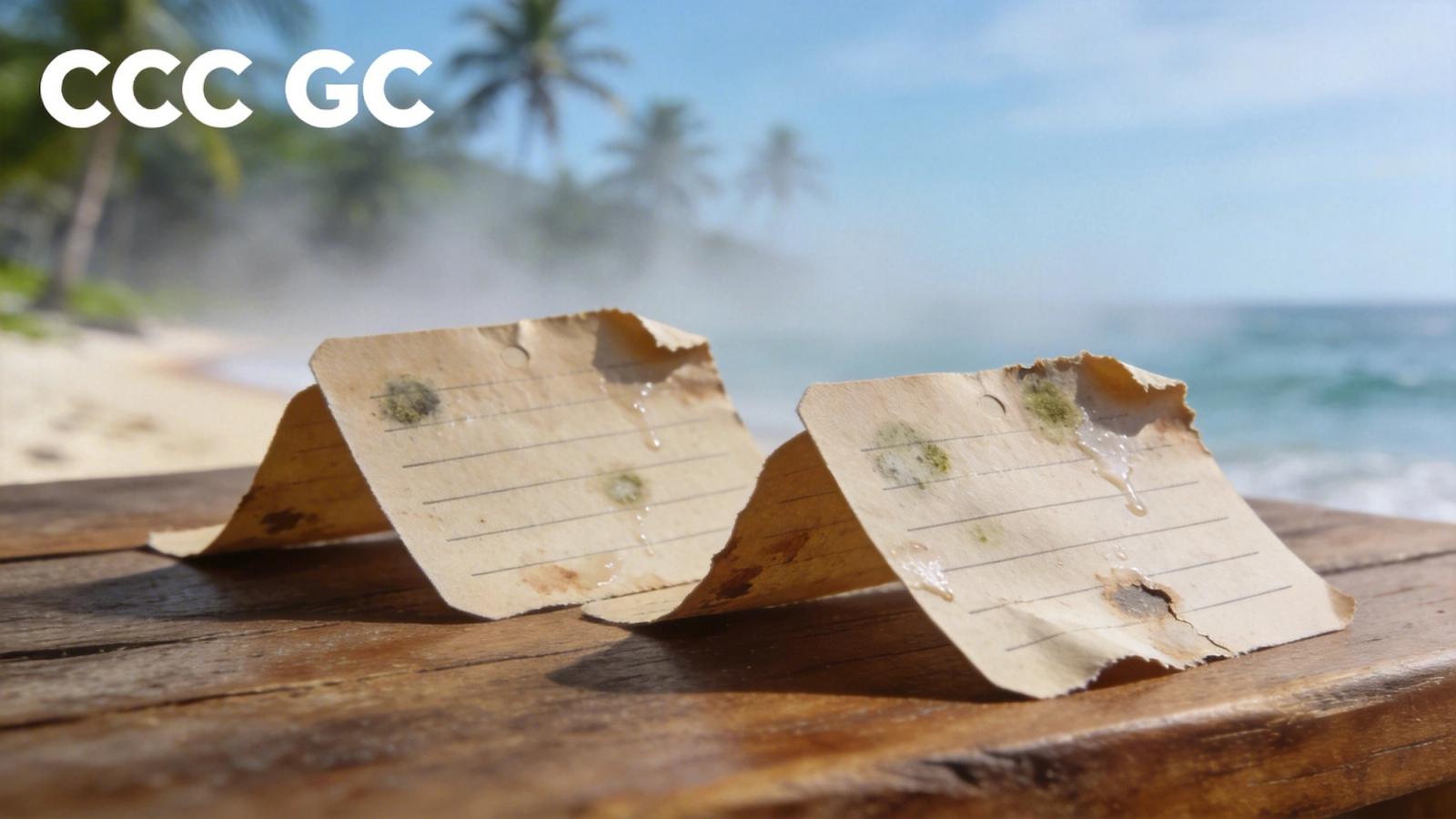
Curling is the most prevalent issue for paper labels on cylindrical containers. When paper fibers swell due to humidity, the label creates mechanical leverage against the adhesive bond. This is often called "flagging."
The "memory" of the paper fights the curvature of the bottle. In high humidity, the stiffness of the paper changes. If the paper expands on the face side more than the liner side (before application), it creates a pre-curl.
Once applied, if the expansion continues, the corners of the label are the first to detach. This is known as edge lift. It is particularly common on small diameter containers like vials or cosmetic jars.
The stress at the edge exceeds the tack of the adhesive. Once the edge lifts, air enters, oxidizing the adhesive and permanently killing the bond. No amount of pressing it back down will fix it.
Paper label curling is exacerbated when the grain direction of the paper runs parallel to the height of the bottle rather than wrapping around it. The path of least resistance for expansion forces the edges outward.
Wrinkling, bubbling, and surface scuffing
Tunneling and wrinkling occur when the label expands after it has been affixed to the container. Because the adhesive holds the center acts as an anchor, the expanding paper buckles upward to relieve the surface tension.
This results in unsightly tunnels or vertical wrinkles. This is highly common in "wet" labeling conditions or when products move from a humid warehouse to a dry retail floor, causing rapid contraction.
Bubbling is distinct from wrinkling. Bubbles are often trapped volatiles or air pockets that expand in the heat. However, on paper labels, bubbles often indicate that the substrate has lost its flatness due to moisture absorption.
Scuffing is a secondary failure mode related to humidity. Wet paper fibers have significantly lower tensile strength than dry ones. The "wet strength" of standard semi-gloss paper is poor.
During transport, bottles vibrate and rub against dividers. In a humid GCC shipping container, the softened paper surfaces abrade easily. This leaves the labels looking worn and white-scuffed before they reach the shelf.
Ink adhesion also suffers. If the paper surface becomes saturated, inks may flake off or smear under friction. The topcoat softens, compromising the protective layer that usually guards the artwork.
Does the packaging environment amplify the risk
The lifecycle of a product in the Middle East involves extreme environmental fluctuations. A label must survive the production line, the logistics chain, and the consumer's usage environment. Each stage presents unique humidity challenges.
Understanding the "Delta" or difference between these environments is key. The greater the shock between the storage humidity and the application humidity, the higher the failure rate.
Products produced in Europe and shipped to the GCC face the harshest transition. They move from temperate, moderate humidity to the extreme heat and moisture of a Jebel Ali summer.
Bathrooms, kitchens, and chilled retail displays
Consumer behavior in the region influences label performance. Detailed attention must be paid to where the product lives. Products like shampoos or cleaners stored in bathrooms face cyclic humidity spikes.
The steam from showers raises the RH to nearly 100%. A standard paper label without heavy lamination will delaminate within days. The layers of the paper itself will separate.
Kitchens are similar high-risk zones. Steam from cooking and heat from appliances degrade paper integrity. But the most aggressive environment is the chilled display case found in supermarkets.
When a consumer removes a chilled beverage from a fridge in a humid climate, condensation forms instantly. This is the "sweating" bottles are famous for. The paper label soaks this water up like a wick.
This drastically reduces the aesthetic appeal of the product at the very moment of consumption. For premium beverages, a soggy, grey label destroys the brand experience.
Warehouses and long-distance shipping logistics
Logistics in the GCC are famously demanding. While modern warehouses are climate-controlled, the transition points are not. Pallets may sit on open loading docks for hours in 40°C temperatures with 80% humidity.
Shipping containers are notoriously aggressive environments. Inside a metal container, the "greenhouse effect" can drive temperatures well above 60°C. This cycles with night temperatures, creating moisture rain inside the container.
This phenomenon, known as "container rain," occurs when moisture evaporates from pallets or packaging and condenses on the container ceiling, dripping back down onto the goods.
Paper labels in these conditions endure a sauna-like test. Even if the cartons are sealed, moisture vapor penetrates standard cardboard. If the labels are not acclimated or protected, they will arrive at the destination pre-curled.
Non-climate-controlled trucks crossing borders between UAE, Saudi Arabia, and Oman expose labels to prolonged heat soaking. This creates adhesive bleed and paper yellowing before the product is even unboxed.
Strategies to prevent moisture damage
Mitigating these risks does not always require abandoning paper. It requires a stricter regimen of material selection and handling. Prevention is largely about process control and physical barriers.
Converters and packagers must treat the label stock as a perishable ingredient. It cannot be left exposed to the elements. Implementing strict standard operating procedures (SOPs) for material handling is the first line of defense.
Furthermore, the specification of the label material itself must be upgraded. Standard commodity papers are insufficient for the Gulf climate. High-performance grades with specific treatments are necessary.
Correct storage habits concerning temperature and RH
Paper label storage is critical. Rolls should never be stored directly on concrete floors, which transmit moisture. They must be racked and kept in the original protective wrapping until the moment of use.
The "24-hour rule" is vital for GCC label printing. Bring the label stock into the press room or application room at least 24 hours before use. This allows the material to reach thermal and hygroscopic equilibrium.
If a cold roll of labels is opened in a warm, humid room, condensation will form on the edges immediately. This unseen moisture ruins the edge-wetting capability of the adhesive.
Maintain the storage facility at a stable RH, ideally between 45% and 55%. Dehumidifiers are non-negotiable in coastal warehouses storing label stock. Fluctuations are more damaging than constant high levels.
Reseal partial rolls immediately. Leaving a roll on a label applicator overnight in a humid factory is a guarantee of tracking issues and jamming the next morning.
Choosing coated papers and protective finishes
For paper labels in hot climates, uncoated "natural" papers are risky. Brands should gravitate toward Cast Coated or Machine Coated papers. These have a clay coating that smooths the surface and provides a moderate moisture barrier.
However, the coating alone is not enough. A heavy-duty varnish or added lamination is the most effective shield. A UV varnish acts as a hydrophobic cap, repelling surface condensation.
Polyproylene (PP) lamination offers the highest protection for paper. It essentially turns the face of the paper into a synthetic hybrid. It provides a robust barrier against the condensation encountered in chilled displays.
Be aware that lamination does not seal the sides. The "wicking" issue at the die-cut edge remains. To combat this, ensure the paper has high "wet strength" properties—additives that keep the fiber bonds strong even when wet.
Select adhesives formulated for high-temperature and high-humidity service. Look for "tropical" or "climate-resistant" hot melts or acrylics designed to resist re-emulsification.
Testing protocols before full production
Relying on datasheet specifications is insufficient for the GCC market. What works in a lab in Germany may fail in a warehouse in Dammam. Empirical testing in real-world conditions is mandatory.
These tests should simulate the worst-case scenarios of the supply chain. Stress-testing the label application reveals weaknesses that are invisible during the design phase.
Engage your label converter early in this process. Request printed samples on the actual specified stock, not just generic digital proofs.
Performing a hold test on real containers
The simplest validation creates the most value. Apply the label to the actual production container. Do not use flat panels for testing if your product is a round jar.
Place the labeled container in an environment that mimics the destination. If you lack an environmental chamber, a simple bathroom test or placing the product outside in a shaded area during summer can serve as a crude stress test.
Check for edge lift after 24, 48, and 72 hours. Most memory-based lifting happens within the first day. Run your finger over the edge; if it catches or feels sharp, the label is lifting.
Test the "mandrel hold." Wrap the label around a dowel with a smaller diameter than your product. This amplifies the lifting forces. If the label holds on a tight radius, it will likely hold on your larger bottle.
Checklist for pilot batch production
Before ordering a million labels, run a pilot batch of a few thousand. Run them through the actual applicator line. High-speed application generates heat and tension that hand-application does not.
Monitor the liner release. High humidity can cause the specialized silicone liner to swell, making the labels dispense poorly or snap the web. If the liner breaks, the line stops.
Inspect the pilot batch after shipping. Send a pallet to a distributor and have them send photos upon arrival. This validates the transit survivability of the paper label failure points.
Evaluate the scuff resistance. Did the vibration of the truck rub the ink off the paper? If yes, you need a harder varnish or a switch to lamination.
When to switch materials entirely
There is a threshold where engineering paper to survive becomes more expensive than simply using plastic. While paper offers a specific tactile, organic feel, it is chemically disadvantaged in the Gulf.
Brand managers must recognize when they are fighting a losing battle. If the cost of varnishes, laminates, and specialized adhesives exceeds the cost of a standard film label, the switch is logical.
Sustainability concerns often drive the desire for paper. However, a paper label that falls off and causes product waste is not sustainable. Functionality must precede ideology in harsh climates.
Thresholds for moving to synthetics
If your product is stored outdoors (e.g., lubricants, industrial chemicals), paper is non-viable. UV exposure and humidity will destroy it in weeks. Move to Vinyl or Polyester (PET).
For bathroom and shower products, the constant wet/dry cycle is too aggressive for paper. Polyethylene (PE) or Polypropylene (PP) are the industry standards here for a reason. They squeeze with the bottle and are impervious to water.
Use the "Ice Bucket Rule." If your product (like a white wine or sparkling beverage) is intended to be submerged in ice water, paper labels require extremely expensive wet-strength additives. A film label (BOPP) handles this natively at a lower price point.
For the "no-label look" (clear on clear), synthetics are the only option. But even for opaque looks, white PP offers a brightness and gloss that paper struggles to match in humid conditions.
Ultimately, in the GCC packaging landscape, reliability is the premium metric. If paper labels require excessive climatic coddling to remain attached, shifting to a robust film ensures your brand looks as pristine in a consumer's hand as it did on the design screen.