

On this page
- MOQ & Lead Times
- Minimum Order Quantity and Supply Chain Lead: Ways to Reduce Lead Times and Manage Long Lead Times in your Warehouse
- The Economic Reality Behind Minimum Order Quantity: Working with Your Supplier for Low MOQ and Competitive Advantage
- Setup Efficiency and Waste Amortization: Ways to Reduce Lead Times
- Types of Lead Time in Manufacturing: Understanding Manufacturing Lead Time and Material Handling for Reducing Lead
- Tooling and Special Finishes Impact on Material Handling
- Navigating the Production Workflow for Lead Time Reduction and Faster Product Delivery
- From Proof Approvals to Quality Control: Strategies to Reduce the Time
- Effective Strategies to Reduce Lead Time: Using Forecast, Automation, and Inventory Management
- Handling Rush Orders and Strategies to Reduce Lead Time Across the Supply Chain
- Procurement Optimization Checklist: Consolidate Orders and Streamline Your Warehouse Management System
MOQ & Lead Times
Minimum Order Quantity and Supply Chain Lead: Ways to Reduce Lead Times and Manage Long Lead Times in your Warehouse
The Economic Reality Behind Minimum Order Quantity: Working with Your Supplier for Low MOQ and Competitive Advantage
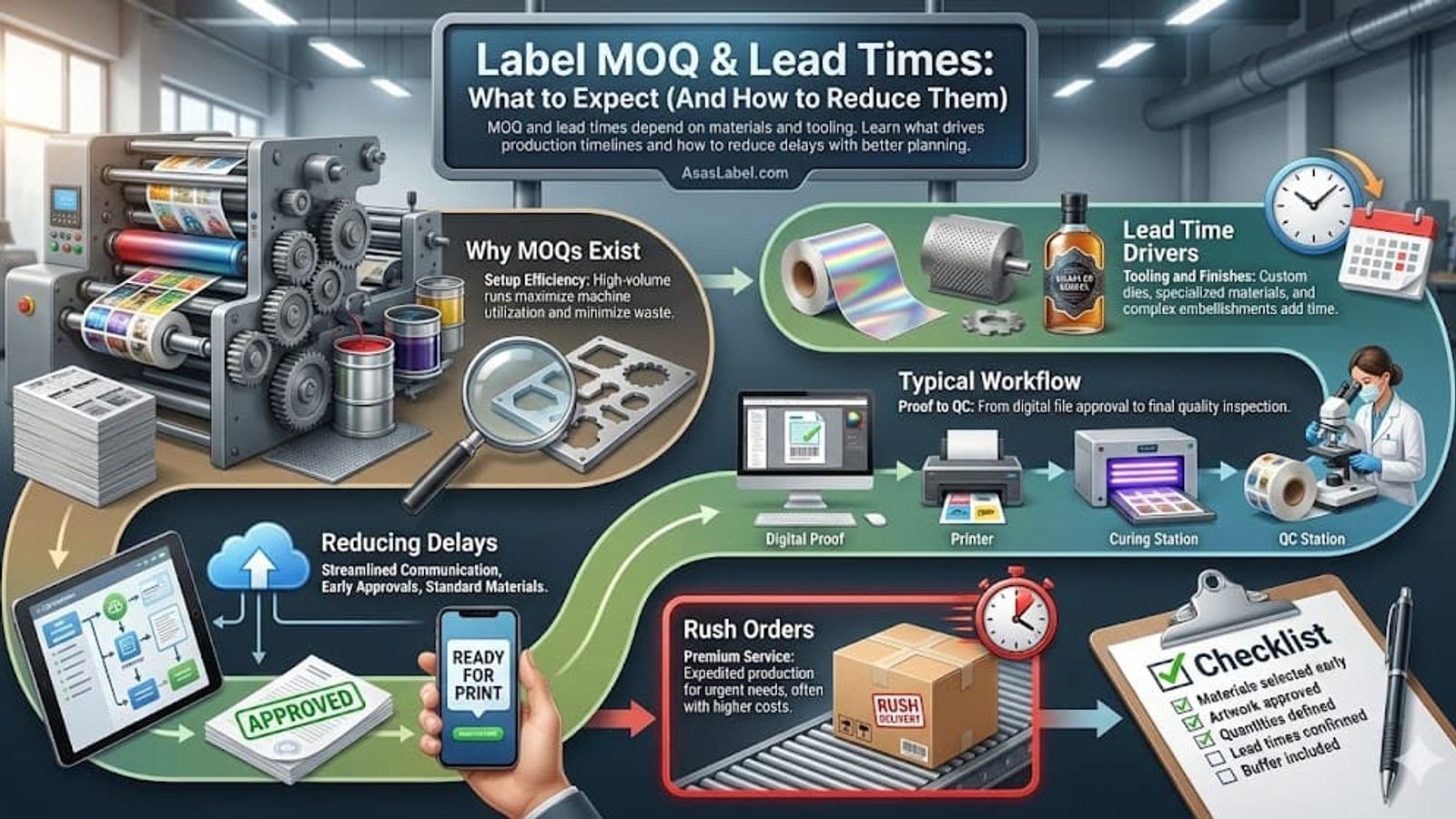
Minimum Order Quantities (MOQs) are rarely arbitrary figures set by manufacturers to force higher volume purchasing; they are essential for managing long lead times. They represent the calculated threshold where a production run becomes financially viable. In the label and packaging industry, viability hinges on the intersection of fixed setup costs and variable unit costs. Understanding your minimum order quantity requirements helps you navigate the supply chain more effectively.
Every manufacturing job incurs static expenses regardless of whether ten units or ten thousand units are produced, directly affecting your lead times. These costs include administrative processing, raw material sourcing, and machine calibration within the production process. When order volumes fall below the MOQ, the revenue generated fails to cover these initial expenditures, resulting in a net loss for the facility and longer lead times for other clients.
Understanding unit economics is essential for procurement professionals looking for ways to reduce costs and maintain customer satisfaction. The price per label is heavily influenced by the amortization of these fixed costs. At the MOQ level, the buyer is essentially paying a premium to cover the setup, ensuring the manufacturer breaks even while maintaining a marginal profit and better supply chain management.
Manufacturers must allocate machine time effectively to maintain operational flow and reducing lead. A press capable of printing hundreds of feet per minute loses significant value when stopped for frequent changeovers. MOQs protect the production schedule from being fragmented by micro-runs that consume more time in setup than in actual manufacturing, which is a core tenet of supply chain management.
Setup Efficiency and Waste Amortization: Ways to Reduce Lead Times
The primary driver of MOQs in flexographic and offset printing is the physical "make-ready" process, which can significantly increase lead times if not optimized. This involves mounting plates, mixing inks to precise Pantone formulas, and threading the substrate through the press. Before a single sellable label is produced, the operator must run hundreds of feet of material to align registration and achieve color consistency. Shorter lead times mean these processes must be highly efficient.
This setup scrap is a sunk cost that affects manufacturing lead time. If a buyer orders 500 labels, the waste material might equal or exceed the volume of the finished product. The cost of this wasted substrate and ink must be absorbed into the unit price. High MOQs allow this waste to become a negligible fraction of the total material usage, which helps reduce lead time for larger batches.
Machine calibration requires skilled labor and impacts production lead time. A master press operator spends valuable time tweaking tension settings and die-cut pressure. If the press runs for only ten minutes to fulfill an order after an hour of setup, the labor efficiency ratio plummets. MOQs ensure that the run time justifies the setup labor, preventing shipping delays down the line.
Digital printing has lowered the barrier for entry by eliminating plates and reducing registration time, allowing for a low moq. However, digital presses still have improved uptime requirements and "click charges" that dictate cost structures. While digital MOQs are lower, they are not non-existent due to the need for finishing, slitting, and quality checks. This can lead to shorter lead times compared to traditional methods.
Finishing equipment often dictates the hard floor for order quantities and material lead time. Even if a digital press prints one label, that label must be die-cut, stripped of the matrix, and rewound. The setup for the finishing line can be just as complex as a traditional press, maintaining the necessity for minimum volume requirements to meet customer expectations.
Types of Lead Time in Manufacturing: Understanding Manufacturing Lead Time and Material Handling for Reducing Lead
Lead times are a function of capacity planning, material availability, and process complexity within the supply chain lead. It is a misconception that production time is solely determined by press speed. The actual printing often accounts for the smallest fraction of the total turnaround time. Identifying the true drivers and how to reduce your lead helps in managing inventory expectations and knowing when to expect reorders.
Raw material sourcing is the first major variable in the total time of production. Standard semi-gloss paper or white BOPP stocks are typically floor items, allowing for immediate scheduling. However, specialty textures, specific adhesives for hazardous environments, or metallic substrates often require procurement from upstream suppliers, adding days or weeks to the manufacturing lead time.
Queue management creates the standard gap between when an order is placed and production. Manufacturers operate on a first-in, first-out basis, but this is complicated by job batching. Efficiency dictates that jobs using similar materials or die sizes are grouped to minimize changeovers. Lead times mean less when you understand your wait for a slot in this optimized schedule.
Tooling and Special Finishes Impact on Material Handling
Custom tooling significantly extends the initial lead time for any new project and can cut lead times if managed correctly. If a label requires a non-standard shape or size, a custom rotary die must be machined. This is a precision engineering task performed by third-party toolmakers, often adding three to five business days before the job can even enter the production queue.
Complex embellishments add distinct passes to the manufacturing process and can increase lead times. Technologies like hot foil stamping, embossing, or high-build screen varnishes often require separate machine stations or entirely different equipment passes. Each additional finish introduces a new setup phase, compounding the total production time.
Curing times and chemical reactions cannot be rushed; they are a vital part of the cycle time. Specific high-end adhesives and UV-cured varnishes require set durations to bond or harden correctly. Rushing these stages risks blocking, where labels stick together on the roll, or adhesive failure in the field. Physics dictates the timeline for these chemical processes.
Finishing specifications also play a role in lead time extension and shipping time. Standard rolls on 3-inch cores are straightforward. However, requirements for fan-folding, sheeted outputs, or specific rewind directions for automated applicators require slower, more manual finishing processes, reducing the throughput of the finishing department.
Navigating the Production Workflow for Lead Time Reduction and Faster Product Delivery
The journey from a purchase order to ship notification involves a series of rigorous checkpoints and efficient order fulfillment. Buyers often only see the "In Production" status, but the internal workflow is granular. Each stage is a gate that determines whether the job moves forward or requires remediation, directly impacting the final delivery date.
Order entry serves as the administrative foundation for the fulfillment process. Here, specifications are reviewed against the quote. Discrepancies between the requested artwork and the quoted number of colors are flagged. This administrative scrub ensures that the bill of materials generated for production matches the commercial agreement.
Prepress is where technical translation occurs and impacts process time. Graphic designers convert art files into press-ready formats, accounting for bleed, trapping, and distortion factors required for rotary printing. This is not merely file conversion but a technical modification to ensure the physical print matches the digital design.
From Proof Approvals to Quality Control: Strategies to Reduce the Time
The proofing cycle is the most common external bottleneck in the workflow, often extending the customer lead time. Production clocks typically pause while waiting for customer approval. A soft proof (PDF) confirms copy and layout, while a contract proof (hard copy) may be required for color-critical jobs. The lead time clock officially starts only after final proof approval is logged.
Automated inspection systems have transformed modern quality control (QC) and help track key performance indicators. High-speed cameras compare the running web against the approved PDF master, flagging anomalies like hickeys, missing text, or color shifts. While this ensures accuracy, setting up these inspection profiles adds time to the make-ready process.
Manual QC remains a vital step, specifically for physical attributes, to reduce errors. Operators verify adhesive integrity, core size accuracy, and rewind direction. This human oversight ensures compatibility with the end-user’s application equipment. If a defect is found, re-running the job is necessary, effectively doubling the production time for that batch.
Slitting and packaging mark the final stage before logistics and the creation of finished goods. Parent rolls are slit down to the final width and rewound to specific outer diameters. Packaging must be robust to prevent telescoping or edge damage during transit. The efficiency of the shipping department in generating labels and manifesting creates the final timestamp in the workflow.
Effective Strategies to Reduce Lead Time: Using Forecast, Automation, and Inventory Management
Optimizing artwork files prior to submission and using analytics is the single most effective way to accelerate the process. Submitting vector-based art (AI, EPS, PDF) rather than raster images ensures the prepress department does not need to rebuild the file. Ensuring fonts are outlined and colors are set to CMYK or specific Pantones expedites the proofing cycle.
Standardizing materials and dies removes supply chain variables and helps maintain optimal inventory levels. Designing labels to fit existing die inventory eliminates the wait for tooling fabrication. Utilizing "house stocks" that the manufacturer keeps in high volume ensures that material shortages do not stagger production start dates.
Forecasting and blanket orders function as a hedge against lead time fluctuations and help reduce the risk of stockouts. By providing a rolling forecast, buyers allow manufacturers to procure raw materials in advance. Blanket orders enable the production of a year's supply at once, which helps avoid excess inventory, with the manufacturer holding inventory and releasing it on demand.
Pre-approving credit terms or maintaining a deposit on file streamlines the administrative entry within your erp. Orders are often held in accounting limbo pending credit checks. Establishing a clear financial track record removes this administrative gate, allowing the order to flow immediately to the production team.
Handling Rush Orders and Strategies to Reduce Lead Time Across the Supply Chain
Expediting a job requires disrupting the established production flow and increases the time required for management. To accommodate a rush order, a manufacturer must pull a scheduled job off the press, break down the setup, run the urgent job, and then re-setup the original job. This triple-setup scenario explains the high premiums associated with rush fees.
Communication regarding "hard dates" is critical to meet customer expectations. A general request for "ASAP" is less effective than defining a specific drop-dead date for an event or product launch. Manufacturers can sometimes engage in "ganging," where the rush job is piggybacked onto a running job using the same material and die, provided the timeline aligns.
Simplify specifications to gain speed and meet demand. Bringing a rush order to the table often means sacrificing complex embellishments. Eliminating foil stamping or shifting from a custom color match to a 4-color process simulation can shave days off the production cycle by removing machine passes and ink mixing requirements.
Logistics upgrades are the final lever to avoid shipping delays. While manufacturing may take a fixed amount of time, upgrading from ground freight to air or expedited truck can recover lost days. This transfer of budget from production to logistics is often the only way to meet critical deadlines when the physical manufacturing process cannot be compressed further.
Procurement Optimization Checklist: Consolidate Orders and Streamline Your Warehouse Management System
Review the artwork technicalities before submission and use management software to track progress. Confirm that all imagery is embedded, fonts are outlined, and layers are clean. Verify that the bleed area extends at least 1/16th or 1/8th of an inch beyond the trim line. Clean files prevent the back-and-forth email volley that stalls the project at the starting gate.
Define the accept/reject criteria early as part of your vendor management. If color matching is critical, specify the Pantone numbers or provide a physical sample to match. Vague instructions like "match the red in our logo" lead to subjective interpretation and potential rejection. Precise specifications lead to precise manufacturing and better inventory control.
Audit your die library and consider diversifying suppliers. Request a list of existing dies from your manufacturer. Modifying your label size by a fraction of an inch to match an existing tool can save hundreds of dollars and days of wait time. Design with manufacturing constraints in mind and try to keep at least one backup supplier available.
Consolidate SKUs where possible to meet customer needs. Instead of ordering ten small runs of different flavors, inquire about digital printing options that allow variable data printing within a single run. This aggregates the volume to meet MOQs easily and streamlines the production into a continuous efficient event, keeping you updated on trends and customer needs.
Clarify the receiving requirements and reduce your time to react. Ensure you know the maximum outer diameter (OD) your application equipment can handle, the core size, and the unwind direction (copy position). Providing these details upfront prevents the costly error of receiving rolls that physically do not fit on your applicators, keeping you ahead of the competition.