
Contact Sales Now
Thank you! Your submission has been received!
Oops! Something went wrong while submitting the form.

Contact Sales Now
Thank you! Your submission has been received!
Oops! Something went wrong while submitting the form.

Packaging involves more than just aesthetics. In the food and beverage sector, the label serves as the primary interface between the product, the consumer, and regulatory bodies. For any brand, ensuring food labeling compliance within the beverage industry is critical to building consumer trust and maintaining product integrity.
Industry professionals understand that a label failure is a product failure. If a label peels in a humid warehouse or fades under retail lighting, the brand’s equity diminishes immediately. Technical specifications for product labels must align perfectly with the product's lifecycle to ensure the label stays intact and legible throughout the supply chain.
Operational efficiency depends on selecting the right combination of substrate, adhesive, and topcoat. This ensures smooth application on the bottling line and durability through distribution. Decisions made here by food and beverage businesses impact the total cost of ownership and shelf velocity while ensuring labels meet regulatory requirements.
The dual mandate of any food packaging component is persuasion and compliance. Your label must arrest the consumer's attention within seconds while satisfying rigorous legal standards like the Fair Packaging and Labeling Act. Neglecting either side of this equation results in lost sales or costly recalls for food manufacturers.
Market saturation requires distinct visual differentiation and high-quality printed labels. High-quality graphics and precise color matching ensure your SKU stands out against competitors. However, visual appeal cannot compromise the accurate transmission of nutrition facts and other mandatory information required by the Food and Drug Administration.
Regulatory bodies like the FDA enforce strict guidelines regarding the Principal Display Panel and the Information Panel. Font sizes, contrast ratios, and allergen declarations are not suggestions; they are design essentials. They represent mandatory legal constraints that dictate design parameters to help consumers make informed choices.
Readability is paramount for consumer safety and regulatory compliance. A confused customer will not purchase the product. You must ensure that the nutrition facts panel remains legible regardless of package size or shape. This often requires strategic use of white space and high-contrast typography to ensure your label is effective.
Ingredient lists must list allergens clearly, as labels must meet the Food Safety and Inspection Service standards for transparency. Hiding this information in condensed fonts invites liability. Modern consumers scrutinize labels to protect their health, looking for transparency regarding preservatives, additives, and caloric content. The design food process must accommodate this data hierarchy without clutter.
Safety extends to lot tracking, traceability, and expiration dating. Variable data printing allows for unique batch codes and security numbers on every unit. This traceability is essential for supply chain management and rapid response during safety alerts. The designated area for this code must accept thermal transfer or inkjet overprinting reliably to maintain compliance.
The intersection of design and law requires a disciplined approach to help you create labels that meet all standards. Marketing teams often push for maximal branding space, while regulatory affairs teams prioritize warnings and facts. The final label construction must harmonize these competing demands without physical overcrowding or compromising the principal display panel.
Format selection dictates the application machinery required on the production line. Moving from a simple cut-and-stack label to a pressure-sensitive roll changes the capital equipment needs for beverage products. Production speed and container geometry largely drive this decision within the food and beverage industry.
Pressure-sensitive adhesive labels dominate the premium segment, including the craft beer label market. They offer high-definition print quality and versatile die-cutting options. PSLs support complex shapes that can accentuate the contours of a bottle or jar, enhancing shelf presence and elevating your brand.
Shrink sleeves provide 360-degree coverage, making them popular labeling solutions. This format maximizes the real estate available for graphics and regulatory text. It conforms to irregular container shapes, allowing for unique structural packaging designs that standard adhesive labels cannot accommodate without compromising quality.
Wrap-around labels function well for high-volume cylindrical containers like water bottles and canned goods. They are cost-effective and apply at very high speeds. However, they typically offer less tactile appeal than textured film labels or matte sleeves used for more sophisticated beverage products.
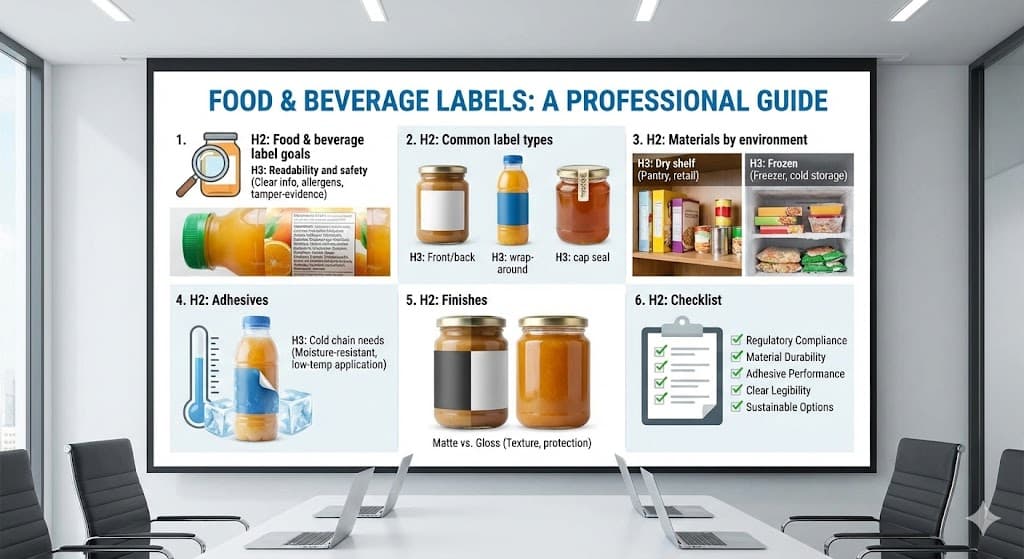
Front and back labeling remains a standard for glass bottles and jars. This separation allows the brand story to dominate the front while legal text resides on the back. It creates a clean, minimalist aesthetic preferred in the artisanal and sauce categories, ensuring the first point of contact is visually striking.
Cap seals and neck bands serve a critical security function. Tamper-evident labels are non-negotiable for consumable goods to ensure product safety. These bands provide visual proof of product integrity. If the seal is broken, the consumer knows to discard the product immediately, which reduces the risk of consuming compromised goods.
Shrink sleeve extensions can cover the cap and the bottle neck. This integrates the tamper-evident feature directly into the primary label. It streamlines the packaging process by removing the need for a separate safety seal application station, helping you create a more efficient production line.
The perforation on a neck band must be precise. If the perforation is too strong, the consumer struggles to open the package. If it is too weak, the band may split during shipping, resulting in unsalable inventory due to false tampering alarms. Finding the right type of security label is essential for maintaining product safety and quality.
The substrate is the foundation of label performance. Selecting a material based solely on cost often leads to failure in the field. You must match the face stock to the environmental stresses the product will encounter to ensure durability and appearance remain consistent.
Paper labels offer a classic, organic look. They function well for dry goods like spices, pasta, or boxed items. Textured paper labels communicate premium quality for wine and spirits, often seen in the beverage industry. However, paper lacks inherent moisture resistance without a heavy coating or lamination.
Film labels, such as Polypropylene (BOPP), provide vastly superior durability. They resist tearing, moisture, and oils, which is a key requirement for food labeling. Films are essential for products containing fats or acids that might migrate onto the label surface, ensuring the label stays intact during moisture and handling.
Metalized films create a reflective, foil-like appearance. While visually striking, these materials effectively block visual inspection of the product inside. They also require specific ink sets to ensure proper adhesion and color rendering, which is why choosing the right label material is so vital for high-end brands.
Dry shelf environments are forgiving. Almost any standard semi-gloss paper or film will suffice for labeling and packaging. The challenge arises when products move between temperature zones. Condensation is the enemy of standard paper labels, making it necessary to choose materials like film for liquid products.
Beverages intended for ice buckets or coolers require high wet strength. A standard paper label will absorb water, turn to pulp, and slide off the bottle. Wet-strength papers or synthetic film labels are mandatory for white wines, craft beer, and sodas to withstand various conditions.
Frozen foods present a distinct set of physical challenges. As a container freezes, it may expand or contract. A rigorous film substrate must flex with the packaging. Rigid materials will wrinkle or bridge, creating tunnels where moisture can attack the adhesive, compromising the product's shelf appeal.
Blast freezing involves rapid temperature drops. This thermal shock can cause varied expansion rates between the bottle and the label. The face stock must possess dimensional stability to withstand these temperature changes without distorting the barcode or graphics, ensuring labels remain legible.
High-humidity storage affects porous packaging. Corrugated boxes in damp warehouses can soften. If the label stock is also hygroscopic, it may curl away from the package. Using durable materials like film in tropical climates or refrigerated trucks mitigates this risk and ensures your label meets industry standards.
The adhesive is the invisible engine of the label. An incorrect adhesive specification is the most common cause of packaging line downtime and market rejection. One adhesive does not fit all food and beverage industry applications.
Surface energy determines how well an adhesive bonds. High-energy surfaces like glass and PET plastic are easy to label. Low-energy surfaces, such as polyethylene (HDPE) or wax-coated cartons, repel standard adhesives and require aggressive tack to ensure labels remain attached throughout the supply chain.
Acrylic adhesives provide excellent clarity and UV resistance. They are ideal for 'no-label look' applications on clear glass. However, they generally require time to flow out and build ultimate bond strength, which is an important aspect of food labeling and compliance.
Rubber-based hot melt adhesives offer high initial tack. They grab the surface immediately, which is crucial for high-speed application lines. However, they may yellow over time and can suffer from adhesive ooze during the die-cutting process, affecting the overall product's appearance.
Does the product arrive at the labeler wet or dry? Condensation on a bottle during filling acts as a barrier. You need a specialized wet-stick adhesive that can emulsify the moisture and bond to the glass beneath, which is often the first point of contact for the label applicator.
Freezer-grade adhesives differ chemically from all-temp adhesives. A standard adhesive crystalizes and loses tack below freezing. Freezer formulations remain malleable at sub-zero temperatures, ensuring the label does not pop off in the consumer's manufacturing freezer or during transport.
Application temperature differs from service temperature. Many freezer adhesives must be applied at room temperature before the product is frozen. If you are labeling a product that is *already* frozen, you need a specialized deep-freeze adhesive with extreme initial tack to ensure your label stays in place.
Recyclability is a growing concern in cold chain logistics. Wash-off adhesives allow the label to separate cleanly from the PET bottle during the recycling bath. This prevents contamination of the recycled plastic stream, a key requirement for sustainable packaging audits and regulatory compliance.
The topcoat or laminate serves as the armor for your ink. Without protection, handling during shipping will scuff the design. Exposure to fluorescent retail lights will cause brand colors to fade, so durable materials are necessary to maintain their quality.
UV varnishes are a cost-effective method to seal the ink. They can be applied in high gloss for vibrancy or matte for a sophisticated, subdued look. Spot varnishing highlights specific design elements, adding depth to beverage products and making your product more attractive to consumers.
Lamination provides the ultimate physical protection. A clear layer of polypropylene film over the print renders the label virtually scratch-proof. This is essential for heavy items that rub against each other during transit in master cases, helping you create labels that withstand the journey.
Tactile finishes engage the consumer's sense of touch. Soft-touch laminates create a velvety feel. Raised screen varnishes simulate embossing without the cost of tooling. These sensory details increase perceived value and shelf impact, helping consumers make informed choices based on premium quality.
Before committing to a full production run, conduct a rigorous audit. Errors discovered after printing destroy margins and delay launch schedules. Verify every technical and legal detail against the master specification and the Department of Agriculture’s or TTB requirements.
Check the barcode scan grade. A barcode that fails at the checkout register frustrates retailers and can lead to delisting. Ensure adequate quiet zones around the UPC and verify that the color contrast is sufficient for scanners to maintain efficiency in the supply chain.
Review the allergen statements one final time. Regulatory changes occur frequently. Ensure the phrasing matches the current FDA or Alcohol and Tobacco Tax and Trade Bureau standards. A typo here is a legal liability, not just a cosmetic flaw, and can damage consumer trust.
Test the adhesive on the actual production container. Theoretical specifications often differ from real-world performance. Apply sample labels and subject them to the expected environmental conditions—heat, cold, and moisture—for at least 24 hours to ensure they meet industry standards.
Verify the unwind direction. The orientation of the label on the roll must match the applicator machine's requirements. An incorrect copy position (unwind direction) will result in upside-down labels and halt the assembly line, increasing costs for food and beverage businesses.
Confirm color consistency under different light sources. Metamerism can cause colors to look correct under standard D50 light but unacceptable under store fluorescent lighting. Use spectrophotometers to adhere to strict Delta E tolerances and maintain your brand’s visual identity.
Assess the liner material. A PET liner reduces dust and allows for faster dispensing speeds compared to paper liners. Ensure your label sensors are calibrated to detect the gap or intended registration mark on the specific liner chosen to ensure your label meets all production benchmarks.