
Contact Sales Now
Thank you! Your submission has been received!
Oops! Something went wrong while submitting the form.

Contact Sales Now
Thank you! Your submission has been received!
Oops! Something went wrong while submitting the form.

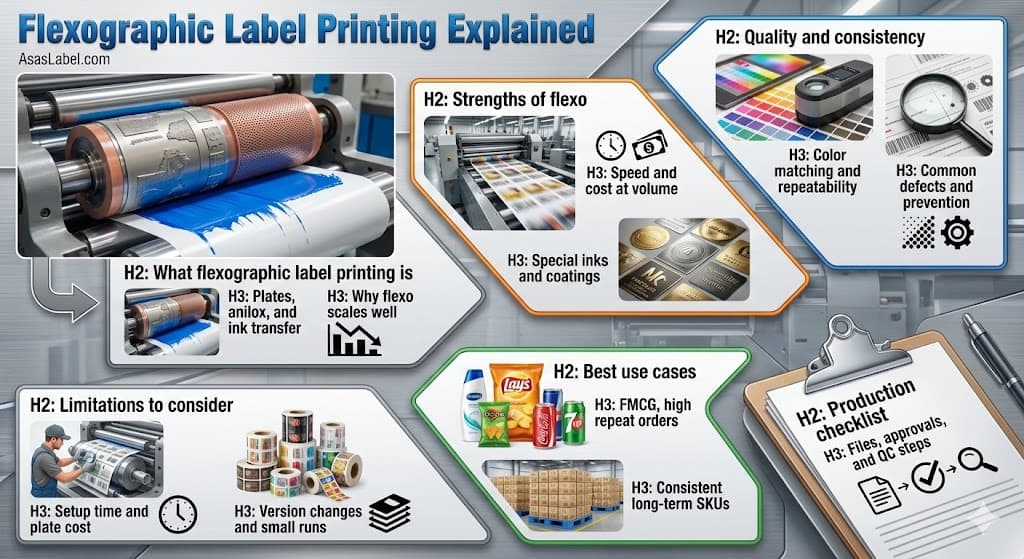
Flexography remains the dominant manufacturing printing process for high-volume label production across the global packaging and label sector. This versatile printing method is a popular method that utilizes flexible relief plates to transfer ink onto a rapidly moving substrate. It serves as the backbone for the Fast-Moving Consumer Goods (FMCG) food and beverage supply chain due to its speed and versatility.
Modern flexo presses and the flexographic press have evolved significantly from simple rubber stamp mechanisms into sophisticated engineering marvels capable of tight registration and high-quality print quality. The printing process accommodates a wide range of substrates, from thin films and metallics to porous papers using photopolymer plates. High-quality results are now the standard for labels used in flexographic printing.
Efficiency drives the continued adoption of this technology. While digital label printing captures the short-run market, flexographic label printing owns the economy of scale for high volumes of labels. Understanding the mechanical nuances of how flexographic printing works is essential for procurement managers and printing companies seeking to optimize their packaging supply chains.
The core of the flexographic system relies on the precise interaction between three main components including the printing plates. The first is the anilox roll, a cylinder used in flexographic printing. This ceramic or steel cylinder contains millions of microscopic cells. These cells carry a specific volume of ink to the flexible relief plate.
Cell volume and line screen count on the anilox roll dictate the ink film thickness. A doctor blade shears excess ink from the anilox surface before it touches the photopolymer plates. This metering ensures that a consistent, measured amount of ink transfers to the image area, preventing smearing or gain issues in this versatile printing process.
The flexible relief plate itself acts as the image carrier. Made from flexible photopolymer materials, these plates feature raised image areas. When the inked anilox rotates against the plate cylinder, ink transfers only to these raised surfaces. The flexible plate then rotates against the substrate primarily held by an impression cylinder.
Plate durometer plays a critical role in print quality for flexo presses. Harder plates generally hold finer dots for process printing, while softer plates provide better coverage for solid color printing. Selecting the correct polymer hardness ensures the label is printed cleanly without distorting the substrate or causing excessive dot gain.
Flexo scales effectively because it operates as a continuous web printing press. The substrate feeds from a master roll, travels through multiple print stations, and rewinds or sheets at the end. This continuous motion allows for a high-volume print run without the start-stop nature of types of printing like letterpress printing or offset printing.
Drying systems facilitate this high velocity. UV curing lamps or high-velocity hot air dryers using ultraviolet light are positioned between print stations. This inter-station drying allows for the immediate overprinting of colors. Since water-based or uv ink does not trap effectively over wet ink, rapid curing is vital for speed and efficiency of flexographic operations.
Inline conversion further enhances scalability in the flexo printing process. A flexographic press does not just print. It can coat, laminate, die-cut, and strip waste matrix in a single pass. A raw roll of material enters one end, and finished, die-cut label products on a liner exit the other as the process into a single pass is completed.
This all-in-one workflow eliminates work-in-progress inventory for printing and finishing. There is no need to move pallets of printed sheets to a separate die-cutting machine. The reduction in material handling and secondary processing steps dramatically lowers the cost per unit as volumes of labels increase, making it more cost-effective.
Speed defines the primary advantage of flexographic label printing. Modern label presses and flexographic printing presses run at speeds ranging from 300 to over 700 feet per minute. When producing volumes of labels in the millions, this throughput capability significantly reduces press time compared to digital printing presses.
The cost structure favors a long print run. The initial setup involves fixed costs such as flexographic printing plates, tooling, and setup waste. Once the press reaches color matching and begins the production run, the variable cost per label drops precipitously. The longer the run, the cheaper the individual unit becomes compared to digital label printing.
Consumables also cost less in flexo printing environments. Buying ink in pails or drums is far more economical than purchasing proprietary digital click charges or toner cartridges. For a print run exceeding 10,000 linear feet, flexo printing is a popular method that almost always offers a superior return on investment.
Flexography handles a broader spectrum of chemistry than any other printing method. Printers can utilize water-based inks for food and beverage packaging or uv-curable inks for high durability and gloss. This chemical flexibility using ultraviolet light allows brands to meet strict environmental or printing for packaging standards.
Specialty coatings apply easily inline during the flexographic printing process. Brands can request soft-touch varnishes for a tactile feel or super-matte finishes for a premium look. Because the label is already on a web, applying a laminate or a rotary screen coating for high-build textures is a standard capability of the versatile printing process.
Adornments extend beyond ink. Cold foil units allow metallic transfers without the cost of hot stamping dies. Rotary embossing and die-cutting units can add dimension to the label surface. These inline value-added processes help products stand out on crowded retail shelves without slowing down the printing press appreciably.
The barrier to entry for a flexo printing job remains the tooling cost. Every color separation requires a unique photopolymer flexible relief plate. If a design has six colors, you must purchase six flexographic printing plates. For a single SKU, this cost is manageable, but it multiplies rapidly across a product line's printing needs.
Make-ready time also impacts the bottom line. Mounting a flexible plate onto cylinders using mounting tape demands precision. Generally, a skilled operator needs time to register each station of the flexo printing process and adjust impression settings. During this setup phase, material is often wasted before the press reaches color matching.
This setup waste makes very short runs economically unviable, as flexography 101 teaches. If a job requires 500 labels, the waste generated to set up the press might exceed the material used for the actual product. In these scenarios, the fixed costs of plates and setup make printing is a fast but expensive choice compared to digital imaging.
Flexography struggles with high-mix, low-volume orders. If a brand has diverse printing needs for ten flavors of a juice label, and only the flavor name changes, flexo requires a plate change for the text plate. The flexographic press must stop, the operator must switch the cylinder, and the setup process repeats for every version.
Variable data is another hurdle for flexography. Flexo is an analog printing method using fixed image carriers. It cannot print sequential numbering, unique QR codes, or personalized images on the fly like digital printing presses. To achieve this, a hybrid solution involving an added digital inkjet head is required.
Inventory management becomes crucial when using flexo for multiple versions. Brands cannot print "just in time" as easily as with digital label printing. They must commit to a larger print run to amortize the setup costs, leading to potential warehousing fees and the risk of obsolescence if labeling and packaging regulations change.
The food and beverage sector relies heavily on flexographic label printing. These industries demand millions of identical labels with high consistency. The requirement for water resistance and durability in refrigeration makes the robust water-based or uv ink systems the preferred choice.
Household and personal care products also fit this model. Shampoo bottles and cleaning agents require flexographic labels that withstand chemical exposure. Flexo printing inks, specifically ultraviolet cured varieties, offer the necessary chemical resistance without requiring expensive over-laminates in every application.
Commodity manufacturing utilizes this printing process for cost control. When the margin on the final product is razor-thin, the packaging and label cost must be minimized. The incredibly low unit cost of flexography on a long print run helps manufacturers protect their margins on high-volume commodity items.
Pharmaceutical and medical device labeling demands strict adherence to validated processes. Once a flexo printing process is validated, the output remains stable over years of reorders. The locked-in nature of the photopolymer plates ensures that the text and graphics do not drift or change unexpectedly.
Industrial chemicals and automotive parts often utilize static designs that rarely change. These label products are purely functional and ordered in bulk. Procuring these via flexography 101 guarantees that the supply chain remains stocked with compliant labeling at the lowest possible price point.
Brand owners with established "hero" products benefit most. If a specific SKU accounts for 80 percent of sales, that SKU should be printed flexographically. The peripheral, slow-moving SKUs can move to digital label printing, but the core volume driver belongs on a flexographic press.
Brand consistency hinges on color matching. Flexographic label printing presses utilize the Pantone Matching System (PMS) to mix specific spot colors. Unlike digital printing which simulates colors using CMYK build, flexo stations run premixed ink that matches the brand standard exactly for solid color printing.
Spectrophotometers measure color accuracy during the flexo printing process. Operators verify the Delta E, a metric indicating the distance between the printed color and the target standard. Modern flexo presses often feature automated closed-loop systems that monitor color in real-time and adjust automatically.
Anilox selection influences color reliability. If a reprint occurs months later, the flexographic printing company must use the same anilox volume and line screen to achieve the same color density. Strict standard operating procedures regarding anilox inventory are necessary for repeatable print quality.
Dot gain is an inherent characteristic of the flexo printing process. As the flexible relief plate compresses against the substrate, halftone dots expand. Prepress technicians apply compensation curves via digital imaging to the files to counteract this, ensuring the printed image looks as intended.
Gear marks or banding can appear if the flexo presses mechanics are worn. This manifests as horizontal lines across the web. Regular maintenance of the flexographic printing presses and ensuring proper tension control prevents this mechanical vibration from transferring to the substrate.
"Halo" effects occur when excessive pressure squeezes ink out from the edges of the text or images. This creates a faint ring around the flexographic labels. Operators must use "kiss" impression settings, applying the bare minimum pressure required to transfer the uv or water-based ink.
Pinholing happens when the ink fails to wet out the substrate completely. It looks like tiny voids in solid areas of color. Adjusting the ink viscosity, surface energy of the packaging and label material, or changing the anilox volume usually resolves this wetting tension issue.
File preparation is the first step in successful flexographic label printing. Designers must account for trapping, which involves slightly overlapping adjacent colors to prevent white gaps if registration shifts. Flexo requires larger trap tolerances than offset printing due to web movement.
Distortion factors must be applied to the artwork. Because the photopolymer plates wrap around a cylinder, the image stretches. Prepress software calculates the cylinder circumference and plate thickness to shrink the image slightly, ensuring it prints at the correct aspect ratio during the printing process.
Dyne level testing of the substrate is mandatory before mounting rolls. If the surface energy of the film is too low, the ink will bead up rather than lay flat. Corona treatment on the flexographic press can raise the dyne level, but verifying this before setup saves hours of downtime.
The final approval requires a press sign-off. This involves comparing the first sellable labels off the printing press against a hard-copy proof or a master target. Operators check copy, color matching, die-cutting position, and laminate levels before ramping the press up to full production speed.