

On this page
- Digital vs Flexo: Cost at Different Volumes
- Digital vs Flexo Printing: Comparing Flexographic Printing vs Digital Label Printing Costs Per Label in High Volume
- Printing Costs and Drivers: How Digital vs Flexo Printing Method Affects Label Printing
- Impact of Setup Waste and Printing Press Speed
- Finishing Capabilities and Substrate Material Costs
- Understanding Digital Printing Costs: When Digital vs Flexo Printing is Ideal
- Why the Need for Plates vs Zero Plates Impacts Cost Per Label
- Digital Label Printing Advantage for High SKU Counts and Variable Data
- Flexographic Printing Costs: Why High Volume Makes Flexo More Cost-Effective
- Amortizing Setup Costs Over Large Volume Flexo Printing Runs
- Savings for Repeat Flexo Label Orders and Reusing Printing Plates
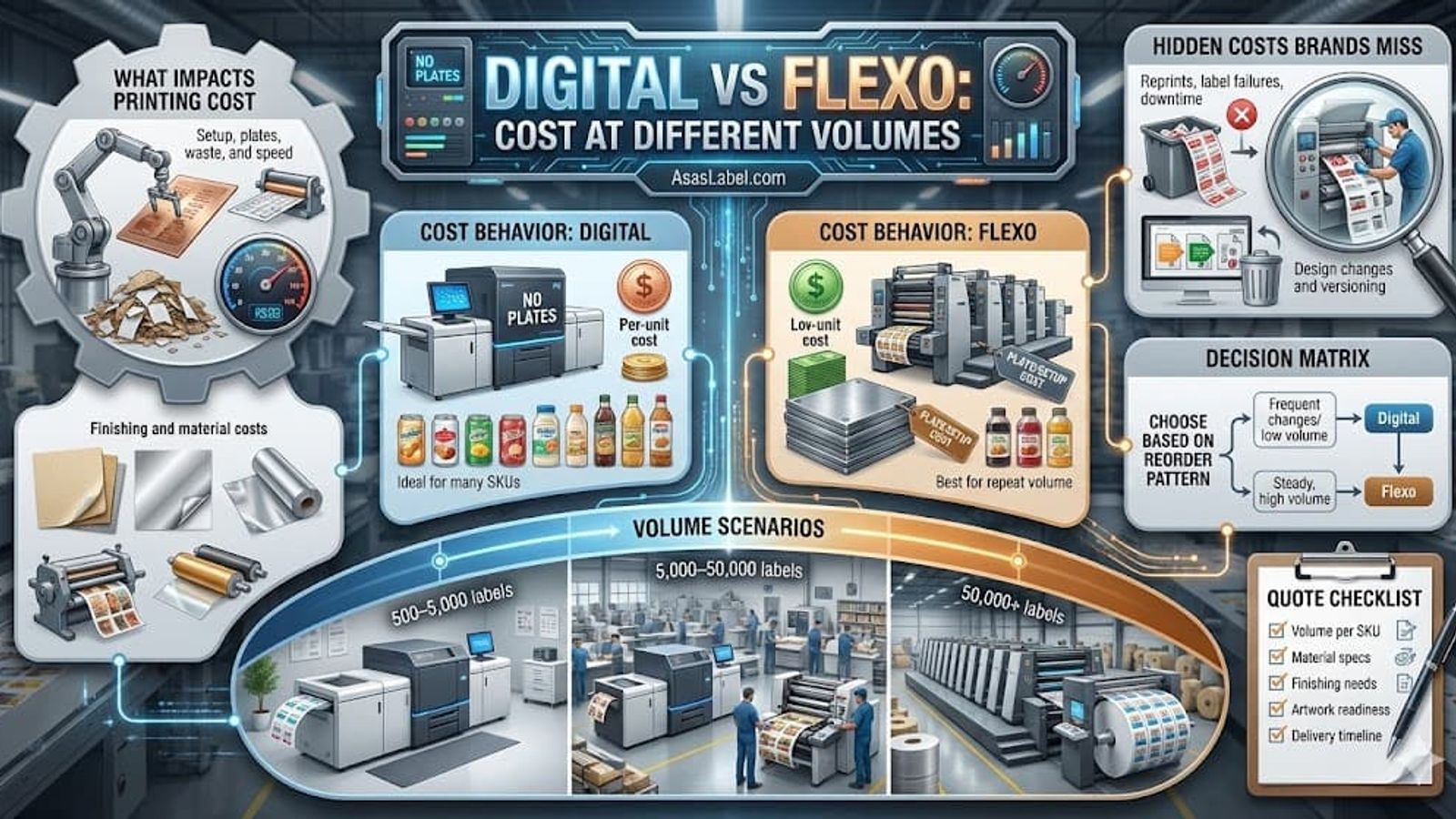
- Comparison Between Digital and Flexographic: Breakdown of Volume Scenarios
- Digital Printing for Short Runs of 500 to 5,000 Product Labels
- Mid-Range Volume: Choosing the Best Printing Method Between 5,000 to 50,000 Labels
- Flexo vs Digital Printing for Long Runs Over 50,000 Labels
- Total Cost of Ownership: Invisible Printing vs Digital Printing Costs
- Costs of Reprints, Label Failures, and Color Consistency
- Managing Label Size, Versioning, and Inventory Obsolescence
- Choosing Between Digital and Flexo Printing Based on Label Production Needs
- Selecting Based on Print Run Lifecycle Patterns and Pressure-Sensitive Labels
- Checklist for Accurate Estimates: Evaluating Digital and Flexo Printing Costs
- Providing Essential Data for Flexo and Digital Label Production Quotes
Digital vs Flexo: Cost at Different Volumes
Digital vs Flexo Printing: Comparing Flexographic Printing vs Digital Label Printing Costs Per Label in High Volume
Procurement managers and brand owners often struggle to identify the exact crossover point where label production becomes more economical on a press. The debate between digital and flexographic printing is fundamentally a calculation of fixed start-up costs versus variable running costs. Making the wrong choice regarding your digital vs flexo printing impacts not only the unit cost and price per label but also supply chain agility and inventory liquidity for your product labels.
Understanding these digital vs flexo economics requires looking beyond the cost of a single sticker and into the total cost of ownership. You must analyze the mechanics of the machinery, the labor involved in the setup process, and the inherent waste generated by each printing process. The total cost of ownership for digital label printing vs flexo label printing differs vastly depending on the lifecycle stage of the pressure-sensitive labels being produced.
This analysis breaks down the financial behavior of both digital and flexo technologies. We will examine the specific volume bands where cost advantages shift and explore the hidden expenses that quoted unit prices often obscure. This is the financial comparison between digital and flexo for optimizing your label spend across your entire product line.
Printing Costs and Drivers: How Digital vs Flexo Printing Method Affects Label Printing
The final price per label on a flexo label quote is an aggregate of material consumption, machine time, and skilled labor. However, the proportion of these printing costs shifts dramatically depending on the digital printing technology used. To control digital printing costs, buyers must understand the physical constraints of the digital printing press vs traditional flexo hardware.
Every best printing method involves a base level of friction to get the image onto the substrate. In flexographic label printing, this friction is financial, involving expensive tooling and the cost of plates. In digital systems, the friction is operational, involving slower throughput speeds per unit. Identifying which variables weigh heaviest on your custom label is the first step toward savings.
Impact of Setup Waste and Printing Press Speed
Flexography is a mechanical printing process that relies on physical pressure and contact. To start a flexo label job, operators must mount photopolymer plates, mix chemical flexo ink, and register multiple print stations. This setup process consumes significant time and cost, often taking several hours before high-quality printed labels are produced.
During this setup process, the flexographic printing press is running, creating significant setup waste. Hundreds or even thousands of feet of substrate are consumed just to align the colors and set the pressure. You pay for this wasted material within the setup fees or amortized into the unit cost. If the print run is short, the waste percentage is disproportionately high compared to digital.
Digital printing technology bypasses this mechanical setup process entirely. There is no tangible printing plate to mount and no registration calibration required for high-quality results. The first label off the digital press is usually sellable. This advantage of digital—the elimination of material waste and setup labor—creates a low barrier to entry for order initiation.
Speed is the counterweight to setup. Once a flexo press is registered, it runs at incredible velocities, often exceeding 500 feet per minute. Digital printing presses generally run slower to maintain imaging quality. As quantities rise to millions of labels, the raw speed of modern flexo presses eventually overtakes the setup handicap, reducing the runtime cost per label.
Finishing Capabilities and Substrate Material Costs
Printing is only half the flexo and digital production equation. Die-cutting labels into their final shape is a major cost driver. Traditional flexo and modern flexo lines typically integrate rotary die-cutting inline. This allows the converting to happen at the same high speed as the printing method, maintaining efficiency for a large volume.
Digital label printing often requires offline finishing or semi-rotary die-cutting. While semi-rotary dies are cheaper than full rotary tooling, the process is slower per unit. If a digital label requires complex embellishments like hot foil stamping or embossing, these additional steps can act as a bottleneck, increasing labor time and printing costs.
Substrate compatibility also dictates the price per label. Flexographic printing vs digital label printing shows that flexo and digital have different needs. Flexo presses can print on almost any raw substrate. Digital printing technology often requires top-coated or primed stocks to ensure digital ink adhesion. These pre-treated digital materials command a premium price per square inch compared to standard flexo-grade stocks.
Understanding Digital Printing Costs: When Digital vs Flexo Printing is Ideal
Digital printing costs behave linearly. The cost to print one label is roughly the same as the cost to print the ten-thousandth label. There are few economies of scale regarding the digital ink and imaging process itself. This flat pricing model offers predictability for short runs but lacks the deep discounts seen in massive manufacturing runs.
The primary cost driver in digital holds with the "click charge" or the cost of consumables. Advanced liquid electrophotography and inkjet digital printing technology rely on complex, engineered digital ink fluids. These inks and toners are significantly more expensive per gram than the flexo ink used in a flexographic printing press.
Why the Need for Plates vs Zero Plates Impacts Cost Per Label
The advantage of digital in the lack of plates is the single greatest benefit for short runs. You avoid the upfront capital expenditure of the cost of plates, which can range from $50 to hundreds of dollars per color per SKU. For a brand launching four new product labels, this digital holds the key to saving thousands in immediate cash outlay.
However, you trade this upfront savings for a higher unit cost per label. Because digital ink is expensive and press speeds are lower, the per unit production cost remains elevated. The digital press does not become more efficient just because it runs longer. The cost per label curve stays relatively flat compared to digital vs flexo printing trends.
This creates a specific financial profile for digital vs flexo. The total ticket price for the job is low because there are no plate costs or setup fees, but the cost per label is higher than it would be on a flexo press. This trade-off makes digital vs flexo printing mathematically superior only until the volume reaches a critical mass.
Digital Label Printing Advantage for High SKU Counts and Variable Data
Digital label printing fundamentally changes the economics of product families. In a flexo press environment, every flavor or scent variation requires a plate change. The press must stop, plates must be swapped, and the machine re-registered. Each stop incurs a setup fee, treating every SKU as a separate flexo label printing job.
Digital printing presses engage in dynamic imaging using digital files. The print engine can switch artwork on the fly without stopping the web. This allows converters to aggregate multiple labels per print run. Instead of ordering 1,000 labels for ten different scents, you are effectively ordering a run of 10,000 labels using variable data.
This aggregation allows brands to achieve volume tiers that would be managed separately in traditional flexo. The cost efficiency in digital printing becomes realized not from press speed, but from the elimination of changeover charges. For product labels with high variety and lower volumes per variety, digital label printing is the only financially viable option.
Flexographic Printing Costs: Why High Volume Makes Flexo More Cost-Effective
Flexo vs digital printing follows a classic manufacturing cost curve. Flexographic printing vs digital shows that flexo requires a high initial investment to begin the print run. However, once the machine is calibrated and running, the variable unit cost per label drops precipitously. The goal of flexo printing is to dilute the setup process cost across as many labels per run as possible.
The flexo ink costs in flexographic and digital comparisons are negligible. Once you have paid for the plates and the setup labor, the primary cost becomes the raw substrate. This makes flexo the dominant technology for long-run efficiency where the plate cost and setup fee become a fraction of a penny per unit.
Amortizing Setup Costs Over Large Volume Flexo Printing Runs
The concept of amortization is key to flexo printing pricing. Imagine a setup process cost of $500. If you print 1,000 labels, that setup adds $0.50 to the cost per label. This is likely prohibitive for most consumer goods. The unit cost is distorted by the preparation fees and initial printing plate investment.
Now apply that same $500 setup to a large volume run of 100,000 labels. The setup cost contribution drops to $0.005 per label. At this high volume, the setup fee is statistically irrelevant. The efficiency of the flexographic printing vs digital printing process shines through, allowing the low cost per label of flexo ink and high speed of the flexographic printing press to drive the price down.
This curve explains why flexo label printing quotes often show massive price breaks at higher quantities. The converter is passing on the efficiency of the machine uptime. The longer the press runs without stopping, the more profitable the job is, and the lower the price per label falls.
Savings for Repeat Flexo Label Orders and Reusing Printing Plates
Flexographic printing vs digital printing also highlights that flexographic plates are reusable assets. Photopolymer plates are durable and can usually withstand hundreds of thousands of impressions. When a brand places a reorder for the exact same artwork, the plate cost is removed from the price per label calculation.
This makes the second print run of a flexo label job significantly cheaper than the first. While there is still a setup fee to mount the plates and ready the flexo press, the tooling investment is already paid for. For brands with stable product labels that do not require frequent design changes, flexo label printing offers long-term savings.
Digital printing does not offer this "reorder discount" in the same way. Since there were no plates to begin with, the digital printing costs for the second run are largely the same as the first run, barring any fluctuations in material substrate costs or total volume aggregation.
Comparison Between Digital and Flexographic: Breakdown of Volume Scenarios
Theory serves as a guide, but decision-making requires hard numbers. While every converter has different overhead structures and printing press hardware, the industry generally adheres to specific "crossover points." These are the production volumes where the cost advantage flips from digital vs flexo printing technology to the other.
The following scenarios assume standard pressure-sensitive labels. Keep in mind that variables like label size and the number of colors play a massive role. A large label size consumes roll footage faster, which makes flexo the best printing method sooner than a small postage-stamp-sized label.
Digital Printing for Short Runs of 500 to 5,000 Product Labels
In this bracket, digital holds the undisputed winning position. The math simply does not support flexography. A run of 500 labels on a flexo press would produce more waste material than finished product labels. The labor time to set up the press would exceed the time spent printing the actual job.
For 5,000 labels, flexo printing might start to look feasible if the label size is very large or uses only one color. However, for a standard 4-color custom label, the plate costs alone would double or triple the job value compared to digital. Brands in this volume tier should almost exclusively utilize digital label printing.
Market testing relies heavily on this tier. Brands launching a limited edition or testing variable data for a new regional flavor need the flexibility of digital printing to order small amounts without tooling penalties. Digital holds the advantage for this low-risk market entry.
Mid-Range Volume: Choosing the Best Printing Method Between 5,000 to 50,000 Labels
This is the gray zone for digital and flexo. The "crossover point" usually lives within this range. For a simpler flexo label with few colors, flexo printing might become cheaper around 15,000 or 20,000 units. For a complex high-definition custom label, digital printing costs might remain competitive up to 40,000 units.
Label dimensions dictate the decision here. A 3”x3” label occupies less linear footage than a 4”x6” label. Flexo label efficiency is based on linear footage, not just unit count. If the job consumes significant roll substrate, the faster running speed of the flexographic printing press begins to eat away at the digital advantage.
Buyers in this zone should request dual quotes. Ask the converter to price the job both ways for a comparison between digital and flexo. Often, the total price difference is negligible, and the decision may come down to other factors like print quality preference or shorter lead time requirements rather than raw cost per label.
Flexo vs Digital Printing for Long Runs Over 50,000 Labels
Once volumes exceed 50,000—and certainly as they approach 100,000—flexographic and digital label printing comparison favors flexo. The high running speed of modern flexo presses drastically reduces press time. The low cost per label of flexo ink consumables maximizes the margin for a large volume.
At these high volume levels, the higher per-unit "click charge" of digital label printing becomes a liability. The accumulation of digital ink costs for 100,000 labels would far exceed the cost of plates and setup on a flexo press. The ROI on the initial plate cost is realized quickly.
Logistics also favor flexo vs digital here. Converters can finish rolls faster with inline die-cutting. For global brands requiring millions of labels, the throughput capacity of flexographic printing is essential to keep supply chains fed. Digital holds a disadvantage and creates production bottlenecks at these massive volumes.
Total Cost of Ownership: Invisible Printing vs Digital Printing Costs
The price per label on a quote is effectively a "best-case scenario" price. It assumes the labels will be used, the versioning won't change, and the application lines will run smoothly. In the real world, inefficiencies occur. These invisible printing vs digital printing costs can erode the savings gained by choosing a specific printing method.
Smart procurement looks at Total Cost of Ownership (TCO). This digital and flexographic approach factors in the cost of obsolescence, storage, and application line downtime. Sometimes, paying a higher unit cost for digital printing becomes the better choice to prevent a much improved financial loss downstream.
Costs of Reprints, Label Failures, and Color Consistency
Print quality consistency varies between flexographic and digital. Flexography relies on chemical handling and operator skill to maintain color consistency throughout a print run. If a flexo press run varies 2,000 feet into the roll, those labels may cause stoppages on the automatic applicator at the co-packer.
Additionally, large volume orders require warehousing. Storing months of label production inventory ties up capital and occupies physical space. If the pressure-sensitive labels are stored improperly—exposed to humidity or heat—the adhesive can degrade. This leads to label failures, requiring reprints and creating production downtime.
Digital label printing technology promotes "Just-in-Time" manufacturing. By ordering smaller quantities more frequently via a digital printing press, brands reduce the risk of inventory degradation. While the unit cost is higher, the reduction in storage costs and waste due to spoilage often balances the ledger in the comparison between digital and flexo.
Managing Label Size, Versioning, and Inventory Obsolescence
The most expensive custom label is the one you throw away. Regulatory changes in sectors like food, beverage, and cannabis are frequent. A minor change in FDA nutritional fact requirements can render a large volume inventory of 50,000 labels instantly obsolete.
If a brand printed 100,000 labels using a flexographic printing press to save 20% per unit, but ends up discarding 40,000 of them due to a version change, the effective cost per label skyrockets. In this flexographic and digital label printing scenario, the savings were an illusion.
Digital holds the insurance policy against obsolescence. Brands that update their digital files frequently to stay relevant or compliant should view the higher digital printing costs as a premium paid for agility. It prevents the sunk cost of unusable bulk inventory that makes flexo more risky in shifting markets.
Choosing Between Digital and Flexo Printing Based on Label Production Needs
Selecting the right technology for label production is rarely just about math. It is about matching the printing method to the business model of the brand. Startups have different liquidity needs than legacy enterprise brands requiring millions of labels.
Converters often have a "sweet spot" for printing vs digital printing based on their equipment list. A shop with mostly digital presses will push you toward digital vs flexo, while a flexo house will push flexo label printing. Understanding your own reorder patterns and time and cost constraints empowers you to direct the conversation.
Selecting Based on Print Run Lifecycle Patterns and Pressure-Sensitive Labels
Analyze your product's lifecycle. Is this a core SKU that has remained unchanged for three years and sells consistent large volume annually? This is a flexo press candidate. You can predict demand, invest in plates, and buy in bulk to maximize your unit cost margin.
Conversely, is the product labels use seasonal? Is it a promotional flavor or a custom label with variable data? Is the brand still in the growth phase where design tweaks are likely every six months? These scenarios make digital printing ideal. The ability to pivot without incurring new plate charges for every minor digital and flexo edit is crucial for protecting cash flow.
Look at the frequency of orders. If you order every two weeks, you might be better off aggregating those orders into one larger monthly flexo label printing run. If cash flow is tight and you prefer to hold cash rather than inventory, smaller frequent digital runs are the superior strategic printing method.
Checklist for Accurate Estimates: Evaluating Digital and Flexo Printing Costs
To get a true comparison between digital and flexo, you must provide the converter with granular details. Vague requests lead to "padded" quotes where the printer adds margin to cover unknowns. Precision in your flexo and digital printing RFQ yields the sharpest pricing.
When requesting a quote for digital and flexographic printing, explicitly ask for the break-even quantity. Ask the converter, "At what quantity does it make sense to move this job from digital vs flexo?" This question forces them to reveal their internal cost structure and run rates for their printing press hardware.
Providing Essential Data for Flexo and Digital Label Production Quotes
Ensure your Request for Quote (RFQ) includes the exact label size and substrate requirements. Even a fraction of an inch change can allow a flexo press converter to fit more labels per width, drastically reducing material substrate costs and unit cost.
Specify the exact number of colors if you are considering flexographic printing vs digital. Remember, in digital label printing, the number of colors rarely impacts price, but in flexo, every spot color is a cost multiplier. If you can convert a spot color to a CMYK build in your digital files, you may save significant setup process fees.
Finally, clearly state the annual volume versus the per-order volume for your digital and flexo needs. A converter might price a 5,000-label order as a digital label printing job. But if they know you will order that 5,000 labels twelve times a year, they might propose a flexo "print-and-hold" agreement that lowers your price per label substantially.