

On this page
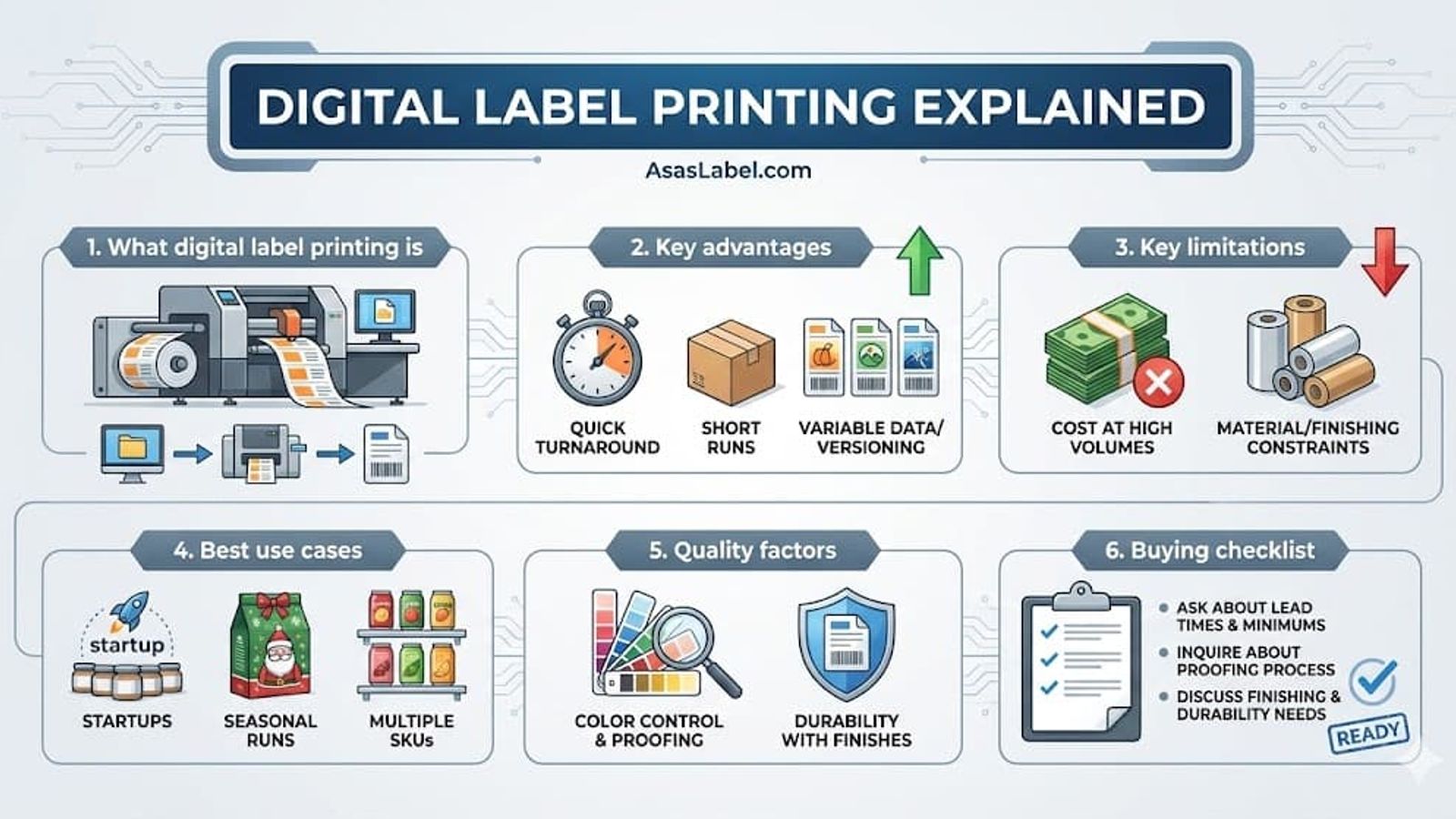
- Digital Label Printing Explained
- Defining Digital Label Technology
- Mechanics of Digital Press Operation
- Where Digital Fits Modern Production
- Why Brands Shift to Digital
- Accelerating Turnaround for Short Runs
- Leveraging Variable Data and SKU Management
- Where Digital Technology Falls Short
- Analyzing Cost Inefficiencies at Scale
- Navigating Material and Finishing Hurdles
- When Functionality Demands Digital
- Managing Seasonal Campaigns and SKU Proliferation
- Executing High Fidelity Designs and Frequent Updates
- How Does Print Quality Compare
- Mastering Color Consistency and Proofing
- Enhancing Durability with Post Press Finishes
- Checklist for Ordering Custom Labels
- Critical Questions for Your Print Partner
Digital Label Printing Explained
Defining Digital Label Technology
Digital label printing removes the mechanical steps required in traditional analog methods. Unlike flexography or offset printing, this process does not utilize physical plates to transfer images onto the substrate. The image is generated directly from a digital file, allowing for immediate transfer to the material.
The core technology typically relies on one of two methods. The first is liquid electro-photography, notably popularized by HP Indigo presses. This method uses charged liquid ink, often referred to as ElectroInk, which forms a thin layer on a photo-imaging plate before transferring to a blanket and finally the substrate.
The second dominant method is UV inkjet printing. This technology uses print heads with thousands of microscopic nozzles. These nozzles jet droplets of UV-curable ink directly onto the moving web of material. LED lamps immediately cure the ink, creating a durable and slightly raised tactile finish.
By eliminating plates, the setup becomes purely electronic. Prepress operators send files directly to the press’s Digital Front End (DFE). This computer manages color separation, imposition, and ripping, streamlining the workflow significantly compared to analog environments.
Mechanics of Digital Press Operation
Digital presses operate closer to a desktop printer but on an industrial scale. In electro-photography, a laser writes the image onto a charged drum. The drum attracts the charged ink particles, which then transfer to the material. This happens for every color separation in rapid succession or simultaneously.
Inkjet presses function without contact involved in the image creation. Piezoelectric print heads pulse chemically engineered inks onto the substrate. Because there is no contact, there is less stress on the material, which helps when printing on sensitive or thinner substrates.
The registration in digital presses is electronically controlled. Sensors constantly monitor the web speed and position. This feedback loop ensures that CMYK layers align perfectly, often achieving tighter registration tolerances than standard flexographic stations managed by gears and cylinders.
Color management is handled via software profiles. The press creates color using a process model, typically CMYK, with the option for extended gamut inks like Orange, Violet, or Green. This simulation allows the press to match Pantone colors without physically mixing spot inks.
Where Digital Fits Modern Production
Digital printing labels acts as a strategic complement to flexography rather than a total replacement. It occupies the production niche where traditional methods are economically unviable. This is typically defined by run length and complexity of design.
Modern production facilities often utilize a hybrid approach. Long-run, static jobs usually go to flexo presses to capitalize on lower consumable costs. Short-run, high-mix jobs are routed to digital lines. This bifurcation maximizes overall equipment efficiency (OEE) across the production floor.
The technology also fits into "just-in-time" manufacturing models. Brands no longer need to warehouse months of inventory. They can order exact quantities needed for immediate production, reducing waste and storage costs. Digital production facilitates lean supply chains.
Furthermore, digital presses are increasingly integrated with inline converting. Modern machines now pair digital print engines with semi-rotary die-cutting, lamination, and varnishing units. This allows raw material to enter one end and finished custom labels to exit the other in a single pass.
Why Brands Shift to Digital
The market demand for customization and speed drives the adoption of digital technologies. Brands require agility to respond to market trends, regulatory changes, and consumer preferences. Digital label printing offers the necessary flexibility to pivot strategies without incurring prohibitive setup costs.
Budget allocation shifts from setup fees to actual product value. In traditional printing, a significant portion of the budget pays for plates and makeready waste. With digital, nearly every dollar spent goes toward the final printed output, providing better ROI for targeted campaigns.
This shift also democratizes professional packaging. Small businesses can access high-quality packaging that was previously reserved for large corporations with massive budgets. The barrier to entry for shelf-appeal is significantly lowered.
Accelerating Turnaround for Short Runs
Speed is the primary currency in short run label printing. Eliminating plate manufacturing saves days of prepress time. A file can be approved in the morning and printed by the afternoon. This rapid cycle creates a massive competitive advantage for brands launching new products.
Setup waste on digital presses is minimal. A flexo press might waste hundreds of feet of material getting colors up to density and registration aligned. A digital press is often up to color and registration within one frame size or a few meters of web.
This efficiency makes runs of 500 to 10,000 labels economically attractive. Converters can schedule dozens of varying jobs in a single shift. The downtime between jobs is limited to changing the roll of material, rather than washing ink stations and changing tooling.
Retailers requiring strict delivery windows benefit immensely. If a product surge occurs, replenishment orders can be processed immediately. The supply chain becomes reactive and elastic, preventing stock-outs on retail shelves.
Leveraging Variable Data and SKU Management
Digital printing excels at handling multiple SKUs. In the food and beverage industry, a single product line might have twenty flavor variations. Analog printing would require different plates for every flavor. Digital printing treats different artworks as a continuous flow of data.
This capability is known as "ganging." A printer can combine multiple varied artworks onto a single roll. As long as the die cut size and material remain the same, distinct products can be printed back-to-back without stopping the press.
Variable Data Printing (VDP) takes this further by changing elements on every single label. This includes serialization, consecutive numbering, barcodes, and QR codes. Such features are essential for track-and-trace security logisitics and inventory management.
Hyper-personalization campaigns leverage VDP for marketing. Brands can print individual names, unique images, or localized messages on every unit. This capability transforms the product packaging into a direct communication channel with the consumer.
Where Digital Technology Falls Short
Despite the advancements, digital is not the universal solution for all labeling needs. Economics and physics still impose boundaries. Understanding these limitations is crucial for procurement managers deciding where to allocate their printing spend.
The production speed of digital is generally slower than mature analog technologies. While digital presses are getting faster, high-end flexo presses can run at speeds exceeding 500 or 600 feet per minute. Most digital units operate significantly below that threshold, creating a bottleneck for massive volume jobs.
Color matching, while advanced, has physical limits. While extended gamut printing can hit a high percentage of the Pantone book, certain fluorescent or metallic colors are difficult to replicate digitally without specialized, expensive inks or hybrid stations.
Analyzing Cost Inefficiencies at Scale
The cost structure of digital printing is linear. The cost per unit remains relatively flat regardless of quantity because there are no setup costs to amortize. However, the unit cost is higher due to expensive inks and sophisticated maintenance contracts.
Analog printing has a declining cost curve. The first label is expensive due to setup, but the millionth label is incredibly cheap. There is a specific "crossover point" where digital becomes more expensive than flexography. This usually lands between 10,000 and 50,000 linear feet, depending on the job.
Click charges or service contracts often apply to digital presses. Manufacturers charge the printer based on the number of impressions or volume of ink used. These recurring costs make very long runs financially impractical compared to buying bulk ink buckets for flexo.
Warehousing strategies affect this equation. If a brand has the space and capital to store six months of labels, buying a massive flexo run is cheaper. Digital is only cost-effective if the brand values cash flow and low inventory over the absolute lowest unit price.
Navigating Material and Finishing Hurdles
Not all substrates are inherently widely compatible with digital inks. Many materials require a "top coat" or primer to ensure the ink adheres correctly and cures properly. This enables the usage of standard stocks but adds a step or cost to the material procurement.
Heat sensitivity can be an issue. The curing process for UV inkjet involves mostly UV lamps, but electro-photography involves heat fusing. Thin films or shrink sleeves require careful management to prevent distortion or shrinking during the printing process.
Finishing options often require offline processing. While hybrid presses exist, many digital labels are printed on a roll and then moved to a separate machine for die-cutting and varnishing. This double handling increases labor costs and the risk of alignment errors.
Metallic embellishments are harder to achieve inline digitally. Cold foil and hot stamping usually require plates and dies. To achieve untooled metallics, printers must use specialized digital foil units, which are slower and more expensive than traditional tooling methods.
When Functionality Demands Digital
Certain business scenarios necessitate digital production regardless of volume. When the risk of obsolescence is high, or the data on the label changes frequently, the static nature of analog plates becomes a liability. Digital offers insurance against waste.
Regulatory environments are a prime driver. Industries like pharmaceuticals and cannabis face constantly shifting legal requirements. Digital allows manufacturers to update warning text or ingredient lists instantly without scrapping expensive tooling.
This technology also serves as a bridge for product prototyping. Brands can produce near-production quality samples for focus groups or investor meetings. These samples look identical to the final shelf product, providing accurate feedback before full-scale manufacturing begins.
Managing Seasonal Campaigns and SKU Proliferation
Seasonal runs are the sweet spot for custom label printing via digital. A coffee roaster might want a specific "Pumpkin Spice" label for only two months. The volume does not justify buying plates. Digital allows for this transient branding with minimal financial exposure.
Startups inherently possess low volume requirements and high SKU counts. A new skincare line might launch with five products, needing only 500 labels for each. Digital allows these companies to look like major players without the capital tied up in inventory.
Market testing becomes viable. A brand can print Version A and Version B of a design to test consumer response in different regions. Since there are no plate costs, the cost of running an A/B test is largely just the time to organize the files.
Event-specific marketing relies on this speed. Labels for conferences, weddings, or local festivals often have short lead times. Digital presses can turn these jobs around in days, accommodating last-minute planning.
Executing High Fidelity Designs and Frequent Updates
Complex imagery often reproduces better on digital presses. High-resolution gradients, vignettes, and photographic images benefit from the precise dot placement of digital engines. There is no "harsh break" in gradients that can sometimes occur in flexo screening.
Micro-text and security features require high definition. Digital printing can render extremely small point sizes legibly. This is crucial for nutritional facts on small containers or anti-counterfeit text hidden within the design.
Frequent versioning for language requires digital flexibility. A product exported to five different countries needs five different label versions. Digital allows these to be printed sequentially on the same roll, keeping the logistics simple and the costs consolidated.
Rebranding transitions are smoother. When a company changes its logo, it doesn't need to throw away thousands of dollars in existing plates. The new logo is simply swapped in the file, and the next run reflects the new brand identity immediately.
How Does Print Quality Compare
There was a time when digital quality lagged behind offset or flexo. That gap has largely closed. For most consumer applications, the quality of digital printing labels is indistinguishable from, and sometimes superior to, traditional analog print.
The resolution of modern digital presses exceeds the perception of the naked eye. With resolutions often hitting 1200 dpi or higher, the text is crisp and line work is sharp. The "stair-stepping" effect on curved lines is virtually non-existent in high-end equipment.
Consistency is a major hallmark of digital. A label printed today will match a label printed six months from now with very little deviation. The removal of manual variables—like ink viscosity adjustments by an operator—ensures repeatability.
Mastering Color Consistency and Proofing
Color control in digital is managed mathematically. Spectrophotometers measure color values to ensure they fall within a specific Delta E tolerance. If the color drifts, the press can often auto-calibrate on the fly to correct it.
Proofing is highly accurate. In analog printing, a "contract proof" is an inkjet approximation of what the final press will do. In digital printing, the proof and the final product are produced using the same technology. What you see is truly what you get.
Spot color simulation reduces inventory. Instead of keeping a library of mixed special inks, digital presses use 4, 6, or 7 process colors to build the specific hue. This covers up to 97% of the Pantone spectrum, satisfying strict brand guidelines.
Transparency and opacity controls are precise. White ink opacity, critical for clear labels, has improved dramatically in digital UV inkjet. Printers can lay down thick, opaque white layers that rival screen printing, ensuring colors pop on clear or metallic substrates.
Enhancing Durability with Post Press Finishes
Raw digital ink can be susceptible to scratching or chemical exposure. To combat this, digital labels almost always receive a protective layer. This is essential for products exposed to moisture, oils, or friction during shipping.
UV varnish serves a dual purpose. It protects the ink and adds aesthetic value. A gloss varnish makes colors vibrant, while a matte varnish provides a sophisticated, natural look. Spot varnishes can highlight specific logos or text, adding dimension.
Lamination offers the ultimate protection. By applying a clear film over the printed material, the label becomes waterproof and tear-resistant. This is standard for beverage labels or industrial applications where the product faces harsh environments.
Adhesion of these finishes is critical. Digital inks have different surface tensions than flexo inks. Printers must ensure that the varnish or laminate is chemically compatible with the digital ink set to prevents delamination or peeling over time.
Checklist for Ordering Custom Labels
Navigating the purchase of digital labels requires preparation. Buyers should approach printers with clear specifications to avoid delays. The more accurate the initial data, the more precise the quote and the improved quality of the final output.
Understanding the application environment is step one. The printer needs to know if the label will be frozen, exposed to sunlight, or submerged in water. This dictates the material choice and the type of protective coating required.
Knowing the application method is equally important. If labels are applied by machine, the "unwind direction" (how the label comes off the roll) is non-negotiable. Getting this wrong can shut down a bottling line. Hand-applied labels have more flexibility.
Critical Questions for Your Print Partner
Ask about color matching capabilities. specifically, ask "What percentage of the Pantone gamut can your digital press hit?" If your brand color is a neon or a very specific pastel, verify they can reproduce it or if they need to run a hybrid spot color.
Inquire about the "crossover point" for your specific size. Ask, "At what quantity does it become cheaper to switch this job to flexo?" A transparent printer will help you optimize your order volumes to get the best price per thousand.
Clarify artwork requirements. Ask for their specific file preparation guide. Questions regarding bleed area, safe zones for text, and preferred file formats (usually vector PDF) will prevent back-and-forth emails and prepress charges.
Request material samples. Before committing to a full run, ask for a material sample kit. Test the adhesives on your actual container. Ensure the paper or film look matches your brand's aesthetic vision before the digital press starts running.