On this page
- Destructible Tamper Labels
- Destructible Label and Tamper-Evident Label Materials: High-Performance Tamper Evident Labels
- The Mechanics of a Destructible Substrate: How Destructible Tamper Evident Labels Enhance Security Labels
- Preventing Reuse with Destructible Vinyl: Clear Indication When Tampering is Attempted
- Selecting the Correct Label Materials: Security Labels and Destructible Substrate Composition
- Ultra-Destructible Vinyl vs. Fragile Destructible Films: Choosing the Best Tamper-Evident Labels
- High Liability Applications: Using Destructible Security Labels to Prevent Tamper Issues
- Pharmaceutical and Electronic Security with Destructible Tamper Proof Labels
- Strategic Design for Destructible Labels: Placement of Tamper Evident Labels
- Controlling Edge Access to Prevent Tamper Removal of Security Labels
- Does Substrate Surface Energy Affect Destructible Label Adhesion Performance?
- Deployment Checklist for Destructible Tamper Evident Labels: A Clear Indication of Security
Destructible Tamper Labels
Destructible Label and Tamper-Evident Label Materials: High-Performance Tamper Evident Labels
The Mechanics of a Destructible Substrate: How Destructible Tamper Evident Labels Enhance Security Labels
Destructible labels and tamper-evident labels are designed to rely on a specific engineering contradiction. The label materials and facestock possess lower tensile strength than the bond strength of the specialized labels. Once the acrylic adhesive cures, any attempt to remove the label exerts force exceeding the material's internal cohesion. This results in immediate structural failure of the destructible label face, ensuring product safety and providing visible evidence of tampering.
The physics involves a race between shear strength and tear resistance. Standard vinyl or polyester asset tags prioritize high tear resistance to remain intact. Destructible tamper-evident labels invert this priority. They utilize "frangible" destructible films designed to shatter into minute fragments rather than peeling off in a single piece. These security features provide protection against tampering for high-value products throughout the supply chain.
Achieving this effect requires a high-performance adhesive, typically a solvent-based acrylic adhesive. This adhesive must develop a permanent bond with the substrate rapidly to prevent tampering. If the adhesive remains tacky or removable for too long, the security solutions and their function are compromised. Instantaneous "wet-out" and high adhesion are the primary goals during the application of these tamper proof labels.
The fracture mechanics are often unidirectional or chaotic depending on the film manufacturing process. Some ultra-destructible films are cast to be brittle in all directions. Others have a grain that encourages tearing along specific stress lines. Understanding this grain direction helps in predicting how the destructible label will fail under removal attempts or attempted removal.
Security measures and professionals rely on this fragmentation to indicate unauthorized access. A seal that comes off in one piece suggests a failure in the adhesive chemistry or improper surface preparation. The goal is total disintegration, leaving non-removable residue that signals unauthorized access, counterfeit attempts, or warranty fraud invalidation. These evident labels help safeguard the integrity of your products.
Preventing Reuse with Destructible Vinyl: Clear Indication When Tampering is Attempted
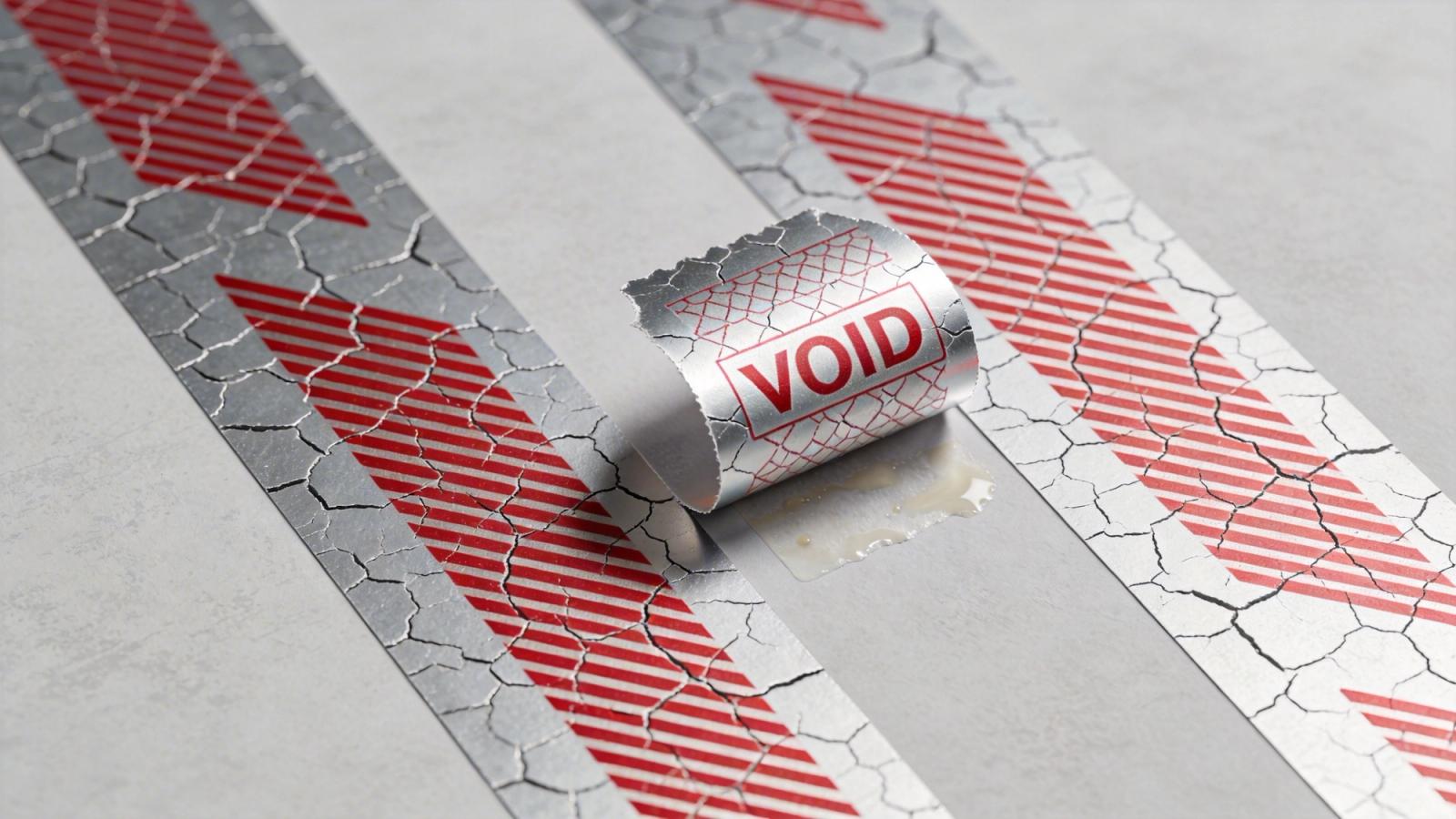
Reuse prevention is the core function of destructible vinyl and ultra-destructible films. Unlike void labels or void patterns that leave a "VOID" message but might allow the top layer to be reconditioned, destructible labels eliminate the label entirely. The residue left behind is jagged, discontinuous, and impossible to realign into a coherent image, offering a clear indication when tampering is attempted.
Recreation of a shattered label is functionally impossible for a bad actor. The fragments differ in size and shape based on the speed and angle of removal. This chaotic failure mode acts as a unique fingerprint of the tampering event. No two removal attempts or attempted removal yield the same fracture pattern, which builds consumer trust in the brand.
This mechanic defeats heat-gun attacks often used on standard vinyl. While heat softens the acrylic adhesive, it also softens the thin facestock of a destructible label. The material becomes even more prone to tearing when heated, rather than pliable. This counteracts common retrieval techniques used by electronics fraudsters to bypass security features.
Solvent attacks also trigger visible signs of damage. Because the topcoat and the vinyl face are porous or sensitive to chemicals, attempting to dissolve the adhesive often destroys the printed data. The ink dissolves or the face swells, rendering the barcode, RFID tag, or serialization unreadable. This chemical resistance ensures the tamper-resistant nature of the asset tag.
Selecting the Correct Label Materials: Security Labels and Destructible Substrate Composition
Choosing a substrate requires balancing printability with brittleness. If a material is too fragile, it becomes a nightmare for the converter to die-cut and impossible for the end-user to apply. If it is too thick or elastic, it peels upon removal without breaking, failing to provide the evidence of tampering required by safety standards.
Manufacturers measure this fragility in terms of tensile modulus and elongation at break. A lower elongation percentage indicates a more brittle film. The "caliper" or thickness also plays a significant role. Thinner films generally fracture more easily but handle poorly in automated localized dispensing systems used for high-value items.
Environmental stability is another variable in tamper-evident solutions. Some frangible papers degrade in high humidity or under UV exposure, making them unsuitable for outdoor assets. Synthetic destructible films offer resistance to moisture and UV light while maintaining their brittle characteristics and dimensional stability. This makes them the standard for industrial application security labels.
Ultra-Destructible Vinyl vs. Fragile Destructible Films: Choosing the Best Tamper-Evident Labels
Ultra-destructible vinyl (UDV) is the industry standard for asset protection and tamper-evident labels. It consists of a PVC formulation loaded with fillers to reduce elasticity. It offers good print receptivity for thermal transfer and flexographic inks. The vinyl allows for high-resolution serialization and barcode printing required in inventory tracking and chain-of-custody integrity.
Acetate destructible films offer a different performance profile. They are often more rigid than vinyl. This rigidity and dimensional stability can be beneficial on perfectly flat surfaces but problematic on curved radii. Acetate tends to snap rather than tear, creating very sharp, distinct fracture lines desirable in sealing high-value electronics.
Polystyrene films are used when dimensional stability is paramount. They do not shrink as much as vinyl over time. This prevents the "adhesive halo" effect where glue oozes from the edges. However, polystyrene requires specific ribbon and ink combinations to ensure the printed data is as durable as the label itself against removal attempts.
Frangible paper serves as a cost-effective alternative for indoor use. It lacks the chemical resistance of vinyl but functions well for box sealing and retail packaging. The fibers of the paper tear easily, but it does not shatter like a synthetic film. It is a cost-effective tamper proof labels option for many consumer goods.
Choosing between these label materials depends on the dispensing method. UDV works well with manual application. Extremely fragile acetate films may snap on the liner during the sharp turn of a peel plate in automated labeling machines. Converter consultation for these specialized labels is vital here to ensure they provide a clear indication of attempted removal.
High Liability Applications: Using Destructible Security Labels to Prevent Tamper Issues
High-risk environments generate the primary demand for destructible tamper evident labels. These are sectors where the cost of a breached container or swapped component is astronomical compared to the cost-effective price of the label. The label acts as the final guardian of chain-of-custody integrity and helps prevent tampering.
In these sectors, the security labels serve a legal function. It proves that a device was not modified between the factory and the end-user. This proof is essential for liability protection and meeting safety standards. If a seal is broken, the manufacturer can disclaim responsibility for malfunctions or safety hazards, preventing warranty fraud.
Counterfeit prevention also drives adoption here. High-value goods are often targeted for component harvesting. Thieves steal genuine parts and replace them with sub-standard knockoffs. A destructible label or seal over the chassis screws ensures that if someone tries to remove the label or open the device, it leaves permanent visible signs.
Pharmaceutical and Electronic Security with Destructible Tamper Proof Labels
Pharmaceutical packaging relies on tamper-evident labels to meet FMD (Falsified Medicines Directive) and FDA mandated safety standards. A destructible seal on a secondary carton ensures the patient receives the exact dosage form sealed at the manufacturing plant. Any visible signs of a breach signal potential contamination or unauthorized access.
In this context, the labels provide critical serialization data. If the destructible label is destroyed upon removal, that unique identifier is also removed from the loop. This prevents grey market diverters from reusing valid packaging to sell counterfeit drugs. The destruction of data and the substrate is a feature that helps to serialize and safeguard medicine.
Consumer electronics utilize these specialized labels for warranty fraud reduction. "Board swapping" involves buying a new device and returning it with a broken internal circuit board from an old unit. Placing a destructible label over a screw hole or seam prevents this undetectable entry and provides protection against tampering.
Service centers look for these security features immediately. An intact seal validates the warranty claim. A fragmented or missing seal moves the repair to a billable service. This simple adhesive component saves electronics leaders millions annually in fraudulent return authorizations. It is a high-performance safeguard for product safety.
Automotive components require similar security labels. Electronic Control Units (ECUs) are often tuned or chipped / flashed for performance. Manufacturers use destructible labels to seal distinct ports. Breaking the seal to flash the firmware voids the powertrain warranty instantly, as the fragments provide evidence of tampering.
Strategic Design for Destructible Labels: Placement of Tamper Evident Labels
Design dictates the failure mode when tampering is attempted. A large rectangular label is easier to peel than a small circular one. The physics of peel force concentrate at corners. Sharp 90-degree corners offer a "dog ear" that a fingernail can catch to remove the label.
To maximize security, designers should radius the corners of the destructible label. A rounded corner disperses the picking force. It makes it difficult to get a solid grip on the facestock. This forces the attacker to pick at the edge, causing immediate localized chipping rather than a clean lift, which is a clear indication of a removal attempt.
Die-cutting creates microscopic stress fractures in the liner and face. If the die strikes too deep, the liner may tear during dispensing. If it cuts too shallow, the waste matrix will not strip away during converting. This balance is harder to achieve with brittle label materials like acetate or UDV.
Minimize the unadhered surface area. Information density and serialization are key. The label should be only as large as necessary to carry the barcode and text. Excess material provides more surface area for a blade or tool to slide under. Smaller tamper evident labels generally offer higher security.
Controlling Edge Access to Prevent Tamper Removal of Security Labels
Edge access is the vulnerability point of any adhesive product. To mitigate this, security labels are often placed in recessed areas of a product housing. A recess acts as a physical guard, preventing tools from sliding parallel to the surface to slice the acrylic adhesive.
Another strategy involves "security cuts" or "tamper slits." These are die-cuts within the label perimeter. They act as pre-defined failure points. If someone tries to remove the label or lifts the edge, the stress travels to the slit and the label tears internally immediately, providing a clear indication of tampering.
Designers must ensure these slits do not compromise the dispensing process. If the slits are too aggressive, the label will fall apart before it even leaves the printer. The bridge material between slits must be strong enough to handle web tension but weak enough to fail upon removal, acting as effective security features.
Overlapping seams is a critical placement strategy for box sealing. The label should wrap around the edge of the carton. This forces the label to bend 90 degrees. Destructible vinyls are under tension at this bend, making them even more likely to snap if tampering is attempted or if there is an attempted removal.
Does Substrate Surface Energy Affect Destructible Label Adhesion Performance?
Adhesion is not just about the glue; it is about the substrate surface energy. Destructible labels require strong "wet-out," where the acrylic adhesive flows into the microscopic peaks and valleys of the application surface to ensure the integrity of your products.
High Surface Energy (HSE) materials include metals like steel, aluminum, and copper. They are easy to bond to. The adhesive flows readily, creating a nearly instant permanent bond strength. Destructible labels perform aggressively on these surfaces, confusing removal efforts almost immediately and providing clear visible evidence of tampering.
Low Surface Energy (LSE) materials present a challenge. Plastics like polyethylene (PE), polypropylene (PP), and powder-coated paints resist wetting. The adhesive beads up rather than flowing out. On LSE surfaces, standard destructible vinyl labels might peel off cleanly after 24 hours without breaking.
Specialized high-tack adhesives and customizable security labels are required for LSE applications. These are formulated with aggressive tackifiers to bite into the slippery plastic. Without this modification, the "destructible" feature is nullified because the bond strength never exceeds the face strength of the label materials.
Texture also impacts the performance of security labels. A highly textured surface reduces the contact area between the adhesive and the device. This effectively lowers the bond strength. Thicker layers of adhesive (higher coat weight) are needed to fill the gaps in textured powder coats to ensure the label remains tamper-resistant.
Contaminants act as bond breakers. Oil, dust, or release agents from plastic molding prevent adhesion. A destructible label applied to a greasy surface will not shatter; it will lift off with the grease. Surface preparation is not optional; it is fundamental to the security measures and the success of the seal.
Deployment Checklist for Destructible Tamper Evident Labels: A Clear Indication of Security
Successful implementation requires a rigid protocol. The best label materials fail if applied incorrectly. Facilities must standardize the application process to ensure consistent security levels and safeguard all assets.
Temperature Control: Adhesives have a minimum application temperature. Applying labels in a freezing warehouse often fails because the adhesive becomes hard and glassy. It cannot wet out. Ensure the asset and label are at room temperature (typically above 50°F/10°C) during application to maintain bond strength.
Dwell Time: Destructible tamper evident labels do not reach maximum bond strength instantly. They require a dwell time, usually 24 to 72 hours. During this window, the bond builds integrity. Do not test or ship assets immediately after labeling. Allow the chemistry and adhesion to set.
Surface Preparation: Mandate a cleaning step unless the surface is fresh from production. Isopropyl alcohol (90%+) is the standard cleaner. It removes oils and evaporates without leaving residue. Avoid citrus cleaners or window sprays that leave surfactants behind which weaken the acrylic adhesive.
Application Pressure: Pressure activates the adhesive. Simply placing the label is insufficient. Operators must apply firm thumb pressure across the entire label, especially the edges. Rubber rollers are recommended for high-volume automated lines to ensure uniform contact and visible evidence of a secure bond.
Storage Conditions: Frangible shelf life is finite. Store unused rolls in climate-controlled environments. High heat or humidity can cause the liner to swell or the adhesive to ooze, blocking the roll. One year is the standard shelf life before performance degradation of the ultra-destructible vinyl occurs.
Lot Validation: Perform random lot testing. Apply a label to a scrap surface identical to the production asset. Wait the required cure time. Attempt removal. If it peels cleanly without shattered fragments, stop the line. Investigate surface contaminants or bad adhesive batches immediately to ensure product safety.
Waste Management: Secure the waste from the printing process. The matrix often contains negative images of the serialized data. In high-security serialization (like pharma), the waste matrix itself is a liability and must be shredded to prevent data recovery and counterfeit labeling.
Staff Training: Staff must understand the fragile nature of the stock. Ripping the liner too fast can tear the labels. Handling the adhesive side deposits finger oils that weaken the bond. Proper training ensures the human element does not negate the engineering of your security solutions.