On this page
- Labels and Stickers for Logistics
- What is labelling in logistics
- Structural data and identification
- Compliance and legal requirements
- Why labels and stickers for logistics industry?
- Efficiency in inventory management
- Enhancing brand identity and trust
- Is a shipping label a sticker
- Materials and adhesive types
- Thermal printing capabilities
- Core types of product labels
- Specialized security labels
- Functional and instructional markers
- Best labels for shipping in the UAE
- Direct thermal vs Thermal transfer
- Custom label solutions for diverse industries
- Role of barcode technology in logistics
- Scanning and data accuracy
- RFID and the future of tracking
- Importance of labels in the supply chain
- Durability and environmental resistance
- Minimizing counterfeit and theft
- Choosing a label printing company in the UAE
- Technical expertise and support
- Innovation in printing technology
- Logistics labels for specific sectors
- Healthcare and pharmaceuticals
- Food and beverage logistics
- Industrial and chemical products
- Advancing logistics with smart labeling
- Integrating with warehouse management systems
- Sustainable labeling practices
Labels and Stickers for Logistics
Modern supply chains rely on precision. A single label serves as the digital heartbeat of a package, carrying vital data from the point of origin to the final destination. In the UAE, high-performance logistics stickers ensure that goods move seamlessly through ports and distribution centers.
Efficient tracking requires specialized materials that withstand friction, heat, and humidity. Using the right shipping label reduces errors in sorting and ensures that every product remains visible within the inventory management system. Businesses across the emirate prioritize these solutions to maintain high quality standards.
What is labelling in logistics
Logistics labeling involves the application of informative markers to transport units like a pallet, carton, or baggage. These markers provide essential data, including the product name, origin, destination, and handling instructions. This process is a pivotal role in global trade and local delivery networks.
In today’s world, a label is more than just paper. It is a sophisticated tool for data capture. Each sticker must remain legible throughout its journey. Whether you need labeling solutions for air freight or sea cargo, durability remains the primary requirement for successful transit.
Structural data and identification
A standard shipping label contains machine-readable codes and human-readable text. This dual-layer information ensures that both automated sorters and human handlers can process the shipment correctly. Accurate data prevents costly delays and misrouting in complex distribution networks.
Logistics professionals in Dubai use these labels to manage high volumes of cargo. By using clear barcode labels, companies can automate their receiving and dispatching workflows. This automation is essential for meeting the demands of modern online shopping and fast delivery expectations.
Compliance and legal requirements
Many jurisdictions require specific information on every product. Labeling in the GCC must often meet industry regulations regarding language and safety warnings. For example, prescription rx bottle labels require strict adherence to medical standards during transport and storage.
Legally required information often includes weight, dimensions, and hazardous material classifications. Failing to provide accurate product information can result in fines or shipment rejection. Working with leading label printing experts helps businesses navigate these regulatory landscapes effectively.
Why labels and stickers for logistics industry?
The logistics industry operates on speed and accuracy. Labels and stickers provide the interface between physical goods and digital tracking software. Without these tools, inventory management would become manual and prone to significant error rates.
Labels provide a cost-effective way to brand and track shipments simultaneously. A custom label can elevate a brand identity while serving a functional purpose. This dual utility makes stickers indispensable for businesses looking to differentiate their services in a competitive market.
Efficiency in inventory management
Automated warehouses use rfid and qr codes to locate items instantly. These technologies are often embedded in or printed on self-adhesive labels. Instant scanning allows for real-time updates to stock levels, reducing the need for manual counts.
When items are labeled at the source, the entire third-party logistics chain benefits. A trusted partner in the UAE will provide premium quality stickers that do not peel or fade. This reliability ensures that the digital twin of the shipment always matches the physical reality.
Enhancing brand identity and trust
A high-quality sticker printing job reflects the brand’s commitment to excellence. When a customer receives a package with a clean, well-applied label, it builds confidence in the logistics provider. Product branding starts the moment the box is seen.
Using state-of-the-art printing solutions allows for crisp logos and clear text. Even a simple fragile label contributes to the professional appearance of the shipment. Professional labeling helps businesses across different industries maintain a premium image during the unboxing experience.
Is a shipping label a sticker
Technically, a shipping label is a specialized form of a sticker. It utilizes a self-adhesive backing to bond with various surfaces like cardboard, plastic, or metal. The primary difference lies in the functional requirements and the type of adhesive used.
While a standard sticker might be decorative, a shipping label is a functional component of the packaging and labeling process. It must survive extreme temperatures and mechanical stress. The adhesive must be strong enough to prevent the label from falling off during transit.
Materials and adhesive types
Logistics stickers often use polyethylene or high-grade paper. The choice depends on the environment. For example, items stored in industrial settings might require a label that resists chemicals, similar to an industrial degreaser label or a stainless steel cleaner label.
High-quality adhesives ensure the label stays attached to textured surfaces. Premium quality materials prevent "winging," where the edges of the sticker lift. For heavy-duty applications, logistics companies often choose synthetic materials that offer superior tear resistance and environmental durability.
Thermal printing capabilities
Most shipping labels are printed using direct thermal shipping technology. This method does not require ink or toner, making it highly efficient for high-volume environments. The label itself contains a heat-sensitive layer that changes color when passed under a thermal printer head.
Thermal transfer printing is another option for labels requiring longer life cycles. This process uses a ribbon to transfer pigment onto the label surface. It is ideal for labels that will be exposed to sunlight or chemicals for extended periods, ensuring the barcode remains scannable.
Core types of product labels
Understanding the different types of labels helps in choosing the right solution for specific cargo. While there are many variations, the logistics industry generally categorizes them based on their function and the information they carry.
Effective labeling solutions often combine multiple types of labels on a single pallet or carton. This ensures that all stakeholders, from the manufacturer to the end consumer, have the information they need. Here are the primary categories:
- Identification Labels: Contain basic product information and brand details.
- Grade Labels: Indicate the quality or classification of the product.
- Descriptive Labels: Provide usage instructions, safety warnings, and ingredients.
- Informational Labels: Focus on logistics data like barcodes and tracking numbers.
Specialized security labels
In the logistics sector, protecting goods from theft or tampering is vital. Tamper-evident security seals provide a visible indication if a package has been opened. These security labels are essential for high-value shipments and pharmaceutical products.
Counterfeit prevention is another critical use for specialized labels. By using unique serial numbers or holographic elements, a company in dubai can verify the authenticity of its goods. This protection is especially important for over-the-counter otc medication labels.
Functional and instructional markers
Some stickers are designed to guide the handler. A fragile label or "this side up" sticker provides immediate visual cues. These instructions are vital for reducing damage rates and ensuring the safety of the logistics personnel.
Instructional labels also include multi-layer booklet labels for products that require extensive documentation. These are often used for chemical or industrial products where safety data sheets must accompany the item. They provide a compact way to include legally required information.
Best labels for shipping in the UAE
Choosing the best labels involves evaluating the specific climate and infrastructure of the region. The UAE experiences high ambient temperatures, which can affect the stability of some adhesives. Selecting a trusted label printing company ensures that the materials are suited for the local environment.
Top label printing companies in the emirate use the latest printing technology to produce durable results. Whether you are shipping locally in Abu Dhabi or across the GCC, the quality of your label printer and media will dictate the success of your logistics operations.
Direct thermal vs Thermal transfer
Direct thermal shipping labels are the standard for short-term shipping. They are cost-effective and easy to produce using a mobile label printer. However, they can darken if exposed to extreme heat for long periods, which is a consideration in the UAE summer.
Thermal transfer labels are more robust. They offer higher durability and are resistant to smudging. For long-term storage or international shipping, thermal transfer is often the preferred choice. It ensures that the product labels remain scannable throughout the entire supply chain.
Custom label solutions for diverse industries
Different sectors have unique labeling requirements. Supermarkets require high-speed barcode labels for inventory and checkout. The aviation industry requires specialized stickers that can withstand altitude and pressure changes during baggage handling.
Food and beverage logistics also have specific needs. For example, ice cream tub labels must remain adhesive in sub-zero temperatures. Similarly, hot sauce labels or olive oil bottle labels must resist oil and moisture to maintain their professional appearance.
Role of barcode technology in logistics
Barcodes are the foundation of modern logistics. A serialized barcode allows for the individual tracking of every item in a shipment. This level of detail is necessary for managing complex returns and cash on delivery services common in the UAE.
A barcode is more than just a series of lines; it is a gateway to a database. When a label printer generates a code, it assigns a unique identifier to that package. This allows for real-time visibility, which is a cornerstone of modern supply chain management.
Scanning and data accuracy
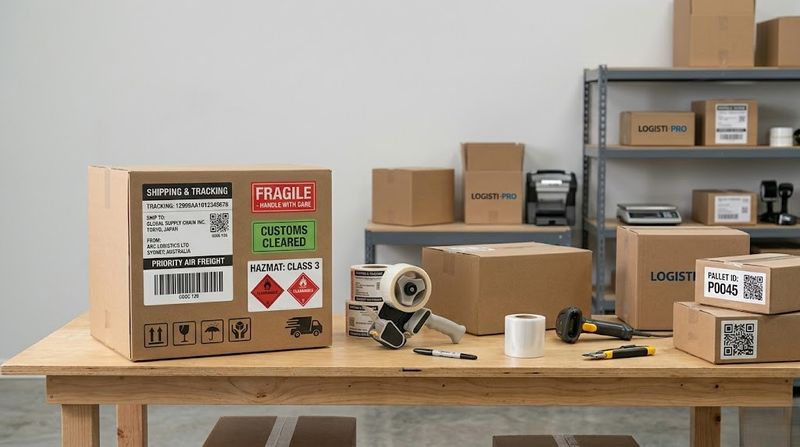
High-quality printing solutions ensure that barcodes have high contrast and sharp edges. This is critical for 100% scan rates. A poorly printed sticker can lead to manual data entry, which introduces errors and slows down the entire facility.
Using serialized barcode data matrix labels allows for more data in a smaller space. These are ideal for small components or luxury items like clear perfume bottle labels. Precision in printing ensures that even the smallest codes are functional.
RFID and the future of tracking
Radio Frequency Identification (RFID) is increasingly used alongside traditional stickers. RFID tags can be read without a direct line of sight, allowing for the scanning of entire pallets at once. This technology is often integrated into the label and packaging design.
While rfid offers significant advantages, traditional labels remain necessary for human backup. Most companies use a hybrid approach, combining digital printing for visual information with embedded chips for automated tracking. This ensures the system is resilient and meet industry standards.
Importance of labels in the supply chain
The importance of labels cannot be overstated. They are the primary source of truth for a shipment. From the moment a label is applied at the factory, it dictates the movement, storage, and delivery of the product.
Labels help in reducing losses by providing clear identification. In large-scale logistics operations, items can easily be misplaced without proper tagging. A one-stop labeling solution simplifies the procurement process for businesses, ensuring consistency across all packaging.
Durability and environmental resistance
Logistics labels are exposed to harsh conditions. They may be stored outdoors, subjected to rain, or handled roughly by machinery. High-quality self-adhesive labels are designed to resist these factors, maintaining their integrity throughout the journey.
For products that contain liquids, such as laundry detergent labels or floor cleaner labels, the label must be waterproof and chemical-resistant. Using materials like polyethylene ensures that the brand identity and safety information remain visible even if the product leaks.
Minimizing counterfeit and theft
Security is a major concern in global trade. Specialized security labels provide a layer of protection against unauthorized access. For example, tamper-evident security seals are used to secure high-value electronics and luxury goods.
By incorporating unique identifiers, companies can track the chain of custody for every product. This makes it much harder for counterfeit goods to enter the legitimate supply chain. Trusted label printing partners provide these advanced features to help businesses protect their assets.
Choosing a label printing company in the UAE
Selecting the right partner for your labeling needs is a strategic decision. A leading label printing company will offer a range of materials and technologies to suit various logistics applications. Look for a provider that understands the local market and GCC regulations.
A reliable llc in the UAE will offer digital printing for short runs and flexographic printing for high-volume orders. This flexibility allows businesses to scale their operations without compromising on quality or cost. Fast delivery of label stock is also a key factor in maintaining an uninterrupted supply chain.
Technical expertise and support
The best providers offer more than just stickers; they provide expertise. They can recommend the best adhesive for a specific carton or the right thermal printer for your warehouse environment. This consultative approach helps in optimizing the entire packaging and labeling process.
Working with a trusted partner ensures that your labels meet all quality standards. Whether you need hand sanitizer labels or sunscreen labels, the right provider will ensure compliance with health and safety regulations.
Innovation in printing technology
The latest printing technology allows for more sustainable and efficient production. Digital printing reduces waste by allowing for precise order quantities. Flexographic printing remains the gold standard for high-speed, cost-effective production of standard shipping labels.
Innovation also extends to the materials used. Eco-friendly adhesives and recyclable liners are becoming more common. Businesses that prioritize sustainability can now find labeling solutions that align with their environmental goals while maintaining high durability.
Logistics labels for specific sectors
Different industries have vastly different logistics needs. A pharmaceutical company requires a different approach than a supermarket chain. Specialized labels ensure that each sector can operate safely and efficiently.
Tailored solutions address the specific challenges of each industry. For example, vial and ampoule wrap around labels must be small yet carry critical medical data. Understanding these nuances is what defines top label printing companies.
Healthcare and pharmaceuticals
In the medical sector, accuracy is a matter of life and death. Labels must be legible and durable under various storage conditions, including refrigeration. Syringe and injectable labels require high-precision printing to ensure dosages and patient information are clear.
Logistics in healthcare also involves strict tracking of temperature-sensitive goods. Labels with integrated thermal indicators can show if a product has been exposed to temperatures outside its safe range. This is vital for maintaining the efficacy of vaccines and other medications.
Food and beverage logistics
The food industry relies on labels for safety and transparency. Nutritional labels and expiration dates are legally required for all products. During transport, these labels must resist moisture and temperature fluctuations.
Specialized food labels, such as those for hummus tubs or mayonnaise squeeze bottles, must remain attractive on the shelf while performing in the supply chain. High-quality adhesive prevents the label from peeling off in a refrigerated display.
Industrial and chemical products
Industrial logistics involves the transport of heavy-duty equipment and chemicals. Labels in this sector must be extremely durable. For instance, wood polish labels or mold and mildew remover labels must withstand contact with the chemicals they contain.
High-quality industrial labels use strong adhesives that bond to metal drums and plastic containers. They provide essential safety information and handling instructions for workers. Using premium quality materials ensures that these warnings remain legible for the life of the product.
Advancing logistics with smart labeling
The future of logistics is increasingly digital. Smart labels, which combine physical markers with digital connectivity, are at the forefront of this change. These tools allow for unprecedented levels of visibility and automation in the supply chain.
As businesses across the UAE continue to grow, the demand for sophisticated labeling solutions will only increase. By investing in high-quality labels and stickers, logistics companies can ensure they stay competitive in a global market.
Integrating with warehouse management systems
Modern labels are designed to interface seamlessly with Warehouse Management Systems (WMS). When a barcode is scanned, the system automatically updates the location and status of the item. This reduces the need for manual data entry and improves accuracy.
For companies using Armor Lubricants as an example of high-performance industrial standards, their logistics labeling must match the quality of the product inside. Reliable labeling ensures that premium goods are handled with the care they deserve throughout the distribution process.
Sustainable labeling practices
Sustainability is becoming a key focus in the logistics industry. Companies are looking for ways to reduce the environmental impact of their packaging and labeling. This includes using thinner liners, recyclable materials, and eco-friendly adhesives.
Digital printing plays a role here by allowing for "on-demand" printing, which minimizes obsolescence and waste. By choosing a forward-thinking label printing company, businesses can improve their environmental footprint while maintaining the high performance required for logistics operations.
Effective logistics labeling is a combination of material science, printing technology, and data management. By selecting the right labels and stickers, businesses can optimize their supply chain, protect their products, and build a stronger brand identity in the UAE and beyond.